
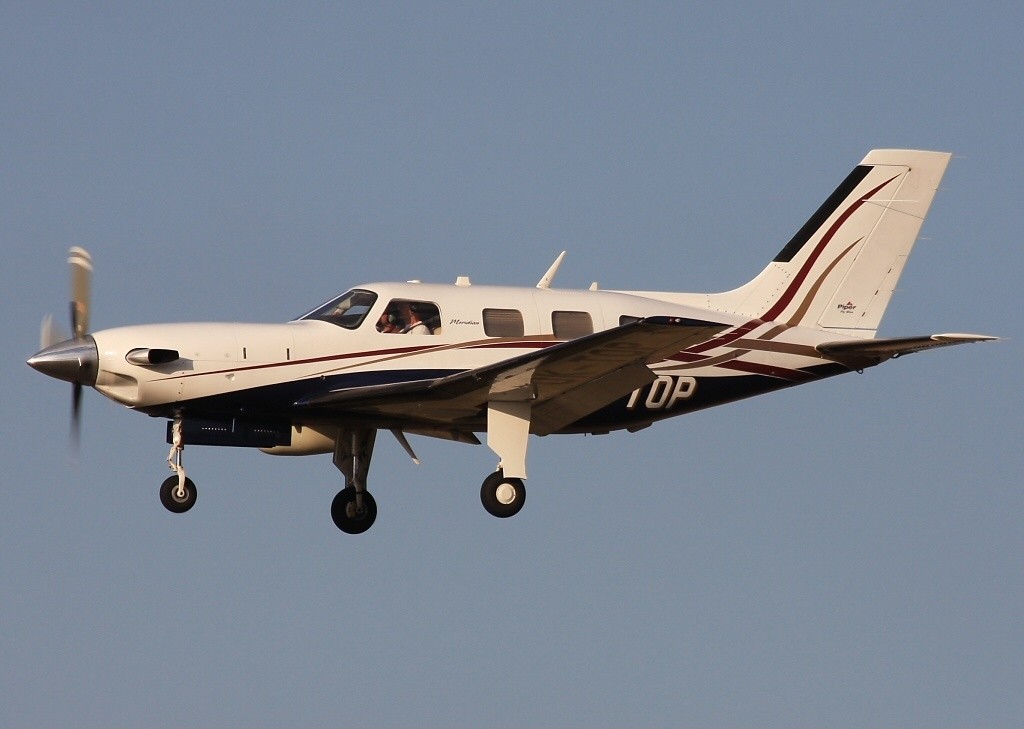
Breaking the Pressurization Barrier
The PA-46-310P Malibu emerged from Piper Aircraft's ambitious late-1970s project to capture the high-altitude single-engine market dominated by Cessna's P210 Centurion. Development began with the prototype PA-46-300T taking flight on November 30, 1979, followed by the production PA-46-310P's maiden flight in August 1982. FAA certification came in September 1983, with initial deliveries commencing in November 1983.
Piper's engineering team designed the Malibu to fill a critical gap in general aviation: an affordable pressurized single-engine aircraft capable of flying above weather and turbulence. The aircraft's 5.5 psi pressurization system maintained an 8,000-foot cabin altitude while cruising at 25,000 feet, delivering unprecedented comfort for owner-pilots and their passengers.
Performance Excellence
The Continental TSIO-520BE powerplant proved ideally suited for high-altitude operations, delivering 310 horsepower through turbocharging to maintain power at altitude. This engine configuration enabled the Malibu to achieve a maximum cruise speed of 234 knots while reaching a service ceiling of 30,000 feet. The aircraft's impressive range of 1,055 to 1,550 nautical miles made it competitive with light twins while offering single-engine simplicity.
Takeoff performance required 2,438 feet, while landing distance measured 2,110 feet, making the Malibu suitable for most general aviation airports. The aircraft's rate of climb reached 1,556 feet per minute, allowing rapid ascent to cruise altitudes where jet streams could be utilized for enhanced ground speeds.
Record-Setting Achievement
The Malibu's capabilities were dramatically demonstrated through a series of world speed records set by pilot Steve Stout in aircraft N9114B. On November 23, 1987, Stout achieved 259.27 mph on the Seattle-to-New York route. He followed this with a Detroit-to-Washington DC record of 395.96 mph on January 4, 1989, and a Chicago-to-Toronto mark of 439.13 mph on January 8, 1989, showcasing the aircraft's ability to exploit high-altitude winds.
The Piper Legacy
Piper Aircraft, founded in 1927 by William T. Piper as Taylor Brothers Aircraft Manufacturing Company, brought decades of general aviation expertise to the PA-46 program. The company had earned its reputation through the legendary J-3 Cub, with over 19,000 examples built from 1938, and continued this tradition of accessible aviation with the Malibu.
Manufacturing took place at Piper's Vero Beach, Florida facility, where the company had operated since 1961 after relocating from Lock Haven, Pennsylvania. Despite surviving bankruptcy in 1991 and subsequent ownership changes including Brunei government investment in 2009 and American Capital in 2011, Piper continued developing the PA-46 line.
Civil Aviation Impact
The Malibu found its primary market among affluent owner-pilots seeking airline-like capability without the complexity and operating costs of twin-engine aircraft. The six-seat cabin provided generous space for one pilot and up to five passengers, making it ideal for business travel and family transportation.
Unlike its pressurized predecessors—the short-lived Mooney M22 (1965-1970) and Cessna P210N/R (1978-1986)—the PA-46 achieved sustained commercial success. Where other manufacturers abandoned the pressurized single-engine market due to complexity and costs, Piper's design proved robust enough for continuous production.
Production Evolution
Exactly 404 PA-46-310P Malibus rolled off Piper's production line before the model evolved into the PA-46-350P Malibu Mirage in late 1988. This transition marked the beginning of a product line that would span decades, eventually encompassing turboprop variants and establishing Piper as the dominant force in pressurized single-engine aviation.
Enduring Legacy
The PA-46-310P's significance extends far beyond its five-year production run. It established the foundation for Piper's most successful high-performance line, with the PA-46 family remaining in continuous production through 2024. Modern derivatives include the M350, M500, M600, and the M700 Fury turboprop, with the M700 representing the 1,000th PA-46 family aircraft when certified on February 29, 2024.
The original Malibu proved that pressurized single-engine flight could be both practical and profitable, opening high-altitude airways to general aviation pilots worldwide and establishing a template that continues to define modern high-performance singles.