
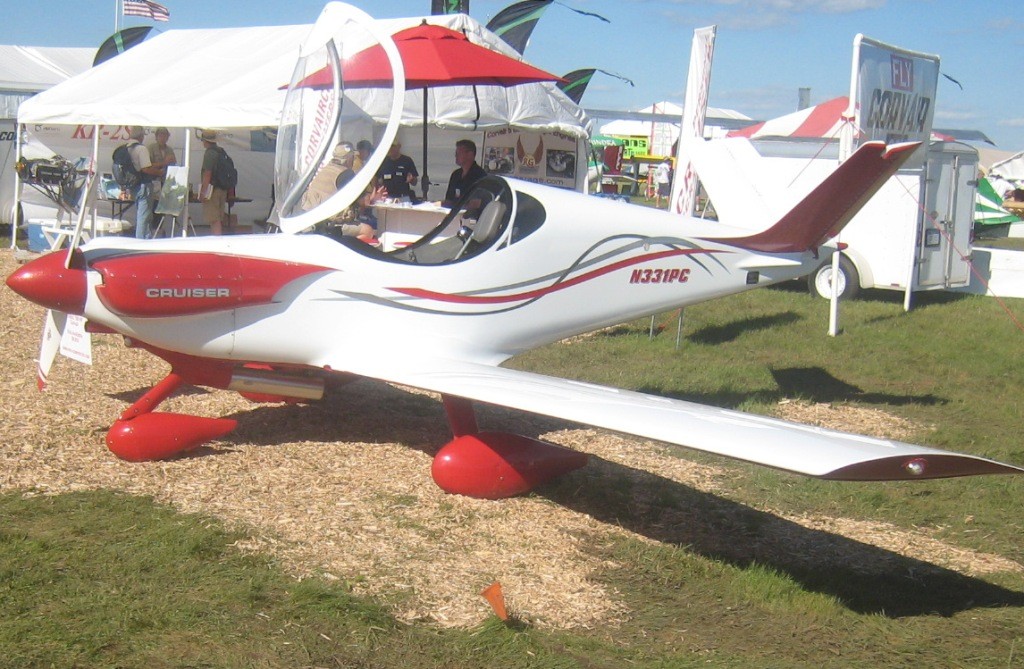
Development and Design Philosophy
Steve Rahm conceived the Personal Cruiser several years before 2009 with ambitious goals for personal aviation. He envisioned a high aspect ratio, economical single-seat aircraft that could deliver 120-160 mph cruise speeds, achieve over 50 miles per gallon fuel efficiency, and provide armchair comfort in a 29.5-inch-wide cockpit. The design emphasized low build times through Rahm's innovative FOLDaPLANE construction method, targeting 800-hour builds compared to traditional homebuilt aircraft requiring thousands of hours.
Revolutionary Construction Method
The Personal Cruiser's most significant innovation was the FOLDaPLANE technique, which used flexible flat composite panels that could be bent into fuselage sections using a building jig. This breakthrough enabled Pro-Composites to ship complete kits via UPS while providing builders with molded-finish exteriors that required minimal finishing work. The method incorporated carbon fiber and honeycomb core options, dramatically reducing the labor typically associated with composite aircraft construction.
The Manufacturer
Pro-Composites, Inc. was formed around 2008 under the ownership of Scott VanderVeen, who provided financial backing for the Personal Cruiser's development alongside builders Morgan and designer Steve Rahm. The company initially operated from Daytona Beach, Florida, where early flight testing occurred, before relocating operations to Waukegan Regional Airport near Chicago by 2010. Business operations were conducted from Buffalo Grove, Illinois, as the company specialized in composite aircraft plans, parts, and complete kits.
Engine and Performance
The prototype Personal Cruiser utilized a 100-horsepower Chevrolet Turbo-Air 6 engine, commonly known as the Corvair conversion. This air-cooled, opposed-six cylinder automotive conversion had been successfully adapted for aircraft use by specialists like CorvairCraft and powered hundreds of homebuilt aircraft. The Corvair engine, originally manufactured by Chevrolet until the 1970s, became popular in experimental aviation for its reliability, low cost, and impressive efficiency—the Personal Cruiser achieved 116 mph while consuming just 2.5 gallons per hour.
The aircraft's design accommodated engines ranging from 65 to 115 horsepower and up to 250 pounds in weight, making it compatible with powerplants from manufacturers including Jabiru and Continental. This flexibility allowed builders to select engines based on their performance requirements and budget constraints.
Technical Specifications and Performance
The Personal Cruiser measured 17 feet 4 inches in length with a 25.5-foot wingspan and 76.5 square feet of wing area. The aircraft featured an Eppler airfoil design and incorporated a two-bladed ground-adjustable propeller. With an empty weight of 750-775 pounds and a gross weight of 1,250 pounds, the aircraft provided a useful load of 475 pounds, including 15-18 gallons of fuel capacity.
Performance figures were impressive for the aircraft's category, with maximum speeds reaching 120-168 mph and cruise speeds of 128-160 mph. The aircraft stalled at 46 knots (53 mph) and had a never-exceed speed of 184 knots (212 mph). Rate of climb reached 1,800 feet per minute, while takeoff and landing distances were approximately 400 and 350 feet respectively.
Production History and Market Position
Pro-Composites began offering Personal Cruiser kits around 2009-2010, with the prototype completing construction in 2011. The company remained active in production as of 2015, though only one prototype had been documented as built by 2011. The complete kit was offered at prices ranging from $17,760 to $28,160, excluding optional equipment, representing a significant value proposition in the experimental aircraft market.
The Personal Cruiser was positioned to compete in the growing light sport and experimental aircraft markets, offering builders an efficient alternative to traditional designs. Its emphasis on fuel economy and ease of construction appealed to aviation enthusiasts seeking cost-effective personal transportation.
Legacy and Influence
The Personal Cruiser's primary contribution to aviation lies in advancing affordable composite kit construction through the FOLDaPLANE method. This innovation influenced subsequent Pro-Composites designs, including the two-seat Vision and four-seat Freedom aircraft. The technique demonstrated that composite construction could be made accessible to amateur builders without sacrificing quality or requiring extensive finishing work.
The aircraft represented an important step toward democratizing efficient personal aviation, proving that modern composite designs could achieve airline-like fuel efficiency in the experimental amateur-built category. At least one example remained flying as of 2011, though updated airworthiness statistics beyond 2015 are not available.