
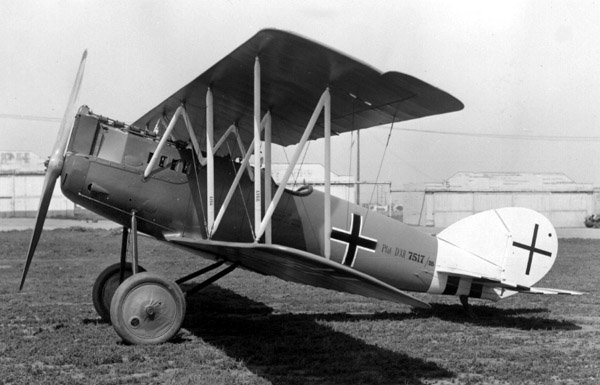
The Pfalz D.XII was a single-seat biplane fighter developed by Rudolph Gehringer as a successor to the Pfalz D.III. The prototype first flew in March 1918 at the Johannisthal Air Field in Adlershof, Germany. However, the aircraft faced early development hurdles, specifically regarding a vertical-tube radiator design that caused overheating. These issues delayed its official Typenprüfung (type test) until 19 June 1918. Once approved, deliveries to front-line units commenced in July 1918.
Produced by Pfalz Flugzeugwerke GmbH in Speyer, the D.XII featured an all-wood construction with a semi-monocoque plywood fuselage, a hallmark of Pfalz designs that provided clean lines and structural strength. The aircraft was powered by a 160 hp Mercedes D.IIIa six-cylinder, water-cooled inline piston engine. A distinguishing visual feature was its front-mounted "car-type" radiator. In terms of performance, the D.XII reached a maximum speed of 106 mph and had a range of 265 miles. While its level-flight performance was considered comparable to the Fokker D.VII and it possessed superior diving speed, pilots found it sluggish in combat and inferior in turning ability.
During World War I, the D.XII served on the Western Front, primarily with Bavarian Jagdstaffeln. Approximately ten Jagdstaffeln operated the type, including four units of the Bavarian Jagdgeschwader IV. For air-to-air combat, it was armed with two 7.92 mm LMG 08/15 Spandau machine guns synchronized to fire through the propeller arc. Production continued until the Armistice on 11 November 1918, with total production estimates ranging between 750 and 800 aircraft. Following the war, approximately 175 units were captured or surrendered to Allied forces.
The original Pfalz Flugzeugwerke collapsed after the Armistice when French forces confiscated its equipment. However, the company was re-formed in 1997 as PFW, which currently operates as an aerospace parts manufacturer. The D.XII also left a cultural mark through Hollywood; surviving airframes used as war reparations were sold as surplus and appeared in films such as "Hell's Angels" (1930) and both the 1930 and 1938 versions of "The Dawn Patrol." Today, original examples are preserved at the National Air and Space Museum and the Museum of Flight in Seattle.