
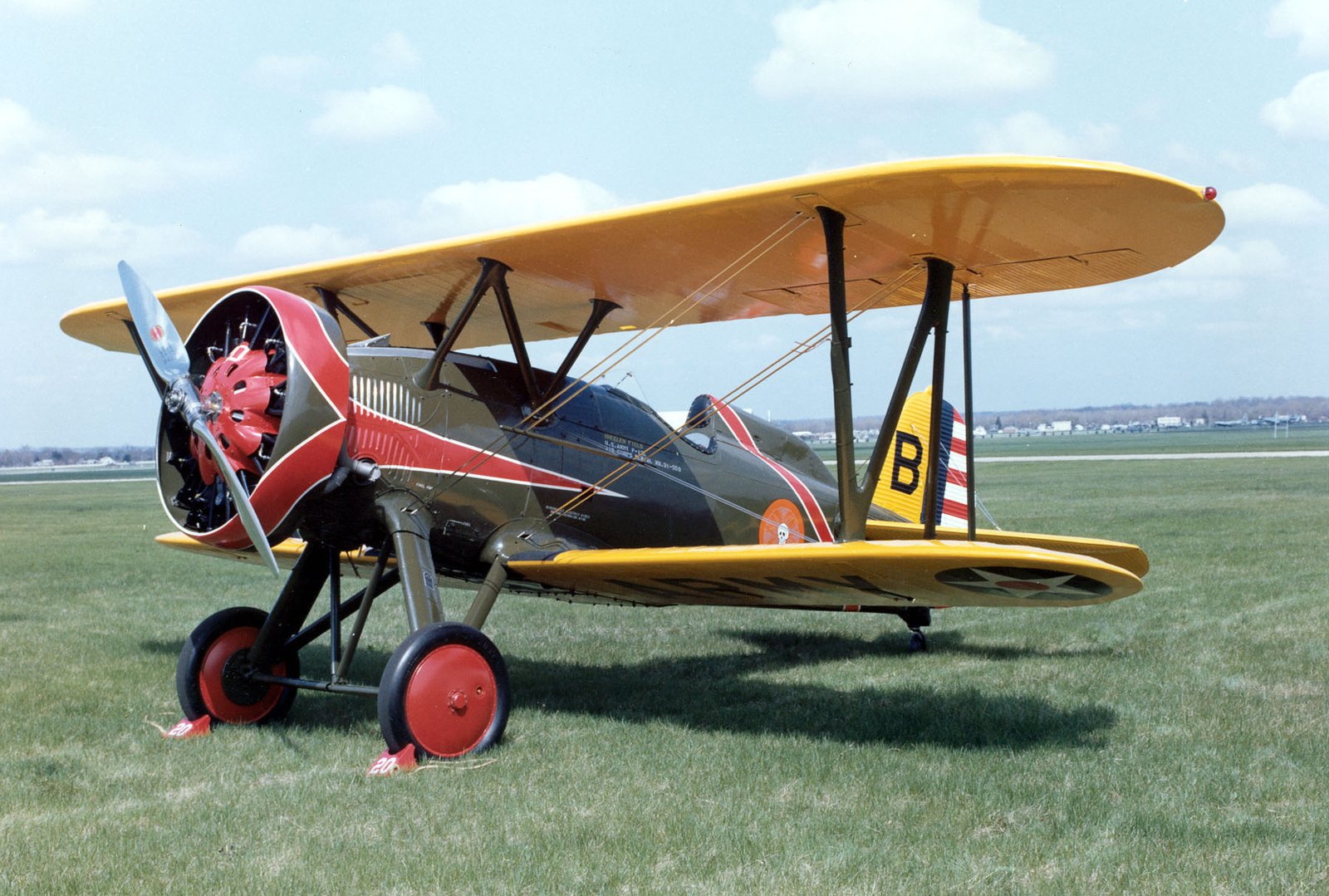
The Boeing P-12/F4B family, encompassing Boeing Models 83, 89, and 100, represented one of the most successful fighter designs of the interwar period. Produced by the Boeing Airplane Company in Seattle, Washington, a total of 586 aircraft were built between 1928 and 1933. This production run was instrumental in establishing Boeing as a major aircraft manufacturer and helped the company maintain stability during the economic challenges of the Great Depression.
The aircraft's development began with two distinct prototypes: the Model 83, designed for U.S. Navy carrier operations and featuring an arresting hook, and the Model 89, an Army version capable of carrying a 500-lb centerline bomb. The Model 83 first flew in June 1928, followed by the Model 89 in August 1928. Production versions followed shortly after, with the production P-12 fighter marking its first flight on April 11, 1929. A notable early delivery occurred on February 26, 1929, when the first P-12 series aircraft was delivered to Army Air Corps Captain Ira C. Eaker for a goodwill mission to Central America.
Technically, the series utilized the Pratt & Whitney R-1340 "Wasp" nine-cylinder air-cooled radial engine. Depending on the variant, power outputs ranged from 500 hp (R-1340-17) to 550 hp (R-1340-16). The P-12E/F4B-3 variant achieved a maximum speed of 189 mph and a service ceiling of 26,300 feet, with a rate of climb of 2,080 feet per minute. Armament typically consisted of forward-firing Browning machine guns, often a combination of one .30-cal and one .50-cal weapon, and the aircraft could carry up to 244 lb of external bombs.
In military service, the P-12 served the U.S. Army Air Corps, while the F4B was utilized by the U.S. Navy and Marine Corps. The F4B-4 served as the Navy's first-line fighter from 1932 to 1937, and some F4B aircraft remained on carriers as late as 1938. By 1941, surviving airframes were repurposed as radio-controlled drones. Beyond the United States, export variants were operated by nations including China, Spain, Thailand, Brazil, and the Philippines. While primarily military, four commercial versions were produced, including a two-seat aircraft purchased by Howard Hughes and one acquired by the U.S. Bureau of Air Commerce.
Today, the legacy of the P-12/F4B is preserved in several museums. The National Air and Space Museum displays an F4B-4 originally used by the U.S. Marine Corps' VF-10M and VF-9M squadrons. Other examples are held by the Museum of Flight in Seattle and the Planes of Fame Air Museum in California.