
Development and Engineering
The Pioneer 400 emerged from ALPI Aviation's engineering team between 2005 and 2006 as an enlarged evolution of their successful Pioneer 300 ultralight. The design team extended the fuselage by 29.5 inches and widened it by 2 inches, while stretching the wingspan from 24.8 feet to 28.9 feet with distinctive winglets. Most significantly, they strengthened the entire structure to meet FAR Part 23 certification standards—a rigorous process that included spin testing and delayed kit availability by two years but ultimately enhanced the aircraft's market appeal.
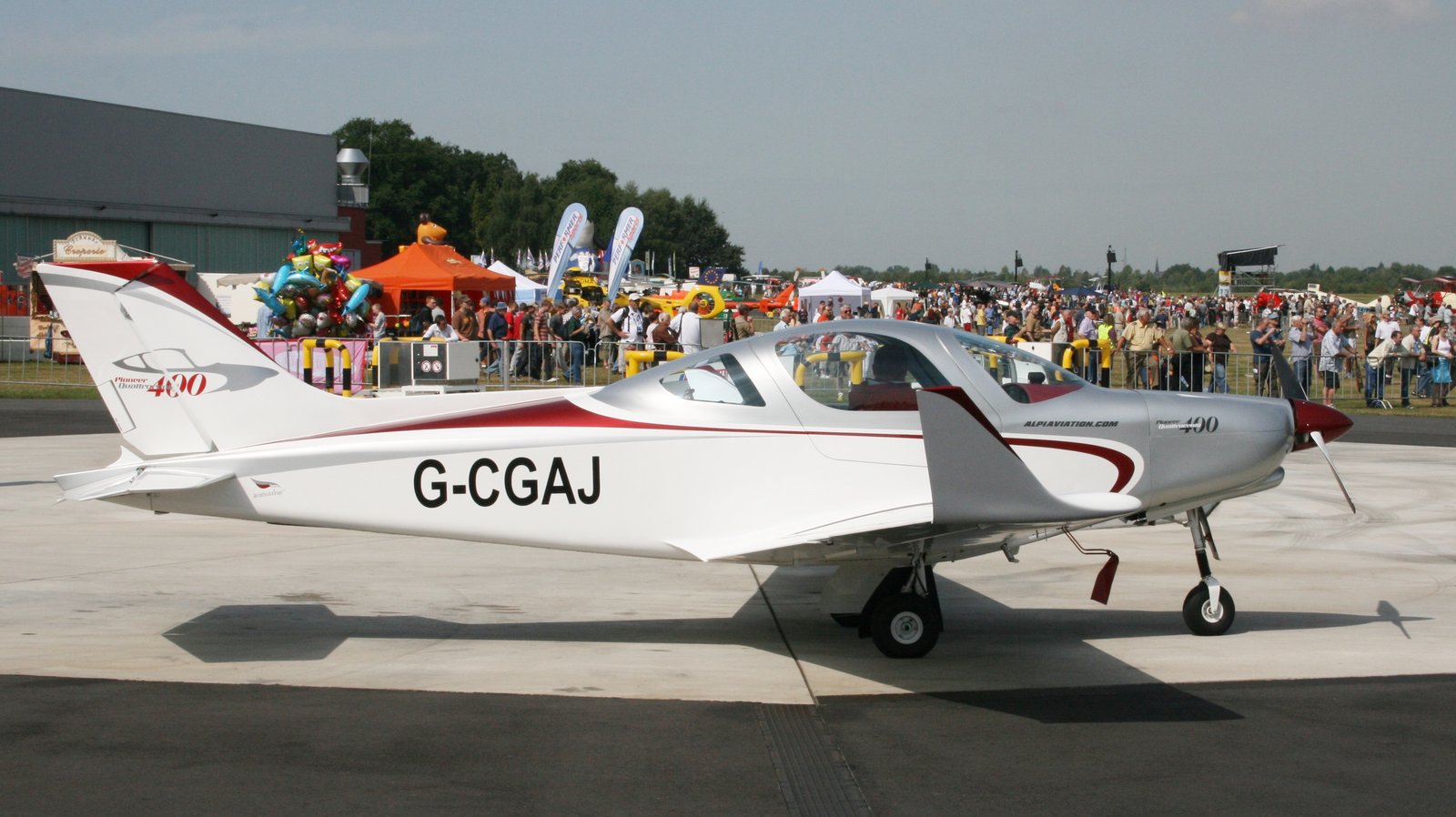
The prototype, registered G-CGAJ with construction number 01, completed its maiden flight in 2009. ALPI unveiled the aircraft publicly at AERO Friedrichshafen, Germany, in April 2010, showcasing its blend of wooden wing construction with carbon fiber fuselage technology. Kit production commenced in 2012, with the company marketing approximately 400-hour build times through pre-constructed wooden wings and carbon fiber fuselage half-shells.
Manufacturing Excellence
ALPI Aviation S.r.l., established in 1999 in Pordenone, Italy, built the Pioneer 400 as their flagship aircraft. The company's roots trace to 1998 when founder developed the original Pioneer 300 ultralight based on Stelio Frati's "ASSO V" design. Key corporate milestones included achieving ISO 9001 certification in 2005, expanding into UAV production in 2007, and opening a second manufacturing facility in Croatia in 2006.
By the time Pioneer 400 production began, ALPI had established a global presence spanning 22 countries. UK agent Frank Cavacuiti alone sold over 70 kits across all ALPI models during a decade of operations, representing approximately 10 percent of the company's total production of more than 800 aircraft. The company remains active today, continuing to manufacture the Pioneer 400 alongside variants including the turbocharged 400T Quattrocento and the Quattrocento 915 iS.
Technical Innovation
The Pioneer 400's design philosophy emphasized both performance and accessibility. The aircraft features electrically-operated retractable landing gear with a narrow 4-foot 8-inch track, retracting outward for improved ground handling. Electric systems also control elevator trim and flaps, reducing pilot workload and mechanical complexity. The winglets provide enhanced low-speed handling characteristics and cruise stability, contributing to the aircraft's forgiving flight envelope.
Construction combines traditional wooden wing structures covered in plywood and Dacron with modern carbon fiber fuselage half-shells built over wooden longerons. This hybrid approach balances weight, strength, and manufacturability while keeping costs reasonable for kit builders. Fuel capacity totals 80 liters (17.6 imperial gallons) stored in two 40-liter PVC crash-resistant tanks located at the wing roots.
Engine and Performance
Standard powerplant is the Austrian-built Rotax 912ULS, a 75-kilowatt (100-horsepower) four-cylinder horizontally-opposed engine featuring both air and liquid cooling systems. BRP-Rotax GmbH & Co KG's 912 series has powered thousands of ultralight and light sport aircraft worldwide, earning recognition for reliability and fuel efficiency. Optional powerplants include the turbocharged 115-horsepower Rotax 914, which powered the UK demonstration aircraft during certification activities.
Propeller options include the Idrovario two-blade electro-hydraulic constant-speed unit, optimizing performance across the flight envelope. With its standard engine, the Pioneer 400 achieves a maximum speed of 155 mph and cruises at 138 mph at 75 percent power. Rate of climb reaches 800 feet per minute at the optimal climb speed of 86 mph, while service ceiling extends to 16,404 feet.
Operational Characteristics
The Pioneer 400 excels in short-field operations, requiring only 280 meters for takeoff and 200 meters for landing. Stall speed of 49 mph contributes to its short-field capabilities while maintaining safety margins for recreational pilots. Never-exceed speed reaches 184 mph, providing adequate margin above cruise speeds. Range at 75 percent power extends to 559 miles, making the aircraft suitable for cross-country touring with its four-seat capacity and 66-pound baggage compartment.
Operational examples include the UK demonstrator flown by Frank Cavacuiti from Hardwick airstrip in Wales, which accumulated approximately 80 hours by 2012. Australian importer M. Prendergast operated VH-LPI (construction number 006) from Lara, Victoria, displaying the aircraft at the Avalon Air Show in March 2011. The Australasian debut occurred on February 14, 2011.
Legacy and Continuing Production
At least three Pioneer 400s remain documented in active service as of 2017, including construction numbers 001, 006, and 028, with the latter registered as LX-028 in Luxembourg. Factory-finished versions commanded approximately $192,000, positioning the aircraft competitively against certified light aircraft while offering superior performance and modern systems.
The Pioneer 400's influence extends through ALPI's continuing product line, including recent developments like the twin-engine Pioneer Twin launched in 2022. As a modern quick-build composite kit advancing affordable four-seat light sport aircraft performance, the Pioneer 400 represents the evolution from ALPI's 1998 ultralight origins to a sophisticated manufacturer serving the global experimental aircraft market.