
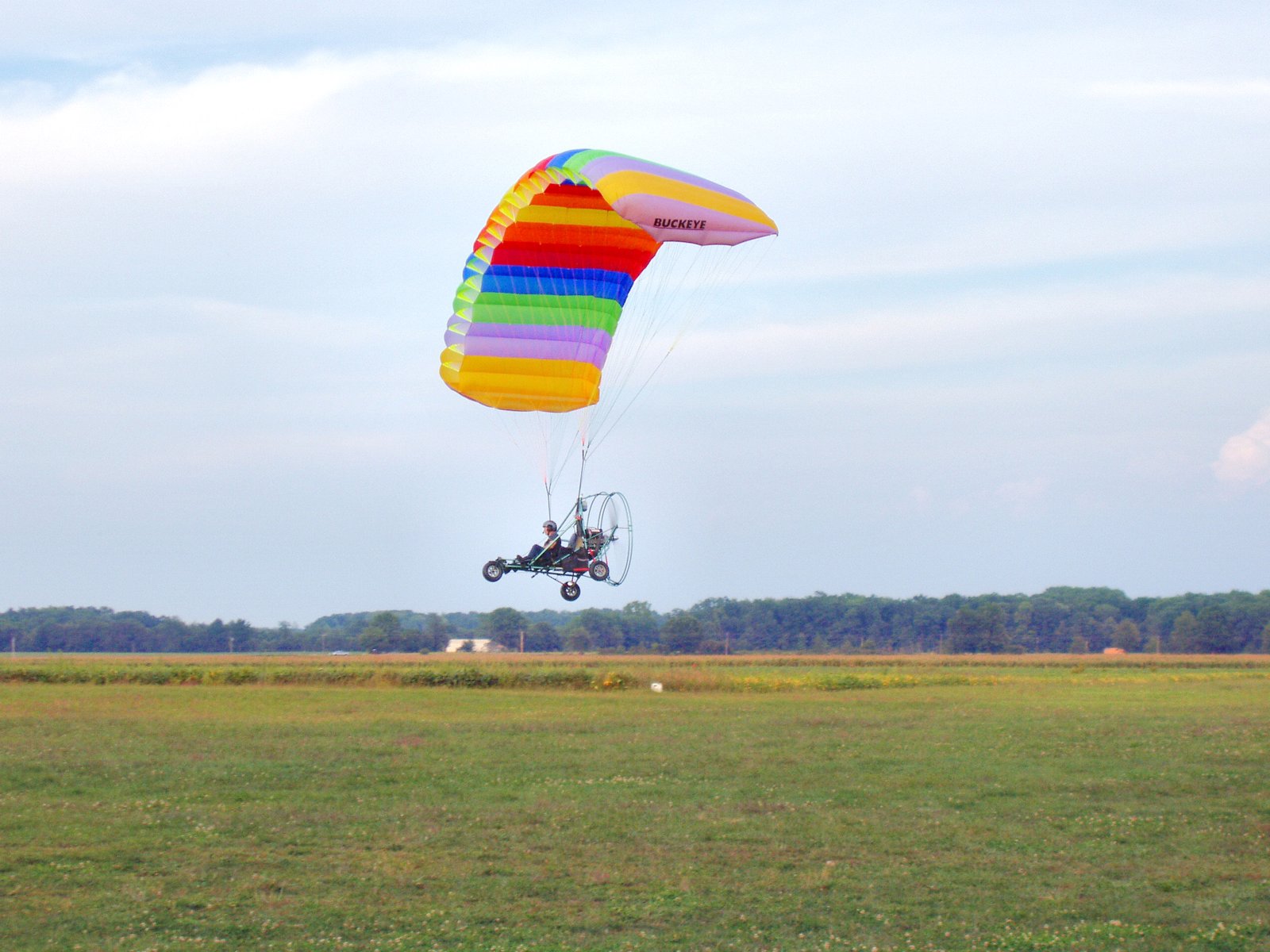
What a Powered Parachute Is
A powered parachute — abbreviated PPC and sometimes called a motorized parachute or paraplane — is a powered aircraft made of a flexible ram-air wing attached to a wheeled fuselage the community calls the "cart." The FAA defines it as a powered aircraft comprised of a flexible or semi-rigid wing connected to a fuselage so that the wing is not in position for flight until the aircraft is in motion. In other words, unlike an airplane's rigid wing, a PPC's fabric canopy lies collapsed on the ground before takeoff and only assumes its airfoil shape once the cart rolls forward and ram air inflates its cells. It should not be confused with a foot-launched powered paraglider, which straps a motor to the pilot's back and has no cart or landing gear.
How It Flies — Parafoil Wing, Cart, and Engine
The wing is a rectangular ram-air parafoil: a nylon canopy of open-fronted cells that fill with air and pressurize into a stable, cambered airfoil as the aircraft moves forward. Suspended beneath it on a network of lines is the cart — a tricycle or quad-wheeled chassis holding the seat(s), fuel, and a small engine (commonly a two- or four-stroke of 40–120+ horsepower) mounted behind the seat in a pusher configuration. Once the canopy is inflated and flying, it hangs at a fixed geometry above the cart, giving the PPC a naturally low, stable center of gravity and a benign, pendulum-like stability that resists upset.
How You Steer and Control It
Control is remarkably simple, which is a large part of the PPC's appeal. The pilot steers with foot bars (steering bars) or rudder-style pedals that pull down the trailing edge, or "brakes," on the left or right side of the canopy — pressing the right bar warps the right side of the wing to turn right, and the left to turn left. The throttle (hand- or foot-operated) controls engine power, which in turn controls climb and descent: add power to climb, reduce power to descend. There is no conventional pitch or roll control and no way to stall the wing in normal flight; the parafoil flies at a nearly constant airspeed and self-corrects toward its trim angle of attack. This two-input scheme — steer with the feet, climb and descend with the throttle — is why PPCs are often described as one of the most accessible ways to fly.
Sport Use and Regulation
Powered parachutes are overwhelmingly recreational: dawn and dusk pleasure flights in calm air, low-and-slow sightseeing, aerial photography, and some agricultural spotting. They typically operate between roughly 500 and 1,500 feet above the ground at 25–35 mph. In the United States, the smallest single-seat PPCs can qualify as unlicensed ultralight vehicles under FAR Part 103 (no pilot certificate required), while two-seat models fall under the Light-Sport Aircraft (LSA) category and require at least a Sport Pilot certificate under Part 61, with a powered-parachute category/class rating. Their low speeds and gentle handling make them a common entry point into aviation.
Major Manufacturers
A compact group of makers has defined the segment, especially in North America. Long-established and current brands include Powrachute, Buckeye (Buckeye Industries / Buckeye Aviation), Six Chuter, Infinity Power Parachutes, and Destiny (Destiny Powered Parachutes), among others. These builders supply both ready-to-fly two-seat LSA carts and single-seat ultralight kits, and they have shaped the training culture and safety practices of the powered-parachute community.
Why This Is a Category, Not One Type
Because powered parachutes are diverse, are flown in uncongested airspace, and are not integrated into commercial or instrument operations, they have no standardized individual ICAO aircraft type designator. As a result, AviatorDB groups all registered powered parachutes under the catch-all code PPAR — so that every PPC in the registry links to a single useful category page rather than to a nonexistent per-model type designator.