
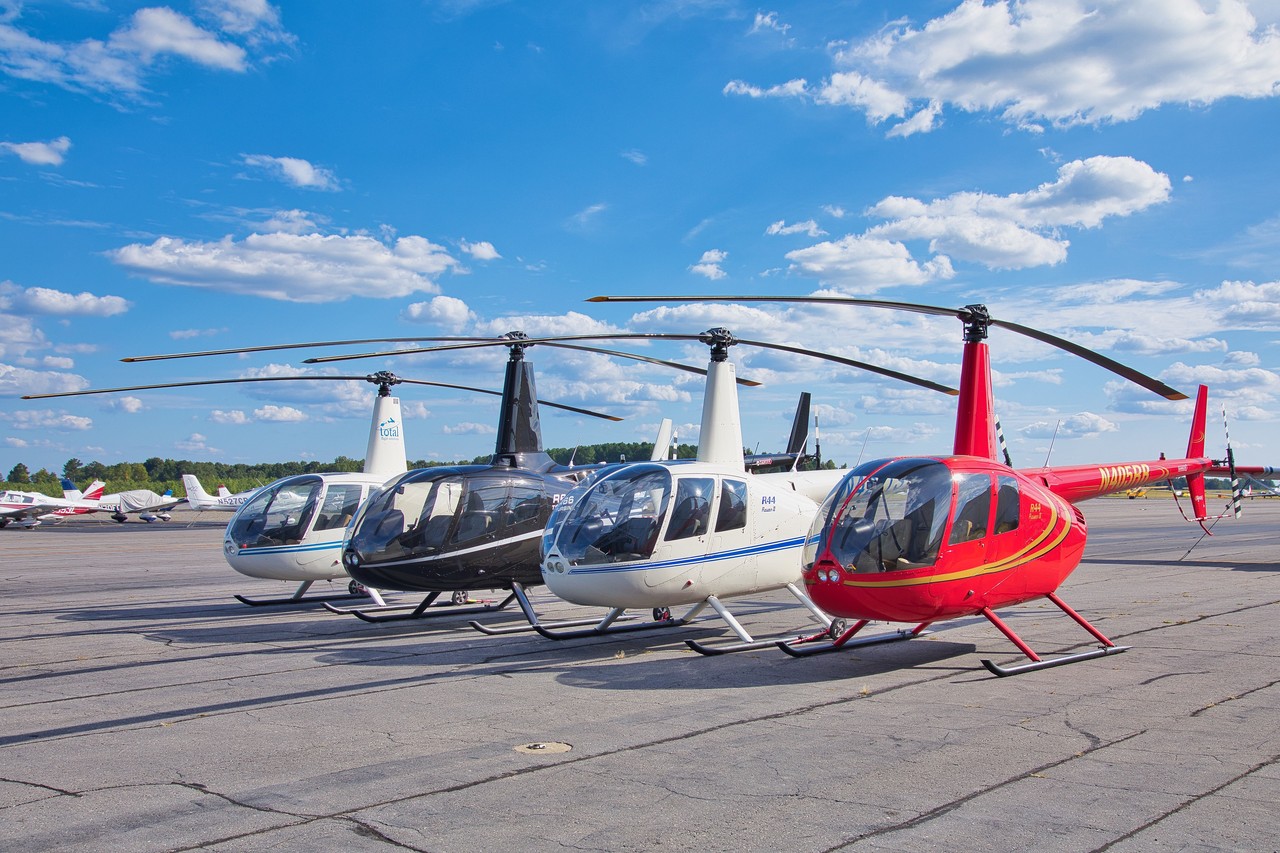
Dominance in General Aviation
The R-44's impact on civilian helicopter operations cannot be overstated. Robinson achieved what many considered impossible: delivering turbine helicopter performance at piston helicopter prices. Since 1999, the R-44 has outsold every competitor in the general aviation helicopter market, with over 5,941 units delivered between 2001 and 2020 alone. By early 2001, more than 1,000 R-44s operated across 50 countries, establishing Robinson's global footprint in civil aviation.
The helicopter found extensive use in commercial operations including aerial photography, pipeline patrol, firefighting support, electronic news gathering, and law enforcement. Serial number 0007, delivered in 1993, exemplifies the type's durability with over 6,100 flight hours logged in Canadian commercial service. The R-44's versatility enabled operations from tourism flights to vertical reference work, capturing markets previously dominated by more expensive turbine aircraft.
Robinson Helicopter Company
Frank Robinson founded Robinson Helicopter Company in 1973 in Torrance, California, initially developing the two-seat R-22 which received certification in 1979. The success of the R-22 provided the foundation for R-44 development, which began in the mid-1980s as Robinson recognized demand for a larger, four-seat variant. The company's philosophy centered on simple, reliable designs using proven components manufactured largely in-house to control costs and quality.
Robinson achieved remarkable manufacturing efficiency, producing 20 helicopters weekly with 1,300 employees, 25 percent of whom maintain tenure exceeding 10 years. The company's ISO 9001 certification encompasses design, manufacturing, and certification processes. In-house capabilities include CNC machining, welding, assembly, painting, and flight testing, enabling Robinson to maintain competitive pricing while ensuring quality control. Over the past three decades, Robinson became the world's largest manufacturer of civil helicopters and, remarkably, the top producer of all civil aircraft combining fixed-wing and rotary-wing categories.
Engineering Excellence
Frank Robinson and his engineering team designed the R-44 as a scaled-up R-22, incorporating hydraulically-assisted flight controls to manage the increased size and weight. The prototype N44RH first flew March 31, 1990, followed by a comprehensive flight test program involving three aircraft before FAA certification in December 1992. First production delivery occurred in February 1993, launching what would become one of aviation's most successful programs.
The R-44 utilizes proven Lycoming six-cylinder engines, with the original Astro and Raven I variants powered by the carbureted O-540-F1B5 producing 205 horsepower continuous and 225 horsepower for takeoff. The 2002 Raven II introduced the fuel-injected IO-540-AE1A5, maintaining 205 horsepower continuous but increasing takeoff power to 245 horsepower for improved altitude performance. These engines, manufactured by Lycoming (a Textron division), represent decades of proven reliability in general aviation applications.
Variants and Innovation
Robinson continuously refined the R-44 through strategic variants addressing specific market needs. The January 2000 Raven I introduced factory hydraulics, upgraded elastomeric tail rotor bearings, adjustable pedals, and increased time between overhauls to 2,200 hours. The July 2002 Raven II featured the fuel-injected engine, wider rotor blades, and increased gross weight to 2,500 pounds, significantly improving high-altitude performance.
Specialized variants expanded market reach. The Clipper configuration added floats for water operations, while the Newscopter variant, first delivered in 1998, incorporated equipment for electronic news gathering. The two-seat Cadet, announced in November 2015 and certified in May 2016, provided increased cargo capacity by eliminating rear seats, addressing commercial operators requiring payload over passenger capacity.
Performance and Pilot Experience
The R-44 Raven II demonstrates impressive performance specifications for a piston helicopter, achieving 135 mph maximum speed, 14,000-foot service ceiling, and climb rates exceeding 1,000 feet per minute. Range extends to 350 nautical miles without reserves, enabling missions previously requiring fuel stops. Hover performance reaches 8,950 feet in ground effect and 7,500 feet out of ground effect at maximum gross weight, providing operational flexibility in mountainous terrain.
In 2014, an R-44 established the piston helicopter speed record at 123 knots, demonstrating the type's performance potential. The helicopter's handling characteristics earned praise from pilots transitioning from smaller aircraft, with hydraulic assistance reducing control forces while maintaining positive feedback. The enclosed four-seat cabin provides comfort levels approaching light aircraft, contributing to the type's popularity in training and personal transportation roles.
Global Impact and Legacy
Jennifer Murray's 1997 first women's helicopter circumnavigation in an R-44, covering 36,000 miles in 97 days, demonstrated the aircraft's reliability and range capabilities on a global stage. This achievement highlighted the R-44's suitability for extended operations far from maintenance facilities, a crucial factor in its commercial success.
With over 6,800 aircraft delivered worldwide, the R-44 fundamentally changed general aviation helicopter economics. Many early examples continue active service, testament to Robinson's design philosophy emphasizing reliability and maintainability. The aircraft's success enabled Robinson to dominate civil helicopter production, selling 823 new helicopters in recent years according to General Aviation Manufacturers Association data. The R-44 remains in production today, continuing its role as the world's most popular general aviation helicopter.