
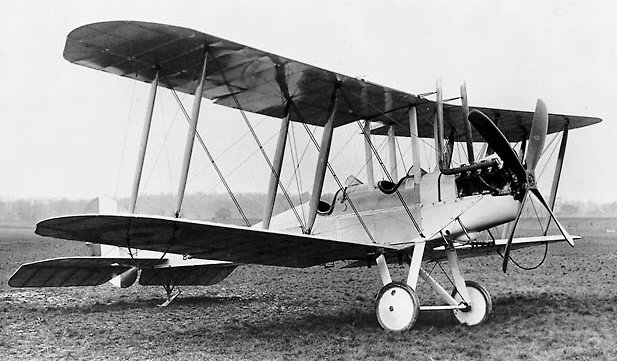
The Royal Aircraft Factory B.E.2 was a two-seat biplane developed at Farnborough, emerging as one of the first practical aircraft utilized by the Royal Flying Corps. The aircraft first flew on 1 February 1912 and entered squadron service that same year. While the design originated at the Royal Aircraft Factory—a government establishment that evolved from the British Army Balloon Factory—the vast majority of the aircraft were produced by private contractors. Only six units were built at Farnborough, while the remaining thousands were manufactured by firms such as Vickers, Handley Page, Armstrong Whitworth, the British & Colonial Aeroplane Company (later Bristol), Hewlett & Blondeau, and Coventry Ordnance Works.
Design development for the B.E.2 family involved several iterations. Geoffrey de Havilland is specifically credited with the design of the B.E.2.a. Later versions, such as the B.E.2b, introduced a revised control arrangement, an improved fuselage, and the replacement of wing warping with ailerons. The aircraft typically featured a crew of two, with the observer positioned in the front cockpit and the pilot in the rear.
Technical specifications varied by model. The B.E.2, B.E.2.a, and B.E.2.b were powered by a 70 hp air-cooled V-8 Renault Type WB engine operating at 1,750 rpm. Some B.E.2c variants were later equipped with a more powerful 90 hp RAF1a engine. Performance figures for the B.E.2.a include an empty weight of 1,274 lb and a gross weight of 1,600 lb, with a maximum sea-level speed of 70 mph. The B.E.2c could reach 72 mph at 6,500 ft and had a service ceiling of 10,000 ft. Endurance ranged from 3 hours to 3.5 hours depending on the variant.
During the First World War, the B.E.2 served in a wide array of roles, including artillery spotting, reconnaissance, communications, light bombing, coastal anti-submarine patrol, and training. In August 1914, three squadrons of B.E.2b aircraft were deployed to France. The B.E.2c was particularly widespread, equipping four Navy squadrons and 72 RFC squadrons. Notably, as a single-seat night fighter, the B.E.2 is credited with destroying six German airships between September and December 1916. However, by late 1915, the aircraft became vulnerable to German Fokker Eindecker fighters, leading to its withdrawal from front-line combat in favor of secondary roles. The type remained in use until its retirement from the RAF in 1919. Today, a B.E.2b is preserved in the RAF Museum collection.