
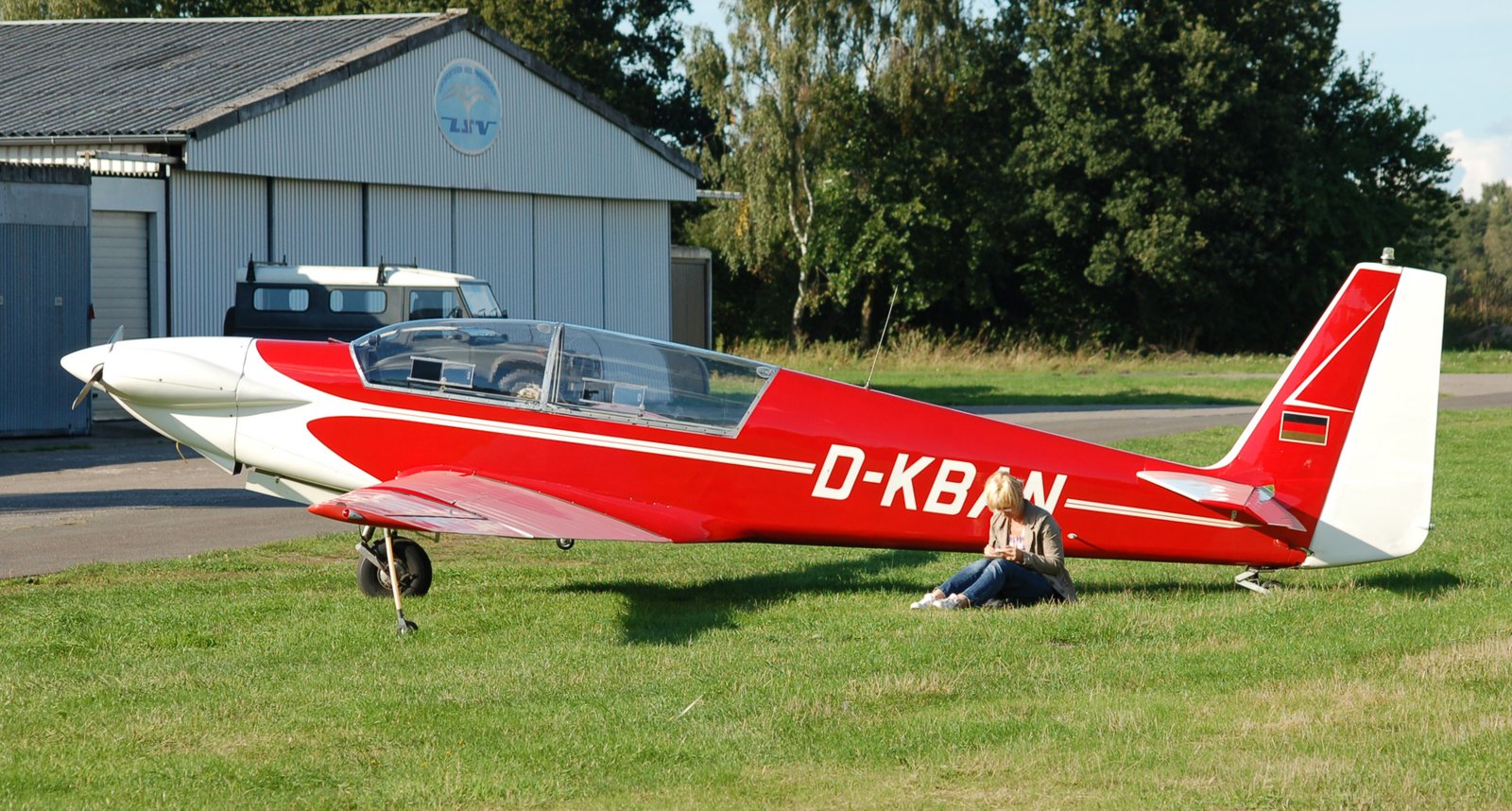
Manufacturing Evolution
Production of the RF-5 began in 1968 at Alpavia in France, where 127 aircraft rolled off the assembly line through construction numbers 5001-5127. However, economic pressures forced a dramatic shift in manufacturing location. As production costs mounted and regulatory challenges intensified, René Fournier faced a difficult decision: "it was becoming difficult to produce in France" with "no alternative but to close the factory, to leave and cross the Rhine."
This migration led to a partnership with Sportavia in Germany, created by Alphons Putzer, which would prove transformational for the aircraft's development. Sportavia didn't simply continue French production - they reimagined the design entirely, creating the RF-5B "Sperber" variant that addressed competitive pressures from lighter, more affordable German motorgliders.
Technical Innovation and the RF-5B
The original RF-5's powerplant story exemplifies the pragmatic innovation of 1960s aviation. Initially equipped with a Rectimo engine, the prototype suffered an early setback when this powerplant failed after merely 50 hours of test flights. Peter Limbach stepped in with remarkable speed, producing an alternative 1700cc engine in just eight days. This Volkswagen Beetle-derived powerplant proved far more reliable than purpose-built aircraft engines, establishing a trend that would influence motorglider design for decades.
Sportavia's RF-5B "Sperber," which first flew in May 1971, represented a quantum leap in performance. Working with pilot Manfred Schliwa, Sportavia enlarged the wingspan to 17 meters, redesigned the canopy, and lowered the rear fuselage. These modifications yielded extraordinary results: the lift-to-drag ratio improved by six points, while sink rate dropped dramatically from 1.40 to 0.89 meters per second (275 to 175 feet per minute). The improvements came at a cost - aerobatic capabilities were sacrificed for soaring performance, making the RF-5B non-aerobatic unlike its predecessor.
Cold War Applications
Perhaps the most intriguing chapter in RF-5 history involves three highly modified airframes built in 1971 for German military reconnaissance. These aircraft received Lycoming O-235 engines, broad-chord three-bladed Hoffmann propellers, extensive exhaust silencing, and infrared shielding. The modifications achieved remarkable stealth characteristics - full-throttle overflights at 600 feet produced only 45 decibels of noise.
However, geopolitical changes rendered these reconnaissance variants obsolete before they could prove their worth operationally. The Cold War's end and rapidly improving satellite imagery technology eliminated the need for low-observable manned reconnaissance aircraft. Today, these unique variants reside in museums as testament to creative military applications of civilian designs.
International Production
The RF-5's global appeal led to production in Spain by Aeronaútica del Jaén SA, which modernized the design using composite materials. The Spanish prototype (EC-650/EC-FNA) first flew in 1992, incorporating advanced materials technology unavailable during the original 1960s production runs. By 1999, eleven composite examples had been completed with construction numbers E-001 through E-011.
Operational Characteristics
The RF-5 earned classification as a motorglider in Germany while France designated it a "short glide high aspect ratio aircraft," reflecting regulatory differences between European nations. The aircraft's semi-aerobatic capabilities included approved loops, stall turns, lazy eights, chandelles, and spins, though French pilot Bernard Chauvreau pushed boundaries by conducting aerobatic demonstrations at Le Bourget despite official prohibitions.
The aircraft's practical design included manually folding wingtips that could be operated by a single person, reducing hangar space requirements significantly. Landing gear consisted of manually retractable center gear with steerable tailwheel and detachable outrigger gear, optimizing both ground handling and aerodynamic efficiency.
Legacy and Current Operations
Total production across all variants and manufacturers reached approximately 227 aircraft: 127 by Alpavia, 99 RF-5B variants by Sportavia through 1977, and 11 composite versions by Aeronaútica del Jaén. Remarkably, the majority of these aircraft remain airworthy today, testament to robust construction and dedicated owner maintenance.
Club Fournier International maintains historical records and promotes the aircraft's legacy, ensuring continued support for remaining operators. The RF-5's influence extends beyond its production numbers - it demonstrated how European manufacturers could adapt to economic pressures through international cooperation while advancing motorglider technology through practical innovation rather than theoretical perfection.