
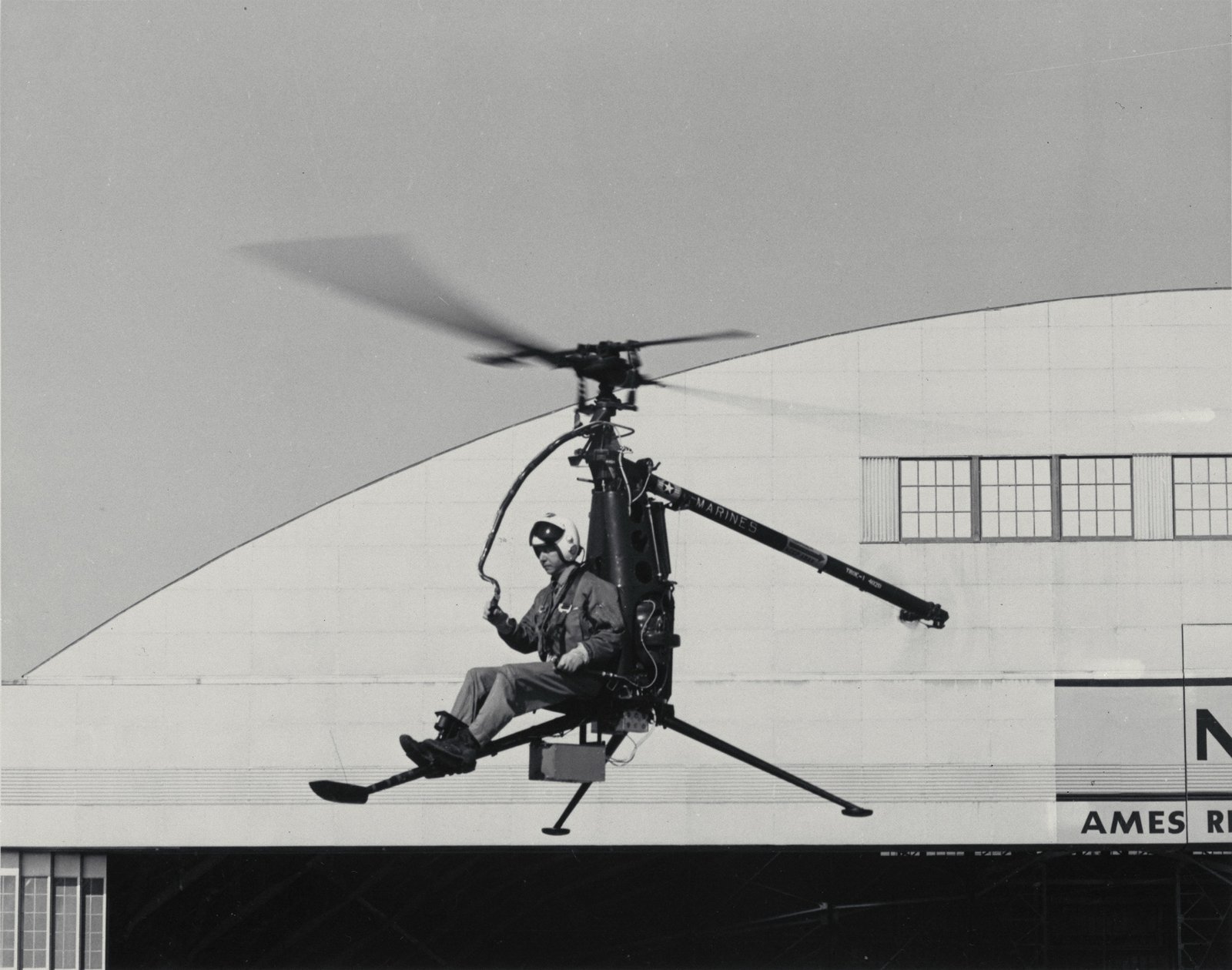
The Hiller ROE-1 Rotorcycle was conceived in 1953 to satisfy a United States military requirement for a one-man, collapsible helicopter capable of being para-dropped into hostile territory. Designed for roles such as reconnaissance, liaison, courier work, and the self-rescue of downed pilots, the aircraft was intended to be easily portable, folding onto a sled-like carrier for transport by two people. The U.S. Navy's Bureau of Aeronautics selected Hiller Helicopters of Palo Alto, California, in 1954 to develop the design.
The prototype, designated the XROE-1, first hovered in November 1956 under the control of Hiller chief pilot Richard Peck. Initial flight testing for the XROE was completed by mid-1957. While the prototypes were built in the United States, small-scale production was handled by the British firm Saunders-Roe. By October 19, 1959, the first YROE-1 was officially flying, and a total of five YROE-1 aircraft were completed by the spring of 1960 for evaluation by the U.S. Marine Corps. An additional five aircraft, designated Model 1033, were produced for Helicop-Air of Paris, bringing the total production run to 12 aircraft.
Technically, the Rotorcycle was powered by a Nelson Aircraft Corporation piston engine—specifically identified as either the H-59 or YO-65-2—which was a four-cylinder, two-cycle, air-cooled, horizontally opposed engine producing between 40 and 43 hp. The aircraft featured a minimalist open airframe with a rotor diameter of 5.64 meters and a length of 3.81 meters. Its lightweight construction resulted in an empty weight of approximately 136 to 140 kg. Performance figures included a cruise speed of 52 mph and a demonstrated maximum speed of up to 70 mph, with a service ceiling of 13,200 feet and a rate of climb of 1,160 ft/min.
Despite its stability—which reportedly allowed non-pilots to fly after eight hours of instruction—the U.S. Marine Corps ultimately rejected the YROE-1. Evaluation trials revealed several critical flaws: slow speed, limited range (approximately 30 to 40 miles), and vulnerability to small-arms fire. Additionally, the open structure caused spatial disorientation at higher altitudes, and the tail rotor had a limited lifespan of only 10 hours. By the early 1960s, the program was cancelled as turbine-powered helicopters and improved rescue doctrines rendered the 'pocket helicopter' concept obsolete. Today, several examples survive in museums, including the National Air and Space Museum's Steven F. Udvar-Hazy Center and the Hiller Aviation Museum.