
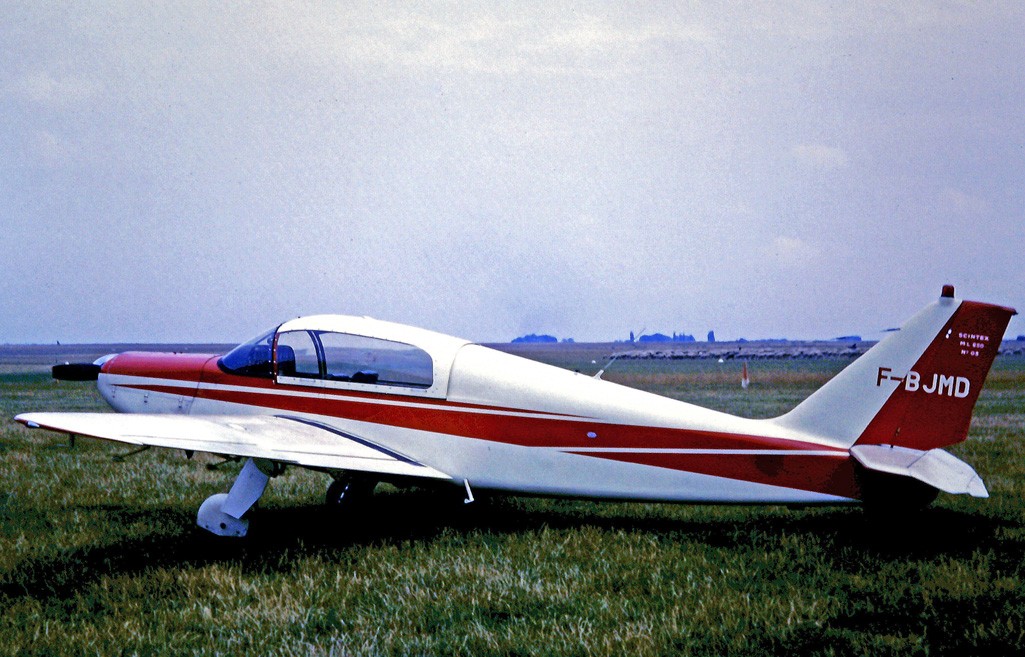
A Brief Commercial Life
The ML-250 Rubis entered a crowded and competitive market dominated by proven American designs. Despite its modern configuration and adequate power, the aircraft struggled to find buyers willing to take a chance on an unproven French alternative to the well-established Beechcraft Bonanza and similar touring aircraft. Production ceased in late 1964 after only eight examples had been completed, marking one of the shortest production runs in general aviation history.
The aircraft's commercial failure stemmed largely from timing and market dynamics. By the early 1960s, American manufacturers had already established strong dealer networks and customer loyalty in the touring aircraft segment. The Rubis, despite offering five-seat capacity and respectable performance, could not overcome the disadvantage of being an unknown quantity from a small French manufacturer.
Scintex Aviation's Rise and Fall
Scintex Aviation S.A. was founded in 1956 by Jean-Michel Vernhes as an ambitious venture to establish France as a competitor in the general aviation market. The company initially built its reputation by producing the Piel CP.301 Emeraude under license, manufacturing it as the CP.30 for French flying clubs and private owners. This arrangement provided steady income and manufacturing experience that would prove valuable for future original designs.
Claude Piel joined the company in 1959 after working at SCANOR, bringing additional design expertise to the growing firm. Under this partnership, Scintex introduced several variants of the Emeraude, including the CP.301C with a sliding canopy in 1960 and the CP.1310 Super Emeraude, which made its first flight on April 20, 1962. The company operated primarily from the Menavia factory at Clermont-Ferrand, establishing itself as a legitimate aircraft manufacturer during France's post-war aviation renaissance.
The decision to develop the ML-250 Rubis represented Scintex's attempt to move beyond license production into the more lucrative market for original designs. However, this ambitious leap ultimately proved fatal to the company, which ceased aircraft production in late 1964, just eight years after its founding.
Design Evolution
The ML-250 Rubis evolved from Scintex's earlier ML-145 Rubis, a four-seat touring aircraft that had made its first flight on May 24, 1961. The ML-145 had shown promise but lacked the power and capacity that market research indicated customers desired. The ML-250 addressed these shortcomings by incorporating a more powerful Lycoming O-540 engine and expanding seating capacity to five occupants.
Development of the ML-250 proceeded rapidly, with the prototype taking to the air just over a year after the ML-145's maiden flight. The June 3, 1962 first flight demonstrated the aircraft's basic airworthiness, but subsequent testing and market introduction revealed the challenges facing any new entrant in the competitive touring aircraft segment.
Powerplant and Performance
The heart of the ML-250 Rubis was its 250-horsepower Lycoming O-540 engine, a six-cylinder horizontally opposed powerplant that had entered production in the early 1950s. This air-cooled engine represented proven technology from Lycoming Engines, a division of Avco Lycoming that would later become part of Textron. The O-540 series had already established itself as a reliable choice for touring aircraft, offering an excellent power-to-weight ratio that made it ideal for the Rubis's intended mission.
The engine choice reflected sound engineering judgment by the Scintex design team. Rather than attempting to develop proprietary powerplant technology, they selected a well-proven American engine that offered good performance characteristics and worldwide support infrastructure. This decision likely represented one of the aircraft's strongest selling points, as potential buyers could be confident in the engine's reliability and serviceability.
Limited Legacy
The ML-250 Rubis left little mark on aviation history beyond serving as a cautionary tale about the challenges facing small aircraft manufacturers attempting to break into established markets. Of the eight aircraft completed, at least one example, registered F-BJMH with constructor's number 103, appeared in French aircraft registries, though its current status remains unknown.
One notable post-production achievement involved pilot Daniel Robert-Bancherelle of France, who established a record flight in a Rubis ML-250 that was officially recognized by the Fédération Aéronautique Internationale. This accomplishment suggested that despite its commercial failure, the aircraft possessed adequate performance characteristics for serious aviation endeavors.
The End of an Era
When Scintex ceased aircraft production in late 1964, the company attempted to salvage something from its Emeraude experience by subcontracting Super Emeraude production to CAARP at Beynes-Thiverval airfield near Paris. CAARP later produced these aircraft independently, ensuring that at least one Scintex design would continue beyond the company's demise. However, the ML-250 Rubis died with its creator, representing the end of France's brief attempt to challenge American dominance in the touring aircraft market.
Today, no airworthy examples of the ML-250 Rubis are known to exist, and none are displayed in museums. The aircraft exists primarily in aviation records and the memories of those few who encountered one of the eight examples during its brief moment in aviation history.