
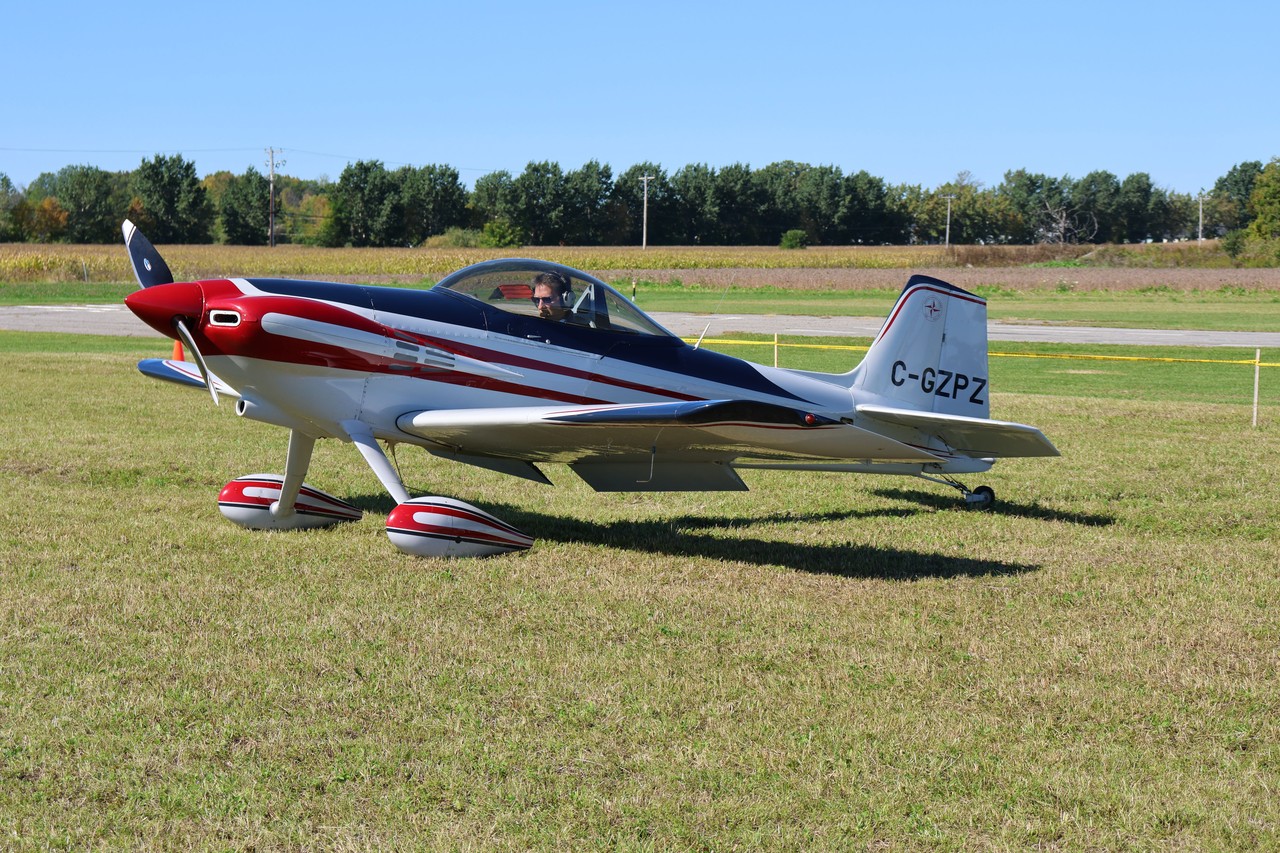
Foundation of an Empire
The RV-3's debut at the 1972 EAA Oshkosh convention marked a watershed moment in homebuilt aviation. Richard VanGrunsven's prototype captured "Best Aerodynamic Detailing" honors and won the 1973 AC/EAA Efficiency Contest, immediately establishing credibility for what would become aviation's most prolific kit aircraft series. The design's success spawned over 14 RV variants and more than 11,000 completed aircraft worldwide, making Van's Aircraft the undisputed champion of the experimental aircraft market.
The Designer's Vision
Richard VanGrunsven conceived the RV-3 in the late 1960s after extensive experience with his modified Stits Playboy, which he had renamed the RV-1. Drawing from this foundation, VanGrunsven engineered his first clean-sheet design with ambitious objectives: light handling characteristics, full aerobatic capability, cruise speeds exceeding 200 miles per hour, and short-field performance. The aircraft incorporated a 30-gallon fuel capacity for 600-mile range, positioning it as a serious cross-country machine rather than merely a local sport aircraft.
VanGrunsven's 2½-year construction effort produced a design that would define sport aviation for decades. His engineering background and pilot experience converged to create an aircraft that balanced performance, buildability, and flying qualities in ways that traditional manufacturers had not achieved in the homebuilt market.
Manufacturing Excellence
Van's Aircraft, founded alongside the RV-3's introduction in 1972, transformed from a one-man operation at Aurora State Airport in Oregon into the world's largest kit aircraft producer. The company manufactures more than 400 RV kits annually, maintaining most production in-house at their Oregon facility. This employee-owned enterprise has sustained operations for over five decades, demonstrating remarkable longevity in the volatile aviation industry.
The RV-3's production history reflects both the design's appeal and VanGrunsven's commitment to safety. Initial production continued until 1996, when structural concerns prompted a suspension. Rather than abandoning the model, VanGrunsven redesigned the wing structure and reintroduced the aircraft as the RV-3B variant, demonstrating the engineering integrity that has characterized Van's Aircraft throughout its history.
Technical Innovation
The RV-3's construction employs semi-monocoque aluminum construction using predominantly 2024-T3 sheet material. Wings utilize a NACA 23012 airfoil built around an aluminum I-beam main spar with a secondary rear spar, creating a constant-chord wing optimized for both speed and handling. Plain flaps operated by a cockpit handle provide short-field capability while maintaining structural simplicity.
The landing gear attachment directly to the welded steel engine mount through tapered, spring steel rods eliminates complex retraction mechanisms while providing excellent ground handling. This engineering approach typifies the RV-3's philosophy of achieving maximum performance through elegant simplicity rather than complex systems.
Powerplant options center on Lycoming engines, typically the O-235 producing 100 horsepower or the O-320 generating 150 horsepower. Some builders have installed more powerful variants, with documented examples using the O-290-G producing 125 horsepower. Even with modest power, the RV-3 achieves cruise speeds of 180 miles per hour, with properly configured examples exceeding 200 miles per hour on 150-horsepower installations.
Builder Experience
The RV-3 requires approximately 1,300 construction hours for first-time builders, establishing a benchmark for kit aircraft complexity and completion time. This figure reflects Van's Aircraft's emphasis on pre-manufactured components and comprehensive documentation, reducing the fabrication skills required compared to plans-built aircraft. The company's approach democratized aircraft construction, enabling builders without extensive metalworking backgrounds to complete professional-quality aircraft.
While designed as a taildragger, some builders have modified their RV-3s with tricycle landing gear, demonstrating the design's adaptability. However, the majority retain the original tailwheel configuration, which contributes to the aircraft's short-field performance and classic appearance.
Operational Legacy
The RV-3's influence extends far beyond its 305-aircraft production run. Customer demand for a two-seat variant led directly to the RV-4, which retained the RV-3's fundamental design philosophy while accommodating a passenger. This evolution pattern continued throughout the RV series, with each subsequent model tracing its lineage to VanGrunsven's original single-seater.
Both the original RV-1 prototype and the first RV-3 reside in the EAA Aviation Museum in Oshkosh, Wisconsin, recognizing their historical significance in experimental aviation. These aircraft represent the foundation of a movement that has produced more completed homebuilt aircraft than any other manufacturer in aviation history.
Enduring Impact
The RV-3's 50-year production span, interrupted only by the wing redesign period, demonstrates exceptional design longevity in an industry where most aircraft enjoy much shorter production runs. The current RV-3B variant continues attracting builders worldwide, with registered examples operating across multiple countries including Australia, the United States, and throughout Europe.
This single-seat aircraft established Van's Aircraft's reputation for combining high performance with reasonable construction complexity, creating a template that has influenced virtually every subsequent homebuilt design. The RV-3's legacy lies not merely in its own accomplishments, but in proving that small-scale manufacturers could produce aircraft rivaling or exceeding the performance of certified general aviation aircraft while remaining accessible to amateur builders.