
Service History
The RV-6 dominated the homebuilt aircraft market from its introduction in 1986 until production ceased in 2001. Van's Aircraft sold approximately 4,000 kits during this 15-year production run, making it the company's most successful design. By 2016, more than 2,500 RV-6s had been certified and were flying, with over 2,700 total kits completed. At the 2016 EAA AirVenture Oshkosh alone, approximately 300 RV-6s were registered, demonstrating the type's enduring popularity among sport aviation enthusiasts.
The aircraft found its primary role as a fast touring and sport flying platform for private owners, offering performance previously available only in much more expensive factory-built aircraft. Its success as Van's "bread and butter" model for a decade enabled the company's expansion and development of subsequent designs.
Limited Military Service
While primarily a civilian aircraft, the RV-6A saw limited military service as a primary trainer. In 1989, the Nigerian Air Force ordered 60 RV-6A kits through the Aeronautical Industrial Engineering Project. Three prototypes were initially assembled, with EXP-1 becoming the first RV-6A assembled and flown in Nigeria with assistance from American consultant Peter Lewis and British consultant John Cook. The remaining aircraft were assembled locally at Kaduna and entered service as the "Air Beetle" T.18 for elementary pilot training. The Nigerian RV-6As appear to have been retired by 2010, with at least one aircraft lost in a fatal accident. Revival efforts in 2010 were unsuccessful.
Iran's Aviation Industries developed a variant called the AVA-202, featuring a modified RV-6A design with a 28.67-foot wingspan. This aircraft first flew in 1997 but saw no documented military service.
The Manufacturer
Van's Aircraft was founded in 1973 by Richard "Van" VanGrunsven, who began the company with the single-seat RV-3 kit. The progression through the RV-4 in 1981 to the RV-6's first flight in 1985 established Van's as the world's largest producer of kitplanes. By the early 2000s, the company was shipping the equivalent of 650 full kits annually from its Aurora, Oregon facility.
The RV-6's commercial success substantially boosted Van's business volume and enabled expansion into improved designs, including the RV-8 in 1995, RV-7 in 2001, and four-seat RV-10 in 2003. Van's Aircraft continues operations today under the same name, still supplying parts for ongoing RV-6 builds despite discontinuing complete kit production in 2001.
Design Innovation
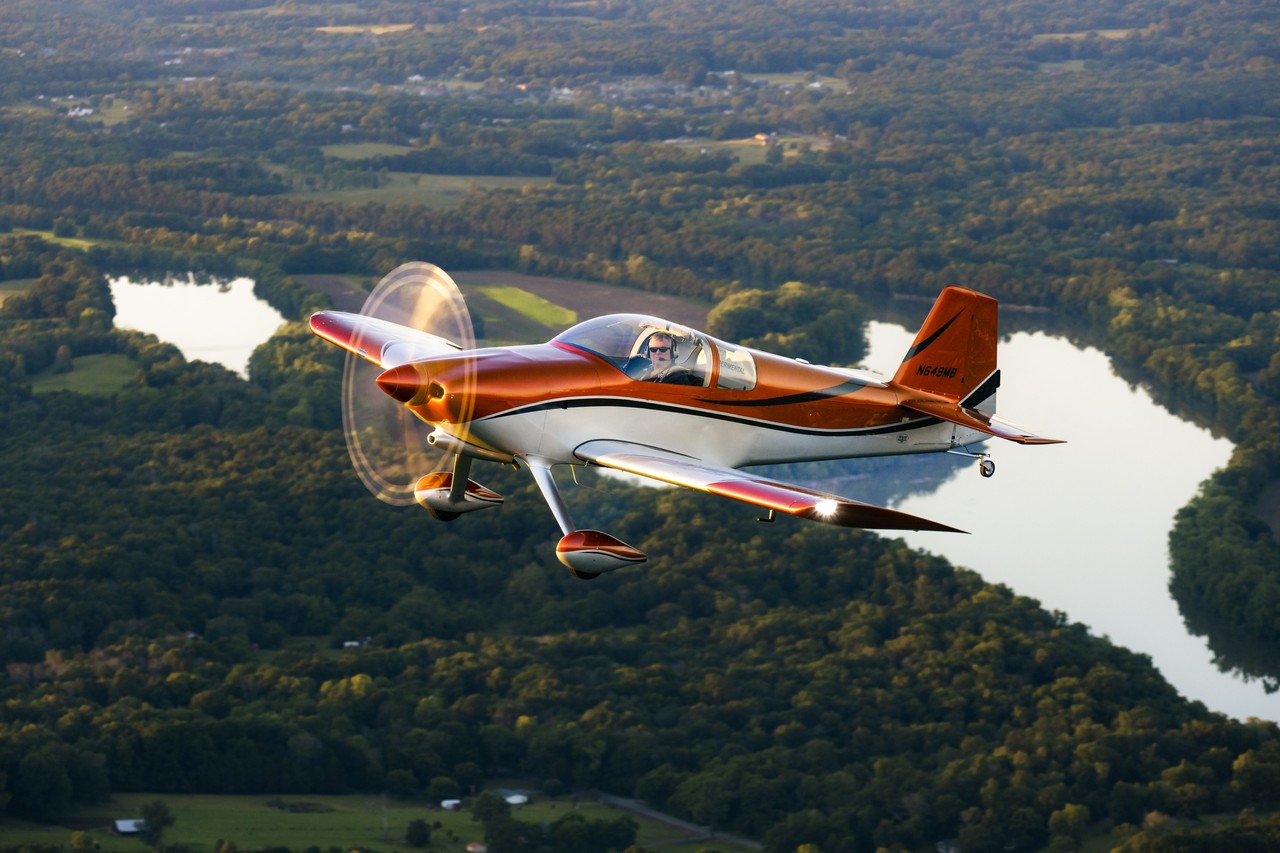
Richard VanGrunsven designed the RV-6 as a two-seat, side-by-side development of the tandem-seat RV-4, itself derived from the single-seat RV-3. The primary design objective addressed market demand for side-by-side seating to better accommodate passengers, particularly spouses, while retaining the RV-4's exceptional handling characteristics, short takeoff and landing performance, and high cruise speeds.
The challenge was significant: creating a 43-inch-wide cockpit without compromising the aerodynamic efficiency that made the RV-4 successful. VanGrunsven's solution achieved cruise speeds only 3 mph slower than the RV-4 despite the wider fuselage, while preserving the excellent handling and STOL characteristics that defined the RV series.
Engine and Performance
The RV-6 is typically powered by the Lycoming O-360, a four-cylinder, air-cooled, horizontally opposed engine producing 180 horsepower. This powerplant, manufactured by Lycoming Engines (a Textron division), has been in production since the 1950s with tens of thousands produced across variants for general aviation applications.
The aircraft carries 38 US gallons of fuel and has an empty weight of 965 pounds with a gross weight of 1,600 pounds. This power-to-weight ratio enables the high cruise speeds that made the RV-6 attractive to builders seeking cross-country touring capability.
Pilot Experience
Pilots consistently praise the RV-6 for retaining the handling characteristics that made the single-seat RV-3 and tandem RV-4 legendary among homebuilders. The low-wing configuration and fighter-like appearance, reminiscent of World War II aircraft, contributed to its appeal. The side-by-side seating arrangement proved far more practical for training passengers and sharing the flying experience than the tandem configuration of earlier RV models.
The aircraft's short takeoff and landing capabilities, combined with its high cruise speed, made it ideal for accessing shorter airstrips while maintaining the ability to cover significant distances efficiently.
Legacy and Current Status
The oldest customer-built RV-6 was completed in spring 1989 by James Baldwin of Columbus, Ohio, and continues to fly today. The RV-6A prototype, which first flew in June 1988, has accumulated more than 5,100 hours of flight time, demonstrating the design's durability.
While Van's replaced the RV-6 with the improved RV-7 series in 2001, the earlier design's impact on homebuilt aviation cannot be overstated. It proved that amateur builders could construct aircraft offering performance rivaling factory-built designs at a fraction of the cost. New RV-6 completions continue from remaining unfinished kits, with Van's Aircraft maintaining parts support for existing aircraft.
The RV-6's success established the template for modern kitplane design and marketing, emphasizing accessible high-performance aviation that paved the way for Van's continued expansion and the broader homebuilt aviation revolution.