
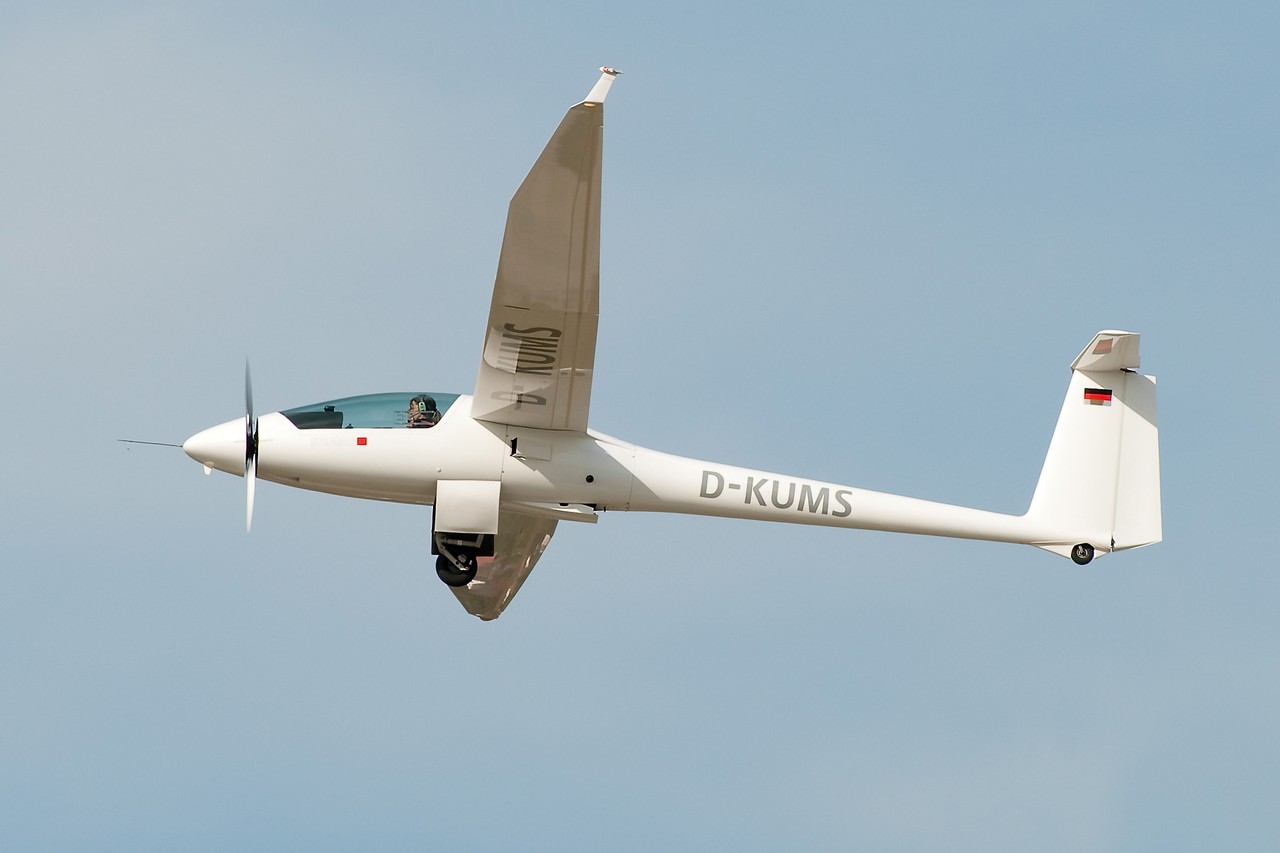
Revolutionary Design Philosophy
The S-10 emerged from Stemme GmbH's ambitious goal to create a sailplane that could launch itself without ground equipment while maintaining pure glider performance. The company, established in Berlin in 1985 specifically to develop high-performance gliders, unveiled their breakthrough design at the 1987 AERO trade show in Friedrichshafen. The aircraft's defining innovation was its nose-mounted propeller that folded completely inside the fuselage when not in use, eliminating drag penalties that plagued earlier motor gliders.
Engineering Excellence
The S-10's engineering centered on its unique three-section wing design constructed from carbon fiber reinforced plastic, which one person could fold for hangar storage. The mid-mounted engine drove a retractable propeller system that could deploy in just 5 seconds, transforming the aircraft from pure sailplane to powered aircraft almost instantaneously. Klaus Ohlmann demonstrated this capability spectacularly on November 26, 2000, setting a world soaring distance record of 1,330 nautical miles in an S-10-VT over the Andes Mountains.
The cockpit featured Kevlar safety lining and side-by-side seating for two pilots, with Schempp-Hirth spoilers providing precise glide path control. The steerable tailwheel landing gear and optional winglets, introduced in 1997, enhanced ground handling and flight efficiency respectively.
Production Evolution
Stemme's production strategy evolved through three distinct variants. The original S-10, powered by a 93-horsepower Limbach L 2400 flat-four engine, saw 54 aircraft completed by March 1994 before production temporarily ceased. Manufacturing resumed in late 1994 with the S-10-V variant, producing 29 new aircraft plus five conversions from earlier models through 1997.
The definitive S-10-VT variant, introduced in 1997, featured the turbocharged 115-horsepower Rotax 914 engine with variable-pitch propeller capability. This powerplant enabled cruise speeds of 161 mph while maintaining the aircraft's 50:1 glide ratio. By October 2002, 78 S-10-VT aircraft had been produced, with 38 delivered to American customers. Most components were manufactured by Wytwornia Konstrukcji Kompozytowych in Poland before final assembly in Germany.
International Recognition
The S-10 achieved certification in major aviation markets, receiving German type approval on December 31, 1990, British certification on October 29, 1991, and FAA approval on July 8, 1992. This regulatory acceptance opened global markets, with aircraft delivered to operators across Australia, Austria, Belgium, Brazil, Canada, Czech Republic, Denmark, Finland, France, Germany, Italy, Mexico, Netherlands, New Zealand, South Africa, Spain, Switzerland, the United Kingdom, and United States.
Military Applications
The United States Air Force Academy recognized the S-10's training potential, operating two examples designated TG-11A between 1995 and 2002. These aircraft served with the 94th Air Training Squadron at Colorado Springs, Colorado, providing advanced soaring instruction to future Air Force officers. The Colombian Air Force later acquired two S-10-VT aircraft in December 2017 for similar training missions.
Performance Benchmark
The S-10-VT established new standards for motor glider capability with its maximum speed of 168 mph, stall speed of just 42 knots, and remarkable range of 1,075 miles at maximum fuel capacity. These specifications, combined with its 50:1 glide ratio, made the aircraft equally capable as a cross-country tourer or competition sailplane.
Manufacturing Legacy
Stemme GmbH, which reorganized as Stemme AG in 1990, established the S-10 as the benchmark for self-launching sailplanes. The aircraft commanded premium pricing, with the S-10-VT listed at €168,000 in 2002. Future production responsibilities transferred to Remos Aircraft, ensuring continued availability of this unique design.
The S-10 Chrysalis proved that innovative engineering could successfully merge seemingly contradictory requirements - the efficiency of a pure sailplane with the independence of powered flight. Its influence on subsequent motor glider designs remains evident in modern high-performance self-launching sailplanes worldwide.