
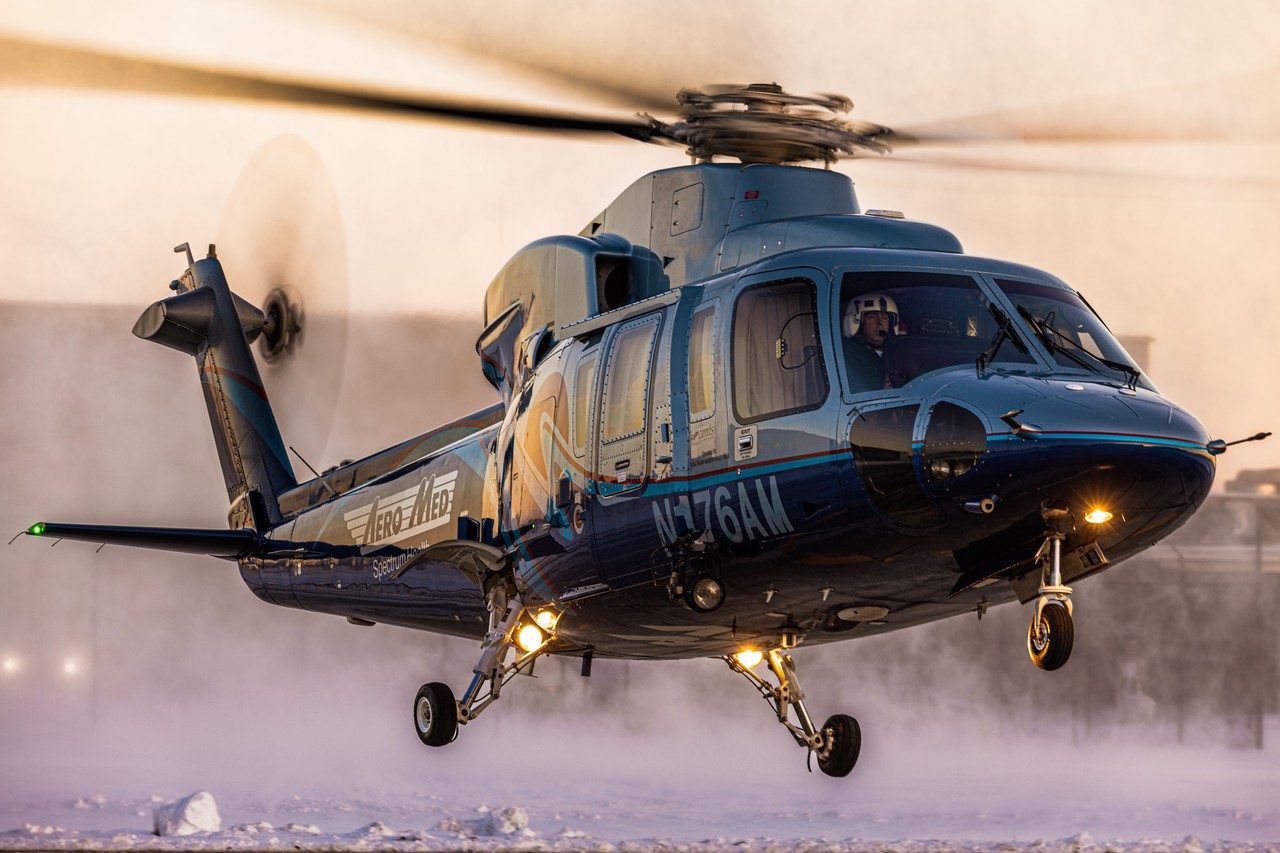
Commercial Aviation Pioneer
The S-76 emerged during a pivotal period when Sikorsky Aircraft Corporation sought to diversify beyond military contracts. Development began in the mid-1970s under the initial designation S-74, but the project was renamed S-76 to commemorate the American Bicentennial. Program announcement came on January 19, 1975, remarkably before the aircraft had been designed, as Sikorsky boldly began accepting contracts from potential operators to guide market research.
Development and Certification
Drawing upon technology from the S-70 helicopter that would become the UH-60 Black Hawk, the S-76 prototype achieved its maiden flight on March 13, 1977, arriving two months ahead of the originally scheduled May target. Federal Aviation Administration certification followed on November 21, 1978, leading to the first customer delivery on February 27, 1979.
The aircraft incorporated several innovative features for its era, including twin turboshaft engines, four-bladed rotor systems, and retractable landing gear. Designed specifically for two-pilot operations, the S-76 could accommodate varying passenger configurations depending on mission requirements: up to 13 passengers for oil and gas support operations or 6-8 passengers in luxurious cabin-class corporate arrangements.
Engine Evolution
Throughout its production life, the S-76 featured more engine options than virtually any other civilian helicopter worldwide. The initial S-76A utilized twin Allison 250-C30 engines producing 557 shaft horsepower each. The 1982 S-76 Mk II retained the same powerplants but incorporated 40 modifications to enhance reliability and maintainability.
Subsequent variants explored different powerplant options. The 1987 S-76B adopted Pratt & Whitney Canada PT6B-36A and PT6B-36B engines, while the 2006 S-76 C++ featured twin Turbomeca Arriel 2S2 engines paired with an improved, quieter transmission system. This engine diversity allowed operators to select configurations best suited to their operational requirements and maintenance preferences.
Performance Achievements
In 1982, the S-76A established multiple class records for range, climb rate, speed, and service ceiling, demonstrating the platform's exceptional capabilities. The helicopter achieved a maximum speed of 155 knots at sea level, with gross weights ranging from 10,500 pounds for the S-76A to 11,700 pounds for the later S-76D variant.
Production History
Manufacturing commenced in 1979 at Sikorsky's American facilities, with production initially peaking at approximately 80 aircraft annually during the early years. However, demand declined significantly during the 2010s, with only nine airframes completing production after 2015. By September 2013, Changhe Aircraft Industries Corporation in China was contracted to manufacture S-76D airframes, expanding the international production base.
Production evolved through numerous variants: 307 S-76A and S-76A+ helicopters were built, followed by the Mk II, B, C, C+, and C++ models. The final S-76D achieved certification on October 12, 2012, after four years of delays related to flight envelope expansion challenges. The C+ variant remained in production until December 2005, when the C++ replaced it on January 3, 2006, with 92 orders already secured.
Commercial Operations
The S-76 found its primary market serving corporate transportation and offshore oil industry support roles. Several airlines operated the type on scheduled passenger services, most notably Helijet Airways of Vancouver, British Columbia. By early 2001, over 500 S-76s had been delivered to operators worldwide, demonstrating strong market acceptance.
The helicopter's versatility proved essential for oil and gas companies requiring reliable transportation to offshore drilling platforms, where the aircraft's twin-engine safety and all-weather capabilities provided crucial operational advantages. Corporate operators appreciated the spacious cabin accommodations and smooth ride characteristics that made executive transport comfortable and efficient.
Legacy and Impact
When production concluded in 2020, Sikorsky had manufactured 890 S-76 helicopters over 41 years, excluding seven pre-production examples. This achievement represented more than commercial success; it marked Sikorsky's successful transition from purely military helicopter manufacturing to civilian market leadership.
The S-76's longevity stemmed from continuous improvement programs that kept the platform competitive throughout its production life. The development of multiple variants with different engines, avionics, and interior configurations allowed the helicopter to adapt to changing market demands and regulatory requirements.
Today, hundreds of S-76 helicopters continue operating worldwide, serving corporate fleets, emergency medical services, and offshore energy companies. The aircraft's reliability record and proven design have established it as a benchmark for medium-twin helicopter performance, influencing subsequent commercial helicopter development across the industry. Its success demonstrated that civilian helicopter markets could sustain major development programs, encouraging other manufacturers to invest in dedicated commercial designs rather than adapting military aircraft.