
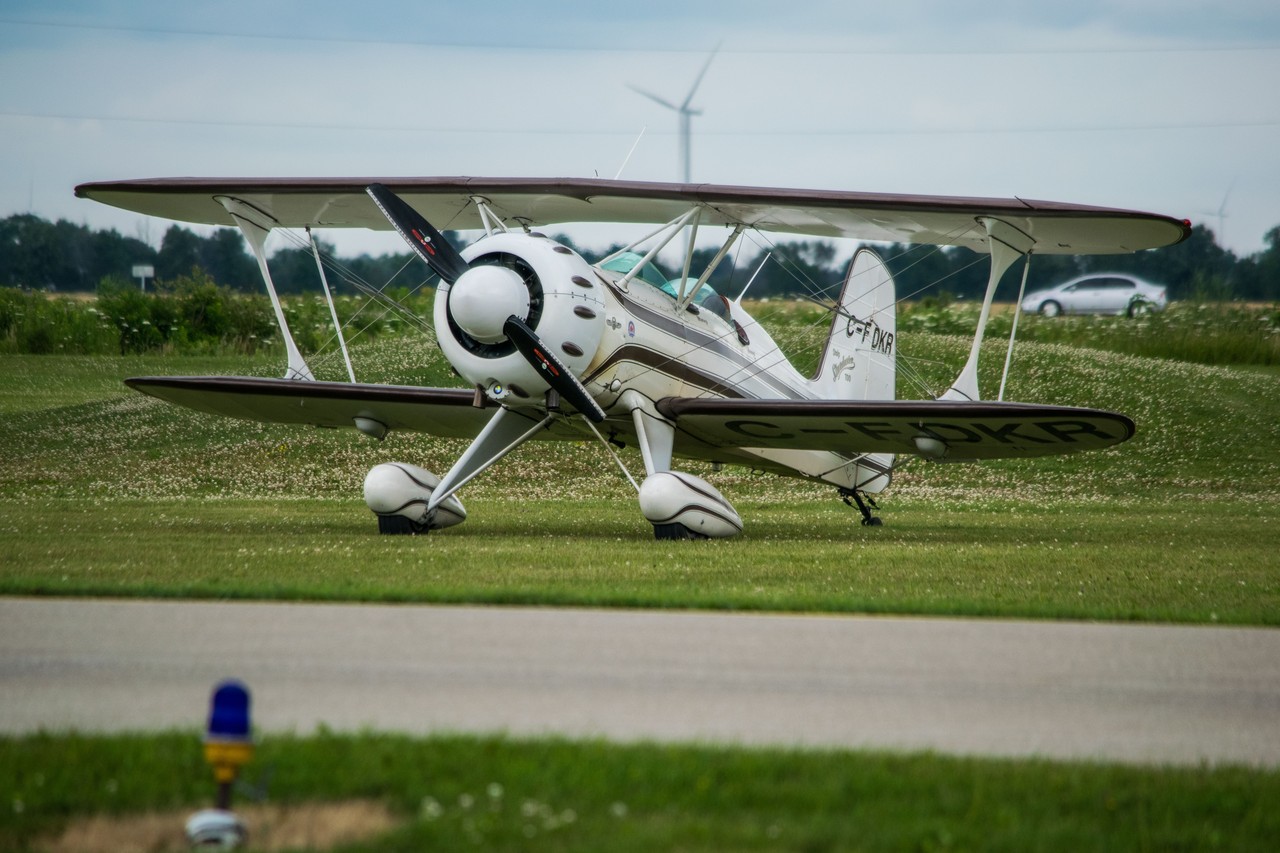
Design Philosophy and Development
Lou Stolp conceived the SA-300 Starduster Too as an evolution of his successful 1957 single-seat SA-100 Starduster, aiming to create an economical two-seat sport biplane accessible to homebuilders. Working through the winter of 1963-1964 in Corona, California, Stolp built the prototype with specific design objectives: providing recreational flying capability with basic aerobatic potential at +6/-6G limits for light weights, though not intended for competition aerobatics.
The prototype's maiden flight in spring 1965 encountered immediate challenges when weight-and-balance issues limited the first hop to a brief flight. Stolp resolved this by relocating the firewall forward 10 inches, establishing the configuration that would define thousands of subsequent aircraft.
The Homebuilt Revolution
Starduster Corporation, operating from Flabob Airport in Rubidoux (now Jurupa Valley), California, launched what became one of general aviation's most successful homebuilt programs. Rather than manufacturing complete aircraft, the company sold construction plans alongside prefabricated components including fuselage weldments, fiberglass parts, and specialized hardware. This approach proved remarkably successful, with over 3,000 sets of plans sold and approximately 650-700 aircraft completed by the 1980s.
The company's business model capitalized on the general aviation boom of the 1960s through 1980s, competing directly with Aircraft Spruce & Specialty Co. for aviation supplies while supporting builders with technical assistance. Individual construction projects varied dramatically in duration, from Jim Snodgrass's focused 26-month build to Neil Reyngoudt's leisurely 20-year project begun in 1972.
Technical Innovation for Amateur Builders
Stolp's design philosophy emphasized construction simplicity without sacrificing performance. The SA-300 featured a 4130 chrome-moly steel tube fuselage with fabric covering, combined with wooden wings using spruce spars and plywood ribs. The wing design incorporated the NACA M-6 airfoil section, shared with famous aircraft including the Waco Taperwing, Gee Bee racers, and Pitts S-1C.
A key innovation was Stolp's use of bolt-in 4130 steel tube Warren truss ribs instead of traditional compression ribs, significantly simplifying construction for amateur builders. The wing design retained the elliptical trailing edges from the original SA-100, contributing to the aircraft's classic biplane aesthetics.
Powerplant Flexibility
While the baseline powerplant specification called for the 180-horsepower Lycoming O-360 horizontally-opposed four-cylinder engine, builders demonstrated remarkable creativity in engine selection. Completed aircraft have flown with powerplants ranging from Continental engines producing 205 horsepower to radial engines including the Jacobs and even the 450-horsepower Pratt & Whitney R-985. Some builders experimented with automotive conversions using Ford V-8 and V-6 engines, though the reliable Lycoming O-360 remained the most popular choice.
Performance and Handling
With typical empty weights between 1,000-1,211 pounds and gross weights of 1,704-1,950 pounds, the Starduster Too achieved cruise speeds of 120-150 mph depending on engine installation and builder modifications. The aircraft's favorable power-to-weight ratio provided spirited takeoff and climb performance, while the conventional fixed landing gear configuration kept maintenance requirements minimal.
Fuel capacity typically consisted of 28 gallons in the fuselage tank plus 15 gallons in wing tanks, though builders often customized fuel systems. One modified example achieved an 830-mile range with 45 gallons of fuel capacity, demonstrating the design's cross-country potential beyond its primary sport flying mission.
Manufacturing Legacy
Starduster Corporation operated through the peak homebuilding decades before transferring rights to Aircraft Spruce & Specialty Co., which continues selling plans and providing parts support today. The original company's influence extended beyond the SA-300, spawning variants including the Acroduster (scaled down 10 percent for +9G capability) and the Acroduster Too.
Current Status
Conservative estimates suggest over 1,000 SA-300 Starduster Too aircraft remain flying today, with many individual aircraft accumulating 2,500-5,000 total hours. The design's enduring popularity reflects its successful balance of construction simplicity, reasonable performance, and classic biplane character that attracted builders during general aviation's golden era and continues appealing to contemporary homebuilders seeking an authentic biplane experience.
The SA-300's cultural significance lies in democratizing biplane ownership during an era when factory-built biplanes had largely disappeared from production, providing recreational pilots access to open-cockpit flying and basic aerobatic capability through amateur construction rather than expensive vintage aircraft acquisition.