
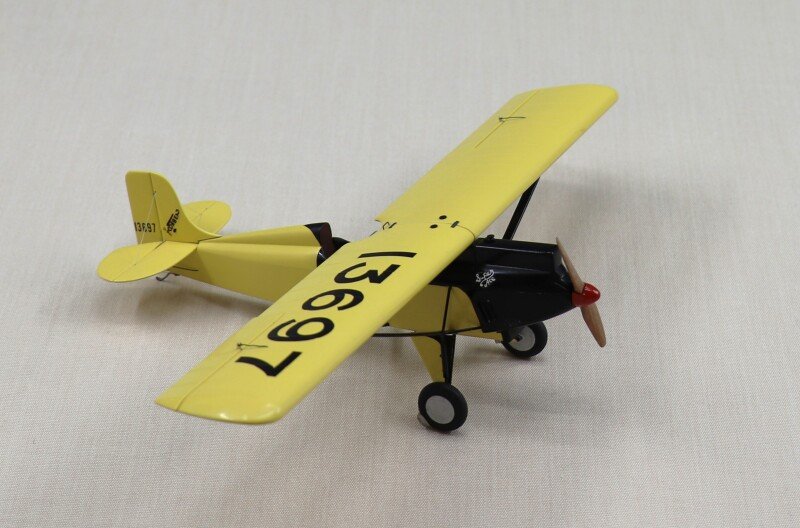
Origins and Design Heritage
The Super Ace traced its lineage to aviation pioneer Orland G. Corben, who established his reputation in 1923 with a vision of creating safe, easy-to-fly, and inexpensive aircraft for average Americans. Corben's Baby Ace debuted in 1928, followed by the Junior Ace in 1929, establishing a foundation of simple parasol monoplane designs that would influence homebuilt aviation for decades.
Paul Poberezny, who would later found the Experimental Aircraft Association, first encountered Corben's work when he built his own Baby Ace for just $67 in materials in 1937. After teaching himself to fly in this aircraft, Poberezny became convinced that homebuilt aviation could democratize flying for ordinary people.
The Pober Era Begins
On December 12, 1953, Poberezny founded the Experimental Aircraft Association, and in November of the same year, he purchased Corben's spare parts inventory and aircraft drawings for the Baby Ace, Junior Ace, and Super Ace for $200. This acquisition marked the beginning of the "Pober" series, as Poberezny modified and remarketed these designs under his own branding from his Wisconsin facilities.
Poberezny's timing proved exceptional. His modified Baby Ace series appeared in Mechanix Illustrated in 1955, sparking renewed interest in homebuilt aircraft construction in post-World War II America. The publication reignited the homebuilding movement that had been dormant during the war years, inspiring thousands of amateur constructors to undertake their own aircraft projects.
Technical Configuration
The Super Ace maintained the fundamental parasol monoplane configuration that had made Corben's earlier designs successful. As a high-wing, single-engine aircraft, it offered the stability and forgiving flight characteristics that made it suitable for sport pilots and amateur builders. The design accommodated either single-seat or two-seat configurations, depending on the builder's preferences and intended use.
The aircraft typically employed a Continental C85 engine, a four-cylinder horizontally opposed air-cooled powerplant that produced 85 horsepower. Continental Motors manufactured the C85 series from the late 1940s through the 1970s, and these engines became popular choices for homebuilt aircraft due to their reliability and reasonable cost. Poberezny recalled purchasing used C85 engines for as little as $25 to $50 in the early days of the homebuilt movement, though costs increased significantly in later decades.
Paul Poberezny's Leadership
Under Poberezny's guidance, the Super Ace became part of a larger ecosystem of amateur aviation that he cultivated through the EAA. Serving as EAA president until 1989 and chairman until 2010, Poberezny authored plans for 15 different aircraft designs, including the Pober Sport and various iterations of the Ace series. His leadership transformed a small group of aircraft builders into an organization that would eventually oversee more than 30,000 Experimental Amateur-Built aircraft in the FAA Registry by 2012.
The Super Ace and other Pober designs gained visibility through EAA publications such as Sport Aviation magazine and Experimenter. A February 1991 issue of Experimenter featured the Super Ace, demonstrating the design's enduring appeal nearly four decades after Poberezny first acquired the rights to the Corben designs.
Production and Distribution
Unlike factory-built aircraft, the Super Ace existed primarily as plans and occasional kits distributed to individual homebuilders. Production of plans continued from 1953 through at least the 1990s, as evidenced by builder receipts from the mid-1990s. This extended availability ensured that new Super Ace aircraft continued to be completed even as aviation technology advanced around them.
The plans-built nature of the Super Ace meant that no central factory produced the aircraft, and consequently, no precise production totals exist. Each aircraft represented an individual builder's interpretation of the basic design, leading to variations in equipment, finish, and sometimes even basic dimensions.
Cultural Impact and Legacy
The Super Ace's significance extended far beyond its individual merits as an aircraft design. It represented a crucial link between the pioneering homebuilt efforts of the 1920s and 1930s and the modern amateur construction movement that emerged in the 1950s. By preserving and promoting Corben's designs, Poberezny helped establish the legitimacy of the Experimental Amateur-Built category with the Federal Aviation Administration.
The aircraft became a regular presence at EAA's annual Oshkosh fly-in, where homebuilt aircraft enthusiasts gathered to share techniques, display their creations, and celebrate amateur aviation. These gatherings helped create a community around homebuilt aircraft that sustained interest in designs like the Super Ace for decades.
Today, while exact numbers of airworthy Super Ace aircraft remain unknown, the design's plans continue to be available through EAA channels. The aircraft's influence lives on through the tens of thousands of homebuilt aircraft that followed in its wake, many of which can trace their conceptual origins to the simple, affordable philosophy that Orland Corben first articulated and Paul Poberezny successfully championed in the modern era.