
Development and Design
The SAH-1 emerged from an unconventional recruitment process when Cornish businessman Mike Robertson, owner of the Trago Mills shopping empire, placed a full-page advertisement in Flight International magazine seeking an aeronautical engineer. Sydney Arthur Holloway responded to the advertisement and was hired to design what would become the SAH-1, with development beginning in 1977. The project aimed to create a modern primary trainer that could potentially replace the RAF's Scottish Aviation Bulldog fleet, which was aging and approaching retirement.
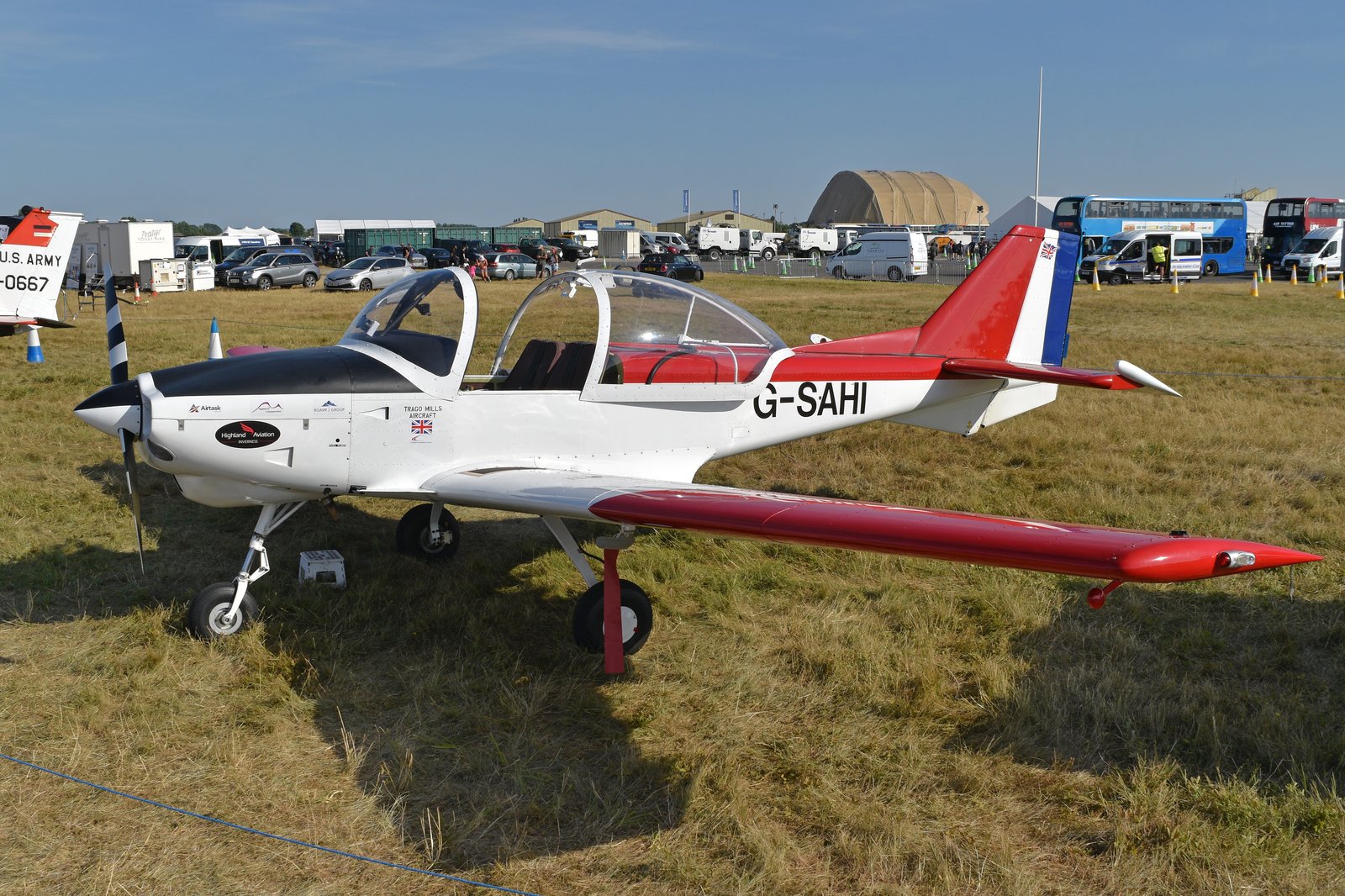
Holloway's design emphasized exceptional handling qualities and full aerobatic capability. The aircraft featured a low-wing configuration with fixed tricycle landing gear and a bubble canopy providing excellent visibility for training operations. The prototype, registered as G-SAHI, incorporated the designer's initials in its registration and first took to the skies from Bodmin airfield on August 23, 1983.
Production Challenges
Trago Mills Ltd built only the single prototype before financial constraints halted production. The escalating development costs during a UK recession in the 1980s strained the company's resources, effectively ending their involvement in aircraft manufacturing after years of investment. The project appeared destined for obscurity with just one aircraft completed.
In the early 1990s, Danish aerospace company FLS Aerospace acquired the rights to both the SAH-1 design and the Edgley Optica aircraft. Between 1993 and 1998, FLS produced five additional aircraft, bringing total production to six units. However, only three complete airframes were actually finished, with three others remaining incomplete when production ceased. FLS marketed their versions as the "Sprint" series, offering the Club Sprint with a 118-horsepower engine and the Sprint 160 with a more powerful 160-horsepower Textron Lycoming AEIO-320-D1B engine aimed at military customers.
Military Ambitions
The SAH-1 was formally submitted for the RAF's trainer replacement program, competing against other designs including the eventual winner, the Slingsby T67 Firefly. Despite receiving universally positive feedback from aviation industry professionals and appearing at prestigious airshows including Farnborough and Dubai, the SAH-1 failed to secure the military contract. The small scale of the operation was cited as insufficient to meet the production capacity requirements for military service.
AFC Bedford, former Chief Test Pilot for BAE Systems at Dunsfold airfield, praised the aircraft as the "Tiger Moth of the 21st Century," highlighting its superb handling characteristics. This endorsement from such a respected test pilot underscored the aircraft's flying qualities, though it was insufficient to overcome the commercial and production limitations.
Technical Specifications
The original prototype underwent extensive testing with various powerplants during FLS Aerospace's development program. The production variants featured the 160-horsepower Textron Lycoming AEIO-320-D1B, an air-cooled, four-cylinder, horizontally-opposed piston engine specifically designed for aerobatic applications. This engine choice provided the power and reliability necessary for training operations while maintaining the aircraft's aerobatic certification.
The aircraft received a full aerobatic UK Certificate of Airworthiness, validating its design for advanced training maneuvers. The fixed tricycle landing gear simplified ground handling and reduced maintenance requirements compared to retractable gear systems, making it more suitable for training environments where frequent landings and takeoffs were expected.
Legacy and Current Status
After military hopes were dashed, the SAH-1 was marketed to civilian flying schools and private pilots. The aircraft garnered attention in aviation publications, being featured in PILOT magazine in 1984 and 1986, Flight International in 1987, and FLYER magazine in 1993 and 2008. Despite positive reviews and excellent flying characteristics, commercial success remained elusive.
The original prototype G-SAHI remains airworthy in private hands and continues to appear at aviation events, including the Royal International Air Tattoo, where it is displayed wearing the RAF markings it was designed to carry. This aircraft represents one of several promising British light aircraft designs from the 1980s that failed to achieve commercial success, joining the ranks of the ARV Super 2 and other innovative but ultimately unsuccessful projects.
The SAH-1's story reflects the challenges faced by small aircraft manufacturers in competing with established companies for military contracts, despite producing aircraft with superior handling characteristics and innovative design features. Today, the aircraft serves as a reminder of Britain's continued innovation in light aircraft design, even as market realities prevented its widespread adoption.