
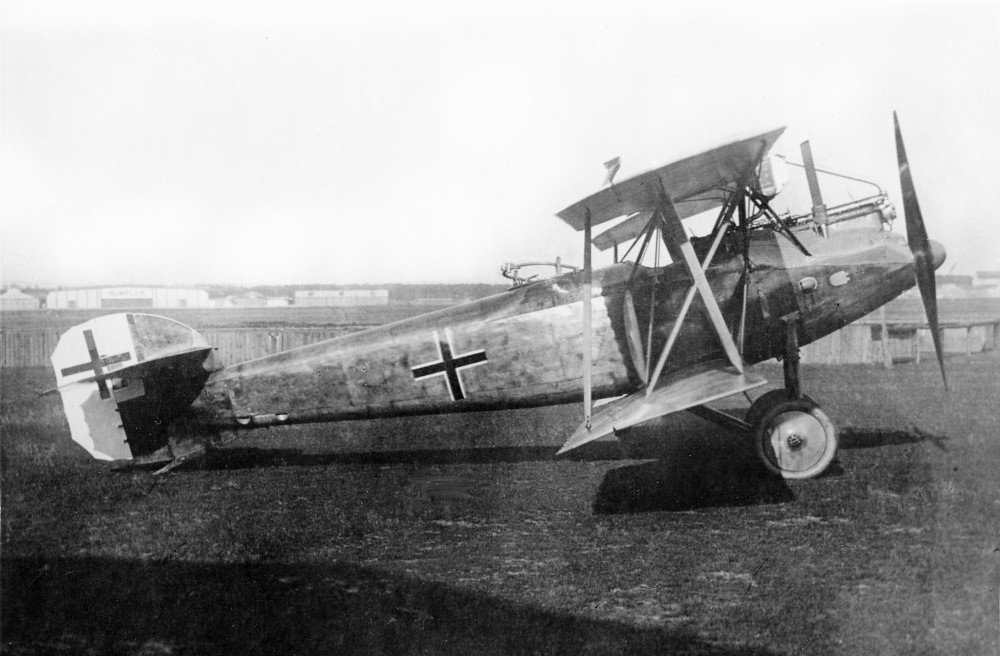
The Sablatnig C.II was a German two-seat reconnaissance aircraft developed and manufactured in 1918 by Sablatnig Flugzeugbau GmbH in Berlin. As a C-type aircraft, it was designed for the Luftstreitkräfte (Imperial German Army Air Service) to perform roles such as aerial observation, photographic missions, and artillery spotting. The aircraft's production was limited, with only a small number of units built during the latter half of 1918 before the Armistice ended aircraft production for the company.
Structurally, the C.II was a conventional two-bay biplane featuring staggered wings and a fixed undercarriage with a tailskid. The airframe utilized wooden construction, consisting of a plywood-covered fuselage and fabric-covered wings and control surfaces. The crew consisted of two members seated in tandem open cockpits, with the pilot in the forward position and the observer/gunner in the rear. To refine the design, Sablatnig produced at least two additional prototypes that featured different elevators and strut arrangements. One experimental version also included a "tunnel-type radial" detail, likely related to the airflow or radiator configuration.
Power was provided by a single Maybach Mb.IV liquid-cooled, inline six-cylinder piston engine manufactured by Maybach-Motorenbau GmbH. This engine provided a significant power increase over the earlier Sablatnig C.I, with output rated between 180 kW (240 hp) and 245 hp. The engine drove a two-bladed fixed-pitch wooden propeller. In terms of performance, the C.II reached a maximum speed of 150 km/h and had a service ceiling of 5,000 m. It could climb to 1,000 m in 4 minutes and 30 seconds, with a maximum range of 530 km.
For defense and offense, the aircraft was equipped with one fixed, forward-firing Spandau machine gun for the pilot and one flexible Parabellum machine gun on a ring mount for the observer. While designed for the German air service, there are no surviving records of specific operational units or combat actions involving the type. Following the end of World War I, Sablatnig Flugzeugbau GmbH ceased aircraft production and is no longer active today. No examples of the C.II are known to survive in museums or flying condition.