
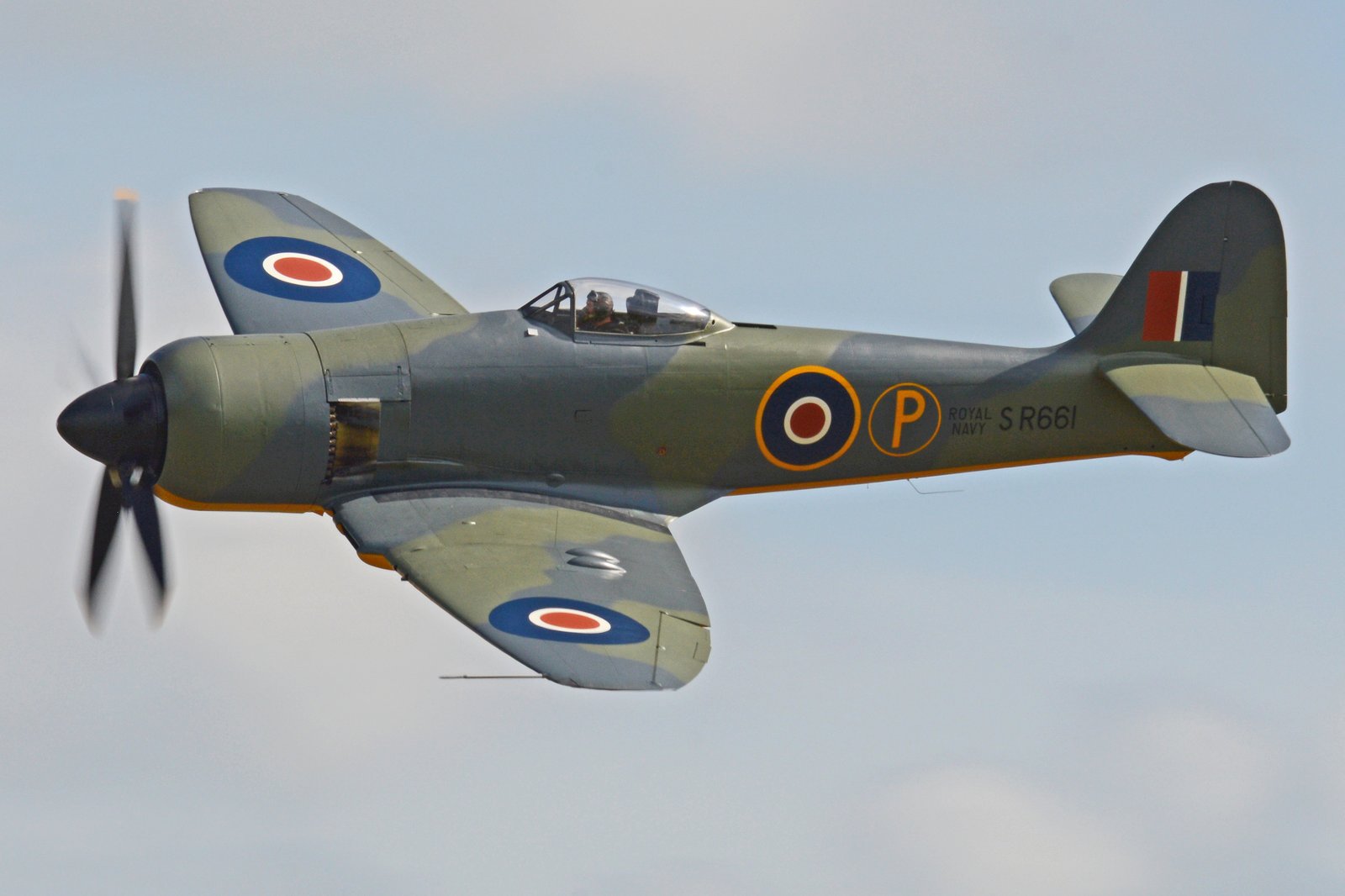
Design and Development
The Hawker Sea Fury was designed by Sir Sydney Camm, the chief designer at Hawker Aircraft and the creator of the Hurricane, Typhoon, and Tempest. Development began in 1943 to meet an RAF requirement for a lightweight fighter derived from the Tempest, initially designated as the Hawker Fury. While the land-based Fury prototype first flew on September 1, 1944, a navalized version was developed for the Royal Navy's Fleet Air Arm (FAA). The first Sea Fury prototype took flight on February 21, 1945, followed by the first production Sea Fury F.X (serial TF895) on September 7, 1946. The aircraft was cleared for operational use on July 31, 1947, following trials at Boscombe Down.
Technical Specifications
As a carrier-borne aircraft, the Sea Fury featured a sturdy all-metal monoplane construction with folding wings, an arrester hook, and catapult spools. It was powered by the Bristol Centaurus, an air-cooled 18-cylinder two-row sleeve-valve radial engine produced by the Bristol Engine Company. This combination of a powerful engine and a clean, compact aerodynamic airframe made the Sea Fury one of the fastest production piston-engined fighters ever constructed. The aircraft was configured as a single-seat fighter, though two-seat trainer variants, such as the T.20, were also produced.
Production and Manufacturer
Designed and built by Hawker Aircraft Limited, the Sea Fury represented the culmination of Hawker's piston-fighter lineage. Total production for the Fury and Sea Fury family is estimated at approximately 864 aircraft, with the FB.11 fighter-bomber serving as the primary production variant with 615 units built. Hawker Aircraft later became part of the Hawker Siddeley Group, which eventually merged into the modern BAE Systems plc.
Operational Service
The Sea Fury entered FAA service in September 1947, with the F.X variant arriving first and the FB.11 following in May 1948. The Royal Canadian Navy's 803 Squadron was the first operational unit to equip with the type in August 1947. The aircraft saw significant combat during the Korean War, operating from carriers such as HMS Glory, HMS Theseus, HMS Ocean, and HMAS Sydney. Notably, the Royal Australian Navy's Sea Furies flew 2,366 sorties over a four-month period starting in October 1951. The type also proved capable of engaging early jet aircraft, including the downing of a MiG-15 in August 1952. Beyond the UK and Commonwealth, the Sea Fury was operated by Canada, Burma, Egypt, Iraq, Pakistan, West Germany, and Cuba. Cuban Sea Furies were notably used against invading forces during the 1961 Bay of Pigs Invasion.
Legacy
The Sea Fury was the last propeller-driven fighter to serve with the Royal Navy, with the final FAA unit, 1832 Squadron, transitioning to jet-powered Supermarine Attackers in 1955. Following military retirement, many aircraft entered the civil sector. Today, several remain airworthy as heritage warbirds and competitive air racers, including the T.20 trainer VX281.