
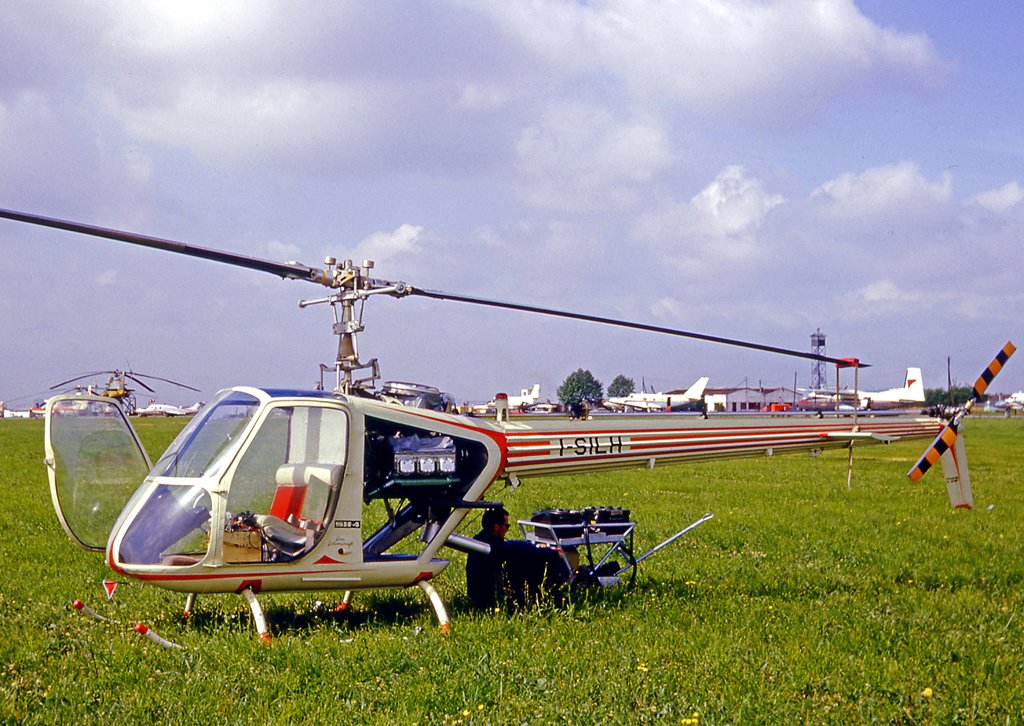
Development and Manufacturing
Silvercraft SpA, established in Italy in 1962, developed the SH-4 with significant financial and technical support from SIAI-Marchetti, one of Italy's premier aerospace manufacturers. The collaboration proved essential, as Silvercraft lacked the resources to independently bring the helicopter to market. Five prototypes were constructed at SIAI-Marchetti's Sesto Calende facility between 1965 and 1968, with the pre-production model making its public debut at the 1967 Paris Air Show.
The development team designed the SH-4 as a highly economical multi-role aircraft capable of serving in training, utility, survey, police, ambulance, military liaison, and observation roles. This versatility was crucial for a light helicopter entering a competitive market dominated by established American manufacturers.
Technical Design and Powerplant
The SH-4 employed conventional helicopter architecture with all-metal construction throughout. Its most distinctive feature was the high-mounted tubular corrugated tailboom, which provided structural strength while minimizing weight. The two-bladed rotor system kept mechanical complexity and maintenance requirements to a minimum.
Powerplant options centered on Franklin Engine Company's 6A-350 series flat-six air-cooled engines. The standard variant utilized the 200-horsepower Franklin 6A-350, while an upgraded version featured the 235-horsepower Franklin 6A-350-D1B, flat-rated to 170 horsepower for extended engine life. Some aircraft received 205-horsepower Lycoming LHIO-360-C1A engines, designated as the SH-4L variant. A turbine-powered SH-4T was also developed, though production details remain limited.
Performance and Specifications
The SH-4 achieved a maximum speed of 100 miles per hour and cruised at 73 miles per hour, typical performance for light piston helicopters of the era. With a service ceiling of 15,100 feet and the ability to hover at 9,800 feet in ground effect, it demonstrated respectable high-altitude capabilities. The aircraft's 200-mile range and 3-hour endurance made it suitable for extended patrol and survey missions.
Maximum takeoff weight reached 1,900 pounds, with an empty weight of 1,142 pounds, providing a useful load of 758 pounds. The 34-gallon fuel capacity balanced range requirements against payload capacity, a critical consideration for operators requiring maximum flexibility.
Variants and Special Applications
The SH-4A agricultural variant represented a significant departure from the standard configuration, equipped with spray tanks and boom systems capable of carrying 53 gallons of chemicals. This variant addressed Italy's growing agricultural aviation market, where helicopters offered advantages over fixed-wing aircraft in treating irregular terrain and small fields.
The experimental SH-200, first flown in April 1977, represented an attempt to modernize the design. This two-seat development incorporated lessons learned from a decade of SH-4 operations but remained a prototype as Silvercraft's financial situation deteriorated.
Military Evaluation and Service
The Italian Air Force acquired two aircraft for evaluation, with one delivered specifically for testing purposes. The military assessment examined the SH-4's suitability for liaison, observation, and training roles, competing against established designs from Bell and Agusta. While the evaluation confirmed the helicopter's basic airworthiness and performance, no large-scale military orders materialized.
The limited military adoption reflected both budgetary constraints and the Italian Air Force's preference for proven designs during a period of modernization. However, the successful certification process demonstrated that Italian industry could produce helicopters meeting international safety standards.
International Sales and Legacy
Despite its Italian origins, the SH-4 found customers in Brazil, South Africa, France, and the Netherlands. These export sales, while modest in number, validated the design's international appeal and demonstrated that smaller aviation companies could compete in specialized market segments.
Production ceased in the late 1970s when Silvercraft SpA terminated aircraft manufacturing operations. The company's departure from aviation ended Italy's first indigenous helicopter program, though the technical knowledge gained contributed to subsequent Italian rotorcraft development.
Historical Significance
The Silvercraft SH-4's primary legacy lies not in production numbers but in breaking new ground for Italian aviation independence. As the first helicopter of entirely Italian design and construction to receive both domestic and FAA certification, it established precedents for regulatory approval and demonstrated Italian technical capability in rotorcraft design.
While only 50 examples were completed, the SH-4 program provided valuable experience that influenced later Italian helicopter projects. The collaboration between Silvercraft and SIAI-Marchetti also established patterns of cooperation that would characterize Italian aerospace development in subsequent decades, proving that innovative design and international partnerships could overcome the limitations of smaller domestic markets.