
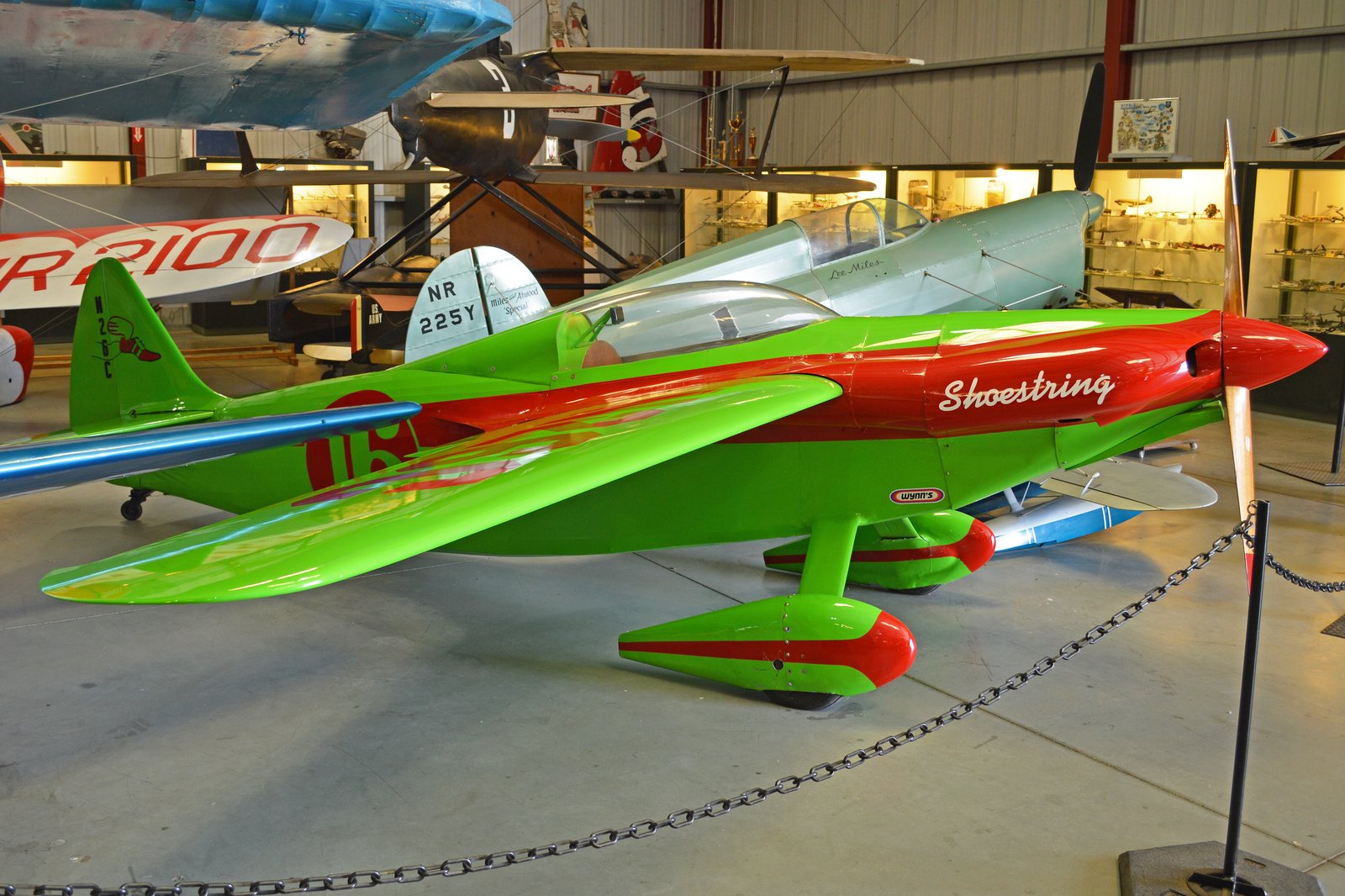
Racing Dominance
The Shoestring established itself as a formidable competitor in American air racing by capturing the 1951 Continental Trophy Race, demonstrating the effectiveness of its meticulous design and construction. The aircraft competed in the Midget Class racing category, which had been introduced at the 1947 Cleveland National Air Races as an affordable alternative to unlimited-class racers. These compact racing machines immediately gained popularity among pilots seeking competitive performance without the enormous costs associated with larger racing aircraft.
By the late 1960s, the Shoestring continued its racing career under new ownership when Ray Cote acquired the aircraft in 1967. Cote campaigned the racer at the Reno Air Races, where the former Midget Class had been incorporated into the newly established Formula 1 Class racing category, extending the aircraft's competitive lifespan well beyond its original racing era.
Manufacturing Excellence
MERCURY Aviation produced the Shoestring as a limited-production custom racing aircraft rather than a mass-manufactured design. Contemporary observers consistently praised the aircraft's exceptional build quality, with aviation writers describing its design and workmanship as being of the finest quality and often comparing it to a precision scale model airplane. This attention to detail reflected the specialized nature of air racing, where marginal gains in aerodynamic efficiency and structural optimization could determine victory or defeat.
The manufacturer's focus on quality over quantity resulted in very limited production numbers, though exact figures remain undocumented in surviving records. Each Shoestring represented a significant investment in both engineering expertise and precision manufacturing techniques.
Engine and Technical Innovation
The Shoestring's powerplant consisted of a Continental C-85 air-cooled engine that had been converted to O-200 specifications, providing the optimal balance of power and weight for competitive racing. Continental Motors' C-85 series engines were widely used in general aviation applications, but the conversion to O-200 specifications enhanced performance characteristics specifically for racing applications.
The aircraft's compact dimensions reflected the engineering philosophy of minimizing drag while maintaining structural integrity under racing conditions. At 17 feet 9 inches in length and standing just 6 feet 1 inch high, the Shoestring presented a minimal frontal area to reduce parasitic drag. The 19-foot wingspan provided sufficient lift generation while keeping induced drag to acceptable levels for high-speed flight.
Performance Characteristics
With a maximum speed of 240 mph, the Shoestring delivered impressive performance for an aircraft weighing less than 800 pounds. The racer achieved a service ceiling of 24,500 feet, demonstrating its capability for high-altitude operations, while maintaining a practical range of 360 miles for cross-country racing events. These performance figures placed the Shoestring among the most capable aircraft in its racing class during the 1950s.
The single-pilot configuration optimized weight distribution and allowed for maximum fuel capacity within the aircraft's compact airframe. Racing pilots appreciated the Shoestring's responsive handling characteristics and predictable flight behavior, essential qualities for competitive racing where precise aircraft control determined race outcomes.
Legacy and Preservation
The Shoestring's racing career represents an important chapter in American motorsport aviation, documenting the evolution from post-war surplus military aircraft racing to purpose-built racing machines. The aircraft's success in the 1951 Continental Trophy Race and subsequent competition history illustrate the viability of specialized racing aircraft designed from the ground up for competitive performance rather than adapted from existing designs.
Today, the Shoestring is preserved in static display at the Planes of Fame Air Museum, where it serves as a tangible reminder of mid-20th century air racing heritage. The museum's decision to acquire and display this particular aircraft reflects its historical significance in documenting the development of Formula 1 air racing and the engineering innovations that emerged from competitive aviation during the 1940s and 1950s.
The Shoestring's preservation ensures that future generations can study the design philosophy and construction techniques that characterized the golden age of American air racing, when small aircraft manufacturers could compete successfully against larger aviation companies through superior engineering and meticulous attention to detail.