
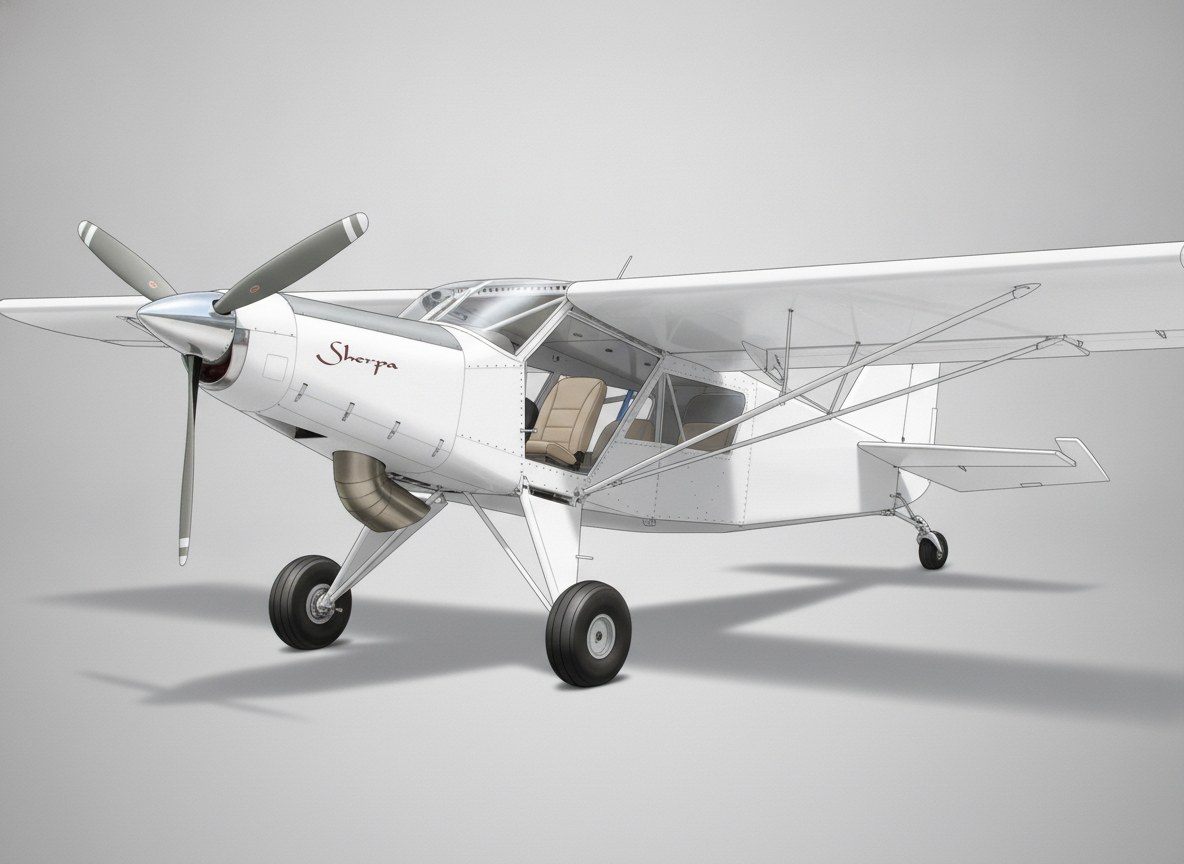
Development and Design Philosophy
Byron Root and Glen Gordon conceived the Sherpa series as a "Piper Cub on steroids," targeting operators requiring maximum utility in challenging environments. The original five-seat Sherpa debuted at EAA Oshkosh in 1994, establishing the foundation for what would evolve into the more capable K-650T variant. Over 25 years of development saw multiple iterations, including transitions from piston to turboprop powerplants and extensive wing redesigns to optimize performance.
The K-650T represented the culmination of this extended development process, featuring a completely redesigned wing spanning over 44 feet compared to the original 42-foot-7-inch span. This new wing incorporated ten fuel tanks and provided the structural foundation for the aircraft's 6,500-pound gross weight, nearly 2,000 pounds heavier than the piston-powered K500 variant at 4,750 pounds.
Powerplant and Performance
The heart of the K-650T was its Honeywell TPE331-5 turboprop engine, formerly manufactured by Garrett before Honeywell's acquisition. This powerplant delivered between 740 and 890 shaft horsepower through a 116-inch Hartzell three-blade propeller operating at 1,591 rpm. The combination provided exceptional static thrust essential for short-field operations while maintaining surprisingly economical fuel consumption at 14.3 gallons per hour during test conditions.
Flight testing revealed true airspeeds reaching 148 knots at 72 percent power settings, with indicated airspeeds of 128 knots. The turboprop installation offered instant power delivery crucial for bush operations, while the direct-drive configuration simplified maintenance requirements compared to geared turboprop alternatives.
Production Challenges and International Expansion
Sherpa Aircraft Manufacturing, owned by Glen Gordon, announced an ambitious builder-assist program around 2006-2007 for constructing 12 K-650T aircraft at their Scappoose, Oregon facility. By 2011, at least one completed aircraft had achieved flight status, with the company promoting kit assembly times of nine months for customer-built examples.
Recognizing the need for expanded manufacturing capacity and certification funding, Sherpa Aircraft formed the Ying-Kou Sherpa joint venture on January 4, 2013. This Chinese partnership aimed to achieve both FAA and Chinese aviation authority certifications within 24 months while establishing local production capabilities. The company maintained its Oregon operations for U.S. sales while exploring additional manufacturing partnerships, including discussions with a Florida-based group interested in military applications.
Market Positioning and Commercial Prospects
The K-650T targeted the specialized utility aviation market with its eight-seat configuration and 3,000-pound useful load capacity. Sherpa Aircraft positioned the aircraft for operations requiring maximum flexibility, offering compatibility with tundra tires, skis, or floats depending on operational requirements. The high-wing configuration provided excellent ground clearance and simplified maintenance access in remote locations.
Pricing for the experimental kit version reached $1.3 million by 2013, reflecting the sophisticated turboprop powerplant and robust construction standards. The company delivered one aircraft to a customer in the Experimental category, with additional deliveries planned on six-week schedules from the February 2013 timeframe.
Certification Efforts and Legacy
Despite substantial investment in Chinese partnerships and certification programs, the K-650T's path to type certification remained incomplete beyond the initial 2013-2015 timeframe. The aircraft represented a niche approach to utility aviation, competing in a market dominated by established manufacturers with existing certification and support networks.
The Sherpa K-650T exemplified the challenges facing innovative general aviation manufacturers attempting to introduce new turboprop designs. While the aircraft demonstrated sound engineering principles and addressed genuine market needs for high-capacity utility aircraft, the combination of certification costs, limited production volumes, and specialized market requirements constrained its commercial success.
Today, the K-650T stands as an example of ambitious general aviation development during the 2000s boom period, when numerous manufacturers attempted to fill perceived market gaps with innovative designs. The 12-aircraft production commitment represents the extent of known manufacturing, with the current operational status of completed examples remaining undocumented in available records.