
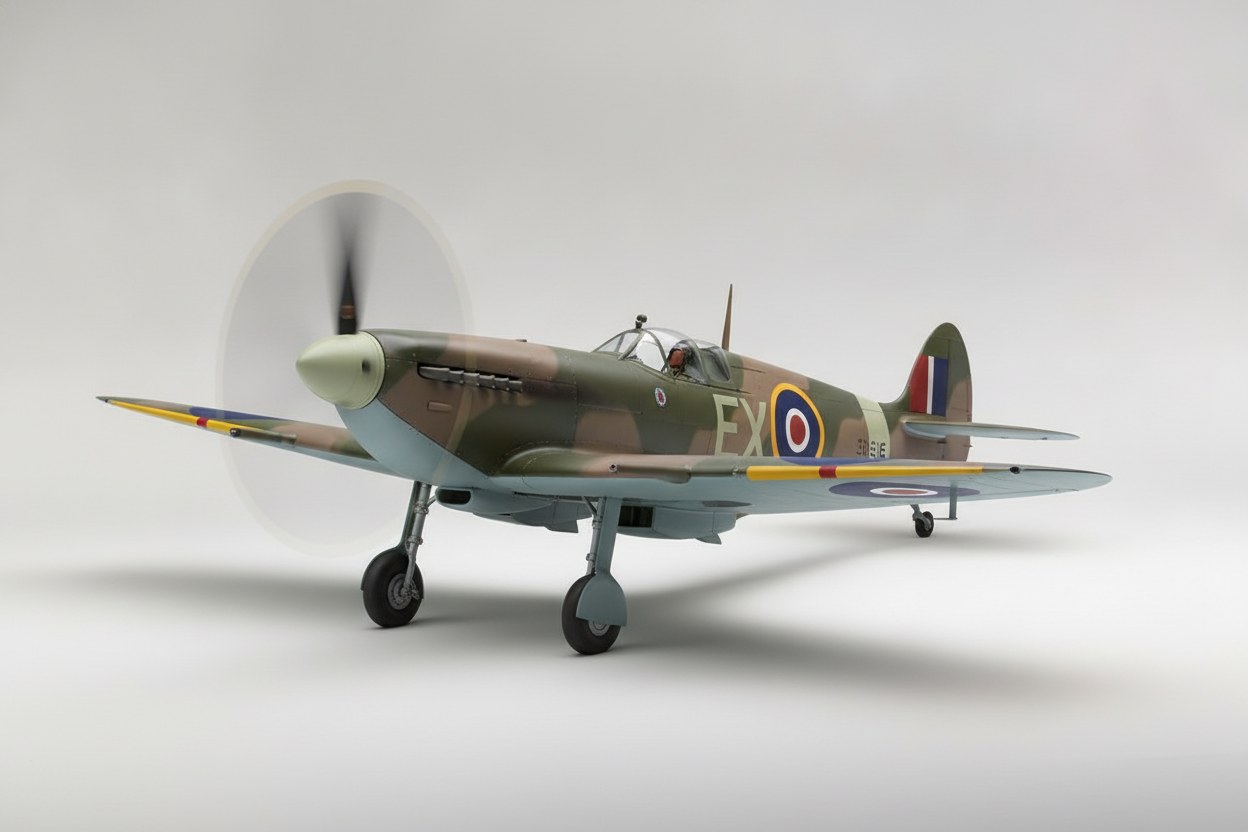
The Manufacturer's Vision
Loehle Aircraft, operating from 1977 to 2017, carved out a specialized niche in the experimental aircraft market by producing affordable three-quarter scale replicas of famous World War II fighters. The company's founder recognized that while many pilots dreamed of flying authentic warbirds, the reality of million-dollar price tags and complex maintenance requirements put such aircraft beyond most aviators' reach. Loehle's solution was to create scaled-down versions using modern materials and lightweight engines that captured the essence of these legendary aircraft while remaining accessible to homebuilders.
The Spitfire Elite, introduced in 1998, represented the pinnacle of Loehle's replica series. Priced at $34,995, the kit commanded a premium over the company's other offerings, reflecting both the complexity of reproducing the Spitfire's elliptical wing design and the enhanced performance specifications that earned it the "Elite" designation. While Loehle had achieved modest success with their P-51 Mustang replica, producing 102 examples by 2007, the Spitfire Elite proved to be a commercial disappointment with only one kit ever sold.
Engineering the Replica
The challenge of scaling down Reginald Mitchell's iconic Spitfire design required careful engineering to maintain the aircraft's distinctive appearance while accommodating modern powerplant and construction techniques. Loehle's designers retained the characteristic elliptical wing planform and sleek fuselage lines that made the original Spitfire instantly recognizable, but adapted the structure for amateur construction using conventional materials rather than the stressed-skin aluminum construction of the original.
The heart of the Spitfire Elite was the Austrian-built Rotax 582 engine, a liquid-cooled two-cylinder two-stroke powerplant that had become the standard for ultralight and light sport aircraft. Producing 45 horsepower, the Rotax 582 offered a favorable power-to-weight ratio and simplified maintenance compared to traditional four-stroke aviation engines. This engine choice allowed the replica to achieve a cruise speed of approximately 140 miles per hour, significantly faster than Loehle's earlier Mustang replica which cruised at just 80 miles per hour.
Market Challenges
Despite its technical merits, the Spitfire Elite faced significant market headwinds that ultimately contributed to its commercial failure. The late 1990s homebuilt market was increasingly competitive, with numerous manufacturers offering replica fighters and sport aircraft. The $34,995 price point, while reasonable for the complexity involved, positioned the kit in direct competition with other replica aircraft that had proven track records and larger builder support networks.
Moreover, the Spitfire's complex curves and compound angles presented a more challenging build compared to aircraft with simpler geometric forms. While experienced builders might relish such a project, the majority of kit aircraft purchasers were first-time builders seeking straightforward construction experiences. The single kit sale suggests that potential customers may have been deterred by the perceived complexity or uncertain resale value of such a rare aircraft.
The Rotax 582 Powerplant
The choice of the Rotax 582 engine reflected the practical realities of homebuilt aircraft economics in the 1990s. Manufactured by BRP-Rotax in Austria from 1984 to 2019, this engine became ubiquitous in the ultralight and light sport aircraft markets due to its reliability, light weight, and reasonable cost. The liquid-cooled design provided consistent operating temperatures, while the two-stroke configuration delivered impressive power-to-weight ratios compared to four-stroke alternatives.
For the Spitfire Elite application, the Rotax 582's 45-horsepower output provided adequate performance for a single-seat sport aircraft weighing significantly less than the original 5,280-pound Spitfire. The engine's modular design simplified installation and maintenance, critical factors for amateur builders who might lack access to specialized aviation maintenance facilities.
Legacy and Current Status
The closure of Loehle Aircraft in 2017 marked the end of an era in replica aircraft manufacturing. The company's 40-year run had produced hundreds of kits across multiple aircraft types, though none achieved the commercial success of mainstream homebuilt designs like the Van's Aircraft RV series or Glasair models. The Spitfire Elite, as the rarest of Loehle's offerings, represents a unique footnote in experimental aviation history.
The fate of the single Spitfire Elite kit remains unknown, though given the specialized nature of the aircraft and the cessation of factory support, it seems unlikely that many examples remain airworthy today. Unlike more common experimental aircraft, owners of rare kits like the Spitfire Elite face ongoing challenges in obtaining parts, technical support, and qualified maintenance assistance.
The Spitfire Elite's story illustrates the challenges facing niche aircraft manufacturers in the experimental market. While the engineering and craftsmanship may be exemplary, commercial success requires not just a quality product but also market timing, pricing strategy, and ongoing support infrastructure that can sustain builders through multi-year construction projects.