
Design and Development
The Sportster emerged from Rearwin's ambition to create a practical sport and business aircraft for the growing civilian aviation market. Company founder R.A. Rearwin, who had been designing light aircraft since 1928, contracted the initial design work to Henry Weeks of Stevenson-Weeks Air Service while the company focused on certifying their earlier Speedster model.
The aircraft underwent significant modifications during its development. In 1936, at the request of George B. Cluett, the Sportster was certified for pontoon operations, but this required enlarging the vertical tail after the test aircraft nearly failed to recover from a flat spin. Additional refinements in 1939 aimed to boost declining sales.
Production and Manufacturing
Rearwin manufactured approximately 260 Sportsters between 1935 and 1941 at their facility at Fairfax Airport in Kansas City, Missouri. This represented one-third of the company's total production of 787 aircraft. The outbreak of World War II and subsequent production demands forced cessation of Sportster manufacturing in 1941.
The aircraft's appeal extended internationally. Between 1938 and 1943, A.B. Götaverken Shipbuilding Company built 14 aircraft under license in Sweden, designated GV-38. These Swedish variants utilized Warner or Ken-Royce engines, with one later retrofitted with a Continental O-190 horizontally-opposed engine.
Engine Evolution
The Sportster's powerplant options reflected the evolving light aircraft engine market. The Model 8500 featured an 85-horsepower LeBlond 5DI five-cylinder radial engine, while later variants used the 90-horsepower LeBlond 5F. In 1938, Rearwin acquired the LeBlond engine works and rebranded the powerplants as Ken-Royce engines, with the Model 9000-KR utilizing the Ken-Royce 5DF producing 90 horsepower.
Military Service
Though designed for civilian use, the Sportster saw limited military service during World War II. The U.S. Army Air Forces acquired two examples of the 9000-KR model, designating them UC-102 for light utility transport duties.
Commonwealth air forces also impressed civilian Sportsters into wartime service. The Royal New Zealand Air Force acquired at least two aircraft—ZK-AIP and ZK-AKA—which received military serial numbers NZ565 and NZ569 respectively. Rearwin also developed the 9000-KRT variant, a modified Sportster configured as an instrument trainer.
International Operations
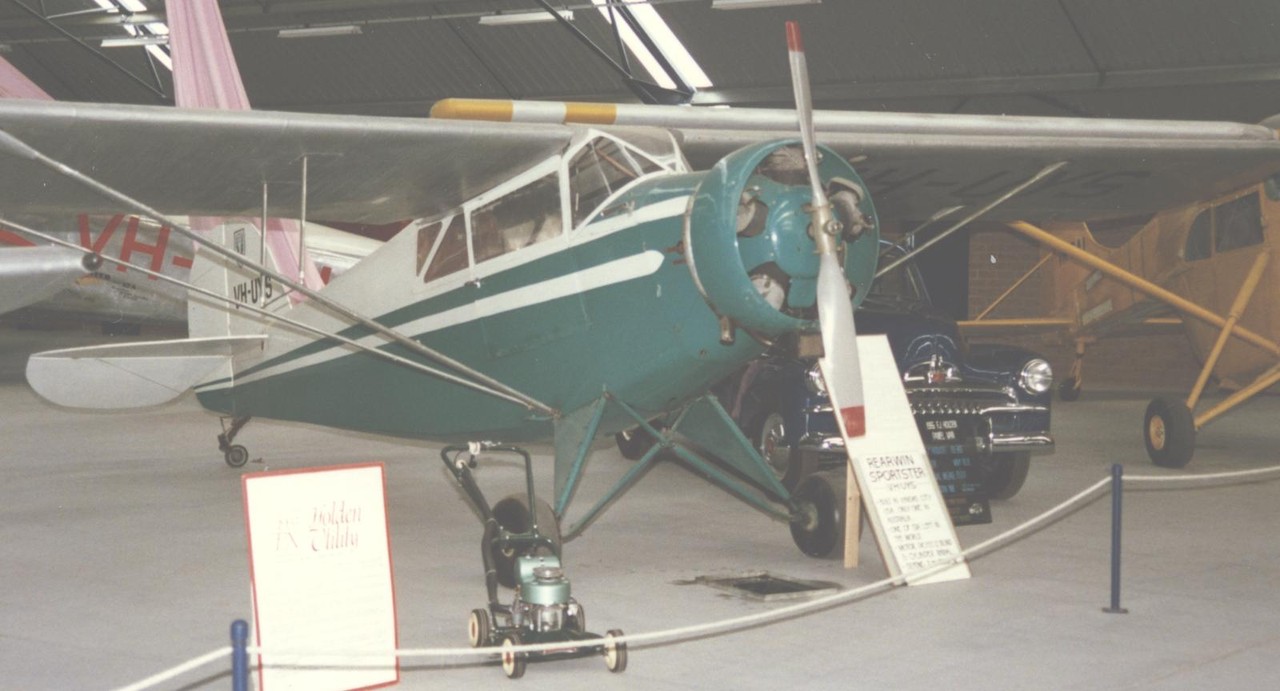
The Sportster established a global presence in civilian aviation. Four aircraft operated in Australia, including VH-UYS (construction number 535D), a Model 9000L registered in June 1937. After retirement in 1972, this aircraft was restored to airworthiness in Queensland in 1999, demonstrating the type's enduring appeal.
New Zealand became a significant operator, with multiple aircraft serving civilian aero clubs including the Te Kukiti Aero Club and Auckland Aero Club. Several of these aircraft transitioned to military service during the war before returning to civilian operations.
Performance and Specifications
The Model 7000 Sportster measured 22 feet 3 inches in length with a 35-foot wingspan and stood 6 feet 9 inches tall. Its 166 square feet of wing area supported an empty weight of 830 pounds and maximum gross weight of 1,410 pounds. The tandem two-seat configuration placed pilot and passenger one behind the other in an enclosed cabin.
Performance figures demonstrated the aircraft's touring capabilities: maximum speed reached 116 mph with a range of 480 miles and service ceiling of 15,200 feet. These specifications made the Sportster competitive with contemporary light aircraft while maintaining operational economy.
Legacy and Preservation
Multiple Sportsters survive today in various stages of restoration and operation. Beyond the restored VH-UYS in Australia, New Zealand's Sport and Vintage Aviation Society has undertaken restoration projects on several examples including ZK-AGQ. These preservation efforts maintain the type's representation in aviation museums and airshows.
The Sportster represents a significant chapter in 1930s American light aircraft development, demonstrating the era's emphasis on practical, affordable aviation for civilian markets. Its design evolution—particularly the aerodynamic lessons learned from spin testing—contributed to improved understanding of light aircraft safety during the critical interwar period of aviation development.