
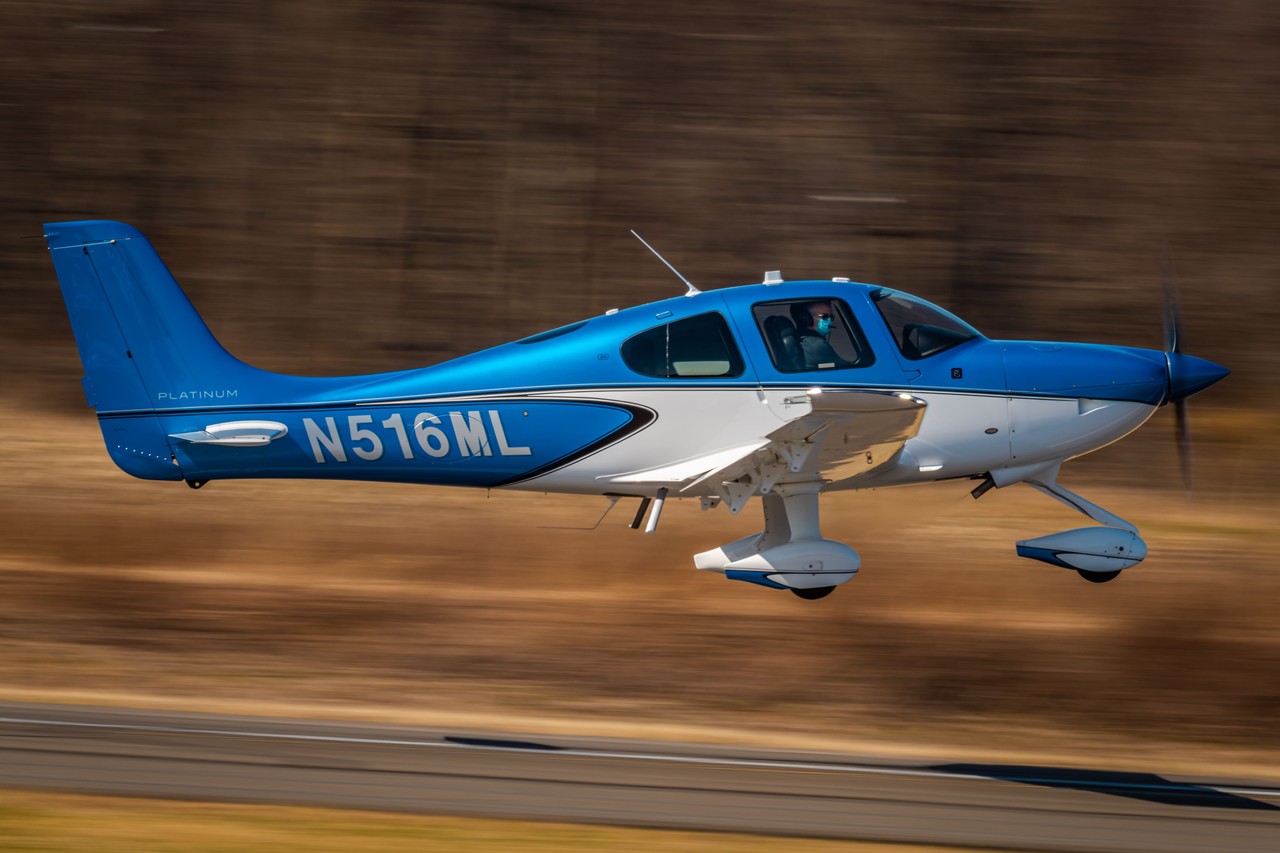
Revolutionary Safety Innovation
The SR20's most groundbreaking feature was the Cirrus Airframe Parachute System (CAPS), making it the first certified aircraft where the entire plane could be lowered to earth by parachute in an emergency. This system, combined with the aircraft's all-composite construction, established new paradigms in general aviation that competitors would eventually follow. The aircraft received FAA certification in October 1998, with first deliveries beginning in 1999.
Service History and Market Impact
Since entering service in 1999, more than 1,800 SR20 aircraft have been delivered worldwide, serving diverse roles from private ownership to professional flight training. The aircraft found particular favor with flying schools globally, while also attracting corporate users seeking modern avionics and enhanced safety features. The United States Air Force Academy selected a modified version designated T-53A for cadet flight training, featuring revised avionics and restraint systems. Both French Air Force and Navy academies similarly adopted the SR20 for their training programs.
The SR20's success in the marketplace demonstrated that general aviation buyers were ready to embrace new technology and pay premium prices for enhanced safety features. Its combination of modern systems and user-friendly design helped attract pilots who might otherwise have been intimidated by traditional aircraft complexity.
The Manufacturer
Cirrus Aircraft emerged from humble beginnings in 1988 with the VK-30, a kit-built composite aircraft that sold approximately 40 units before being discontinued in the mid-1990s. The company's founders recognized the potential for factory-built composite aircraft and expanded operations in 1994 to a 30,000 square foot research facility in Duluth, Minnesota, while establishing composite production capabilities in Grand Forks, North Dakota.
The transition from kit aircraft to certified production represented a massive undertaking for the relatively small company. Cirrus invested heavily in manufacturing infrastructure, eventually operating from a 111,000 square foot facility in Duluth. The company's gamble on advanced technology and composite construction proved prescient, establishing Cirrus as a major force in general aviation.
Engine and Technical Specifications
The SR20 utilizes a Lycoming IO-360 four-cylinder piston engine, a proven powerplant that nonetheless presented initial challenges in the SR20 installation. Early production aircraft experienced problems with hard starting and starter failures, issues that Cirrus addressed through fuel system modifications and improved procedures.
The aircraft's technical innovations extended far beyond the parachute system. The SR20 introduced the first primary flight display in a certified light aircraft, featuring a 10-inch multi-function display that would become standard throughout the industry. Side-mounted control yokes replaced traditional center-mounted controls, providing better cockpit ergonomics and instrument visibility.
Composite construction allowed Cirrus engineers to optimize the airframe's strength-to-weight ratio while creating smoother external surfaces than traditional aluminum construction. This manufacturing approach, while more expensive than conventional methods, provided superior corrosion resistance and allowed complex curved shapes that improved both aesthetics and aerodynamics.
Tragedy and Triumph
The SR20's development was marked by tragedy when Scott D. Anderson, Cirrus's chief test pilot, was killed in 1999 during a test flight of the first production aircraft. Ironically, Anderson had been the lead test pilot for the CAPS parachute system certification, but his aircraft was not yet equipped with the life-saving device he had helped develop. This accident underscored the importance of the safety systems Cirrus was pioneering.
Despite this setback, the SR20 achieved its certification milestones and entered production. The aircraft's success enabled Cirrus to develop the more powerful five-seat SR22, which received FAA certification in November 2000. The SR22 became the world's best-selling general aviation aircraft in 2002 and has maintained that distinction annually since then.
Evolution and Legacy
The SR20 served as the foundation for an entire aircraft family that has achieved more than 10,000 deliveries by mid-2024. Through seven generations of development from G1 in 1998 through G7 in 2025, the basic SR20 design has incorporated continuous improvements in avionics, performance, and manufacturing quality.
Cirrus's success with the SR series enabled expansion into jet aircraft with the SF50, the first single-engine civilian jet certified by both FAA and EASA in 2016. With over 500 SF50 aircraft delivered, Cirrus demonstrated that the innovative approach pioneered with the SR20 could succeed across multiple aircraft categories.
Today, the SR20 continues in production alongside its more powerful siblings, serving as an entry point into modern general aviation. The aircraft's influence extends far beyond its own production numbers, having established new expectations for safety systems, avionics integration, and manufacturing quality that transformed the entire light aircraft industry.