
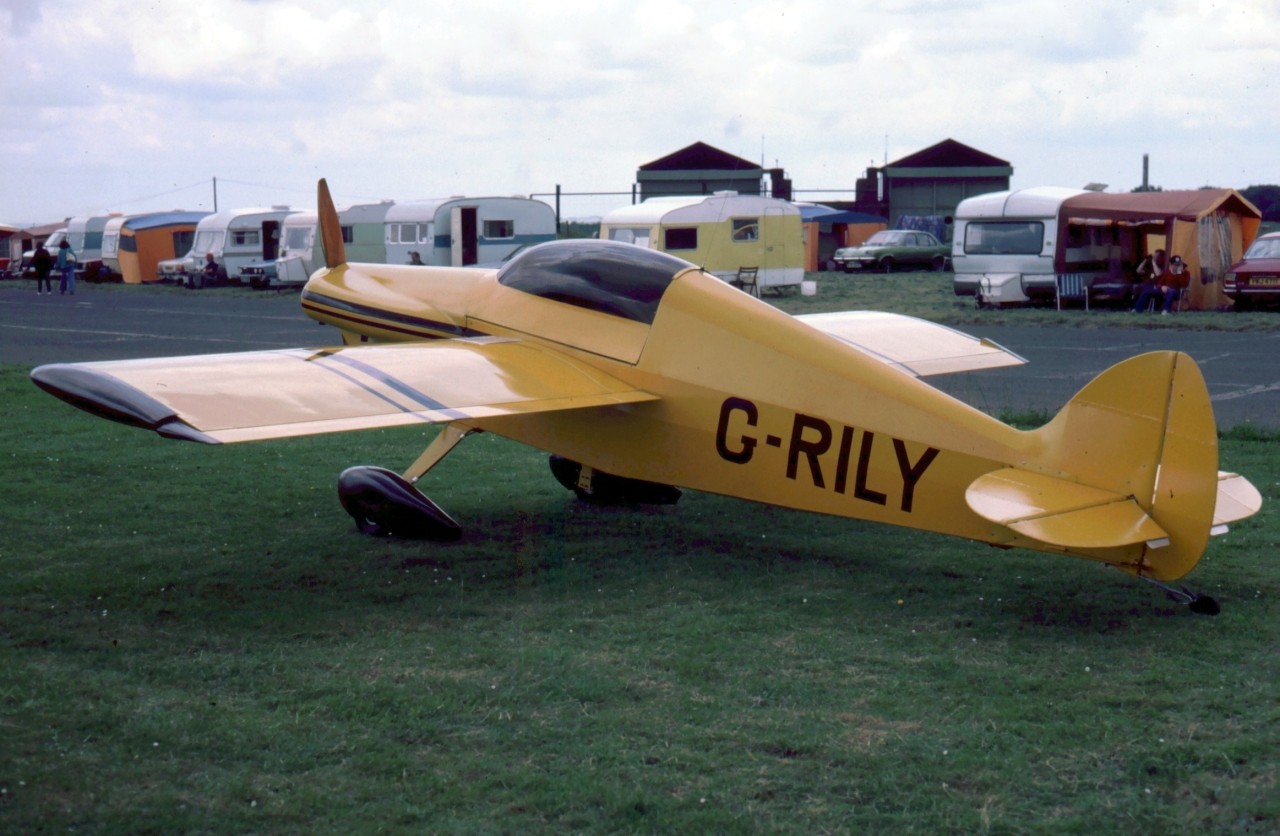
Racing Heritage and Formula V Dominance
The Sonerai emerged as the defining aircraft of Formula V racing, a class established in 1972 specifically for Volkswagen-powered homebuilts competing on two-mile pylon courses at speeds exceeding 170 mph. John Monnett's design won multiple Formula V championships, establishing the aircraft's credentials as a serious racing machine capable of precision handling under extreme conditions. The prototype's debut at the 1971 EAA Oshkosh airshow in "Sassy Grass Green" paint—inspired by a 1971 Dodge Charger—marked the beginning of a new era in affordable performance aviation.
Formula V racing provided the Sonerai with a competitive proving ground that refined its design and demonstrated its capabilities. The aircraft's stressed construction, rated for +6/-6G aerobatics when flown solo in the two-seat Sonerai II variant, proved ideal for the demanding pylon racing environment where pilots regularly pulled high G-forces around tight turns.
The Monnett Legacy and Manufacturing Evolution
John Monnett founded Monnett Experimental Aircraft around 1971 and operated the company until 1986, initially selling plans for just $50-57 in 1974. The designer's remarkable achievement of conceiving, building, and flying the prototype in just 11 months—with only eight months of actual construction time while working full-time—demonstrated the aircraft's buildability and established Monnett as a significant figure in homebuilt aviation.
When Monnett Experimental closed in 1986, Great Plains Aircraft Supply Company acquired the rights and maintained them until 2015. Fred Keip's Sonerai Works LLC then held the rights from 2015 to 2019, operating from Franksville, Wisconsin, before the design returned to Sonex Aircraft—founded by John Monnett's son—in late 2019. This transition brought the Sonerai full circle to the Monnett family legacy.
Volkswagen Power Innovation
The Sonerai's defining characteristic was its successful adaptation of Volkswagen automotive engines for aircraft use, pioneering the reliable conversion of flat-four air-cooled engines ranging from 1600cc to 2180cc displacement. These conversions, producing 50-100 horsepower, enabled impressive performance figures including 150-170+ mph cruise speeds with stall speeds as low as 40 mph. A typical 2110cc conversion could achieve 160 mph cruise with climb rates exceeding 1,300 feet per minute.
The economics of Volkswagen power proved revolutionary for homebuilders. With millions of Beetle engines available as affordable donors, builders could construct high-performance aircraft without the expense of traditional aircraft engines. Modifications including larger carburettors, improved exhaust systems, and optimized propellers frequently added 20 mph or more to cruise performance.
Variants and Evolution
The original single-seat Sonerai I, with its 440-pound empty weight and 750-pound gross weight, evolved into the two-seat Sonerai II by July 1973. The Sonerai II featured tandem seating under a bubble canopy and slightly larger dimensions while maintaining the mid-wing configuration and tailwheel landing gear.
Subsequent variants included the Sonerai II-L with increased dihedral, the II-LT featuring tricycle landing gear and an enlarged cockpit, and the II-LTS with a stretched 20-foot 4-inch fuselage and folding wings for easier storage. The Sonerai IILS and IILTS variants first flew in 1984 and June 1984 respectively, offering builders multiple configuration options.
Record-Setting Performance
The Sonerai's capabilities extended beyond racing to international record-setting. Robin Austin's VH-SGS, powered by a 100-horsepower Rotax 912 engine, achieved multiple FAI world records including a fuel efficiency record of 29.79 kilometers per kilogram on June 5, 2008, and a speed record of 404.3 km/h on May 17, 2008, in the C-1a/0 weight class.
These achievements demonstrated the design's fundamental soundness and its potential for optimization beyond the original Volkswagen-powered configuration. The aircraft's clean aerodynamics and efficient structure proved adaptable to various powerplants and mission profiles.
Construction and Builder Experience
The Sonerai's all-metal construction with fabric covering struck an ideal balance between structural integrity and buildability. Experienced builders could complete construction in 800-1,000 hours, making it accessible to amateur constructors while maintaining professional standards of strength and finish. The design's conventional construction methods avoided exotic materials or complex fabrication techniques that might intimidate first-time builders.
With hundreds constructed worldwide by individual builders, the Sonerai created a substantial community of owners and builders. At least 22 examples across various models are registered in Australia alone, indicating the design's global appeal and successful adaptation to different regulatory environments.
Current Status and Continuing Legacy
Sonex Aircraft currently offers Sonerai plans starting at $21,340 for Volkswagen-powered variants, ensuring the design's continued availability to new builders. The aircraft's 50th anniversary in 2021 highlighted its enduring significance in homebuilt aviation and its role in establishing the broader Sonex Aircraft product line.
Dozens to hundreds of Sonerai aircraft remain active worldwide, with ongoing construction projects maintaining the type's presence at airports and fly-ins. The design's influence extends beyond its direct descendants, having established principles of affordable, high-performance homebuilt construction that continue to influence contemporary kit aircraft development.