
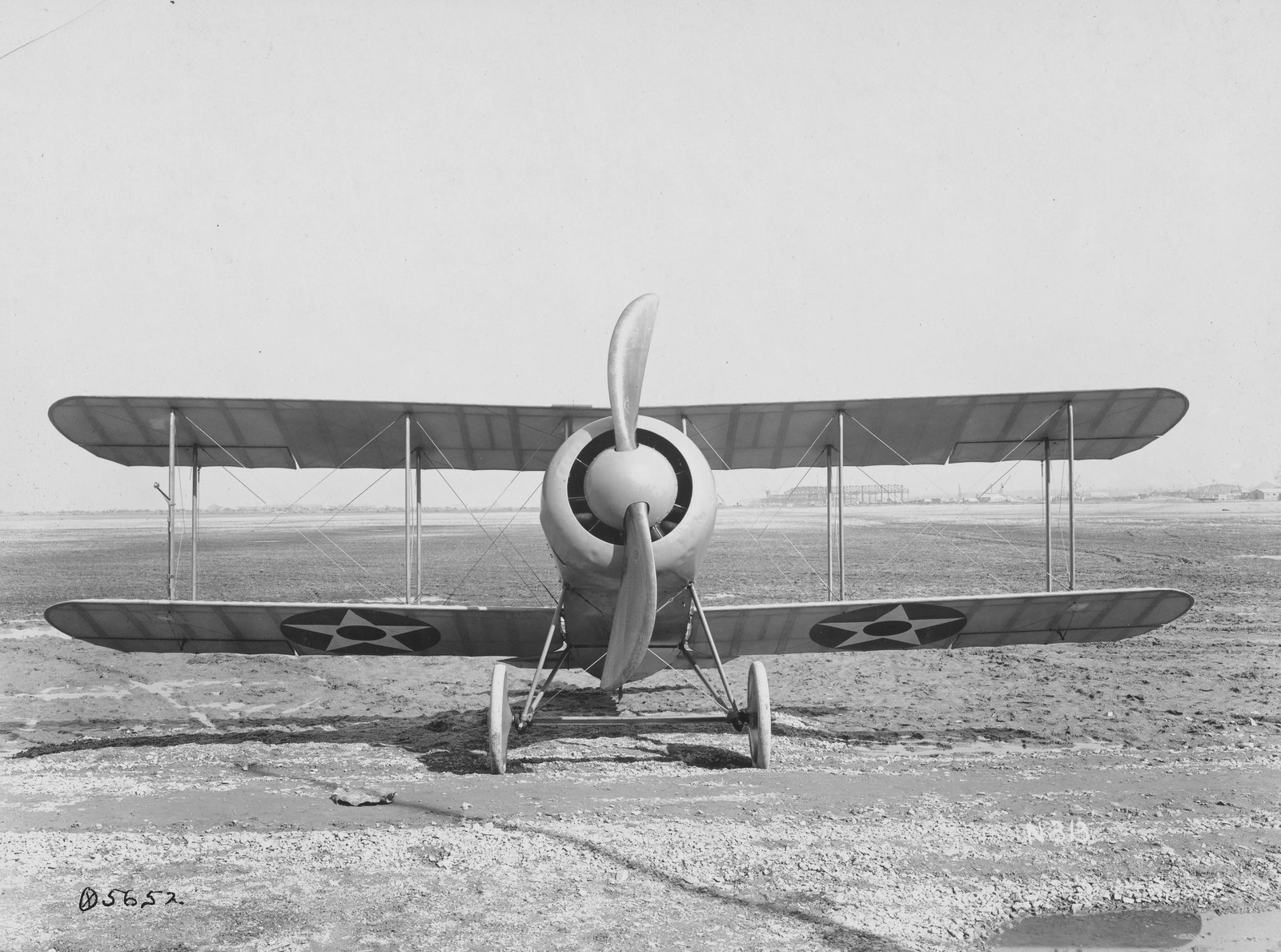
Production and Manufacturer History
The Standard E-1 was designed in 1917 by the Standard Aircraft Corporation, a firm founded in 1916 in Plainfield, New Jersey. The company, which evolved from the Sloane Aeroplane Company, operated production facilities in both Plainfield and Elizabeth, New Jersey, utilizing the latter's former John Stephenson Car Works plant for wartime manufacturing. While production orders were placed for as many as 460 aircraft to serve as advanced trainers, the actual number delivered was significantly lower. Estimates of the delivered fleet range from 100 to 130 airframes, including two prototypes with serial numbers 33769 and 33770. The first M-Defense variant was delivered to the Signal Corps in January 1918.
Design and Technical Specifications
Designed as a single-seat, open-cockpit tractor biplane, the E-1 featured a wooden structure with fabric covering and a fixed tailskid undercarriage. The aircraft was powered by air-cooled rotary piston engines, specifically either a 100 hp Gnome or an 80 hp Le Rhône C-9. The 80 hp Le Rhône version had a wingspan of 8.84 meters (29 ft 0 in), a length of 6.31 meters (20 ft 8 in), and a wing area of 23.04 square meters. With an empty weight of 408 kg (900 lb) and a gross weight of 630 kg (1,389 lb), the aircraft could reach a maximum speed of 166 km/h (103 mph) and a service ceiling of 4,900 meters.
Service History
Although intended as a pursuit fighter, the E-1 was found to be unsuitable for combat during testing, likely due to the limited power of its rotary engines compared to contemporary European fighters. Consequently, the U.S. Army (Signal Corps/USAAS) utilized the type as an advanced trainer. A specific sub-type, the M-Defense, was produced with provisions for machine guns to allow trainees to practice fighter tactics and gunnery. Because it arrived late in World War I, the E-1 saw more extensive use following the November 1918 Armistice than during the conflict itself.
Legacy and Modifications
The E-1 served as the final aircraft type produced by the Standard Aircraft Corporation before the company ceased operations shortly after the war. Beyond its training role, three E-1 airframes were converted by Sperry into radio-controlled "aerial torpedoes" under the Sperry MAT designation. These unmanned aircraft featured lengthened fuselages and were assigned new serial numbers 64228–64230. Today, very few examples survive, with aircraft noted in the collections of the Fantasy of Flight museum and the (now closed) Virginia Aviation Museum.