
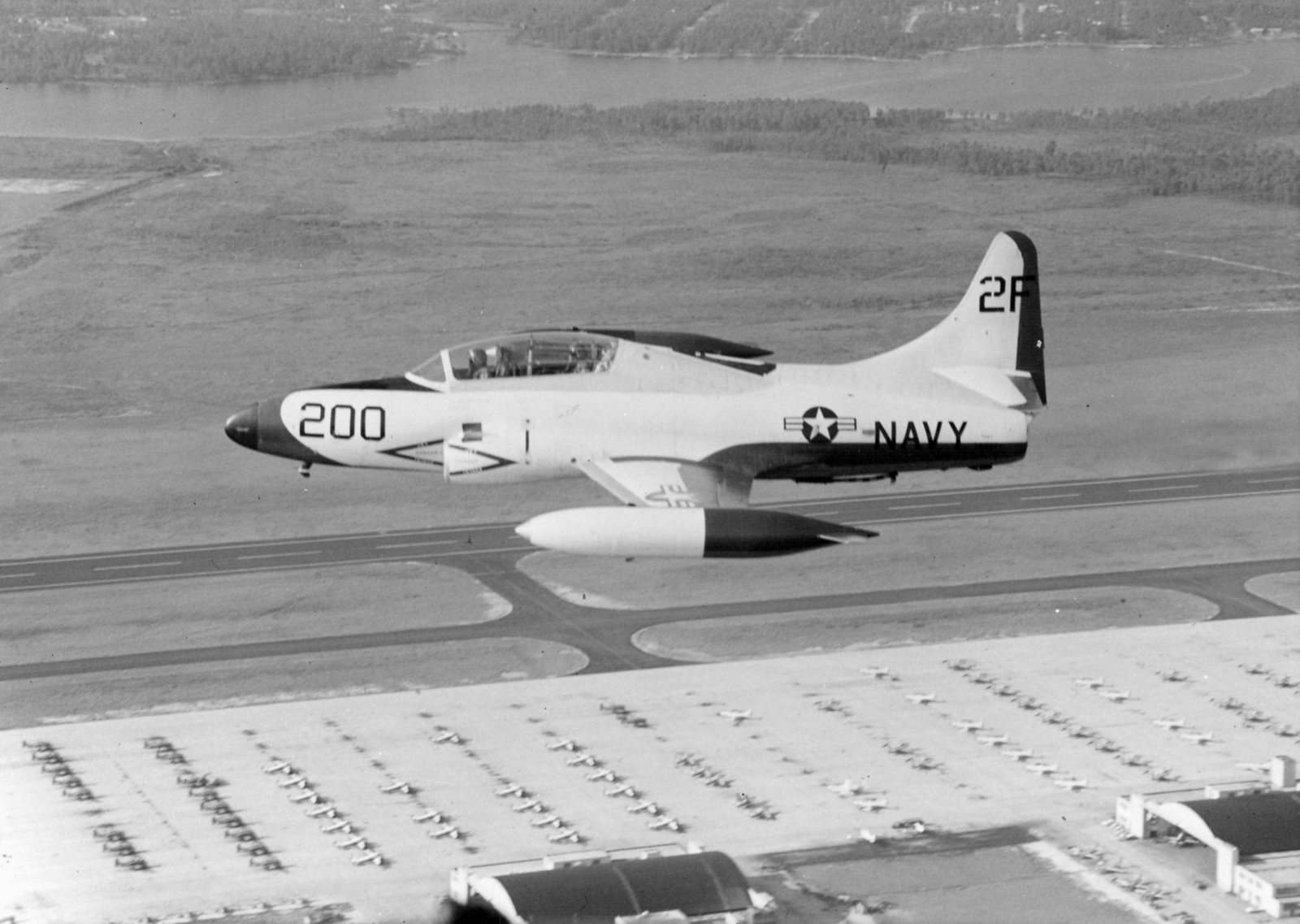
The Lockheed T2V-1 SeaStar, later redesignated as the T-1A in 1962, was developed as a specialized naval trainer to meet the U.S. Navy's requirements for carrier-based jet instruction. The aircraft originated as a company-funded modification of the T-33/TV-2 family, designated internally by Lockheed as the L-245. The prototype L-245 first took to the skies on December 16, 1953. To adapt the land-based design for the rigors of carrier operations, Lockheed's California Division implemented several critical enhancements, including a retractable arresting hook under the rear fuselage, catapult fittings, and strengthened landing gear. To improve low-speed handling and approach control during carrier landings, the aircraft was equipped with a redesigned tail and power-operated leading-edge flaps. Additionally, the airframe utilized modified materials to better resist saltwater corrosion.
Production of the SeaStar began in 1956 at Lockheed Aircraft Corporation's facilities in Burbank, California. A total of 150 aircraft were manufactured. The T2V-1 entered active service with the U.S. Navy in May 1957. To enhance training effectiveness, the cockpit was modified to raise the instructor's seat by six inches, providing better visibility over the student pilot. Power was provided by a single Allison J33-A-24 or J33-A-24A centrifugal-flow turbojet engine, which produced 6,100 lbf of thrust—a significant increase over the 4,600 lbf produced by the J33-A-20 used in the earlier TV-2.
In terms of performance, the T-1A could reach a maximum speed of 580 mph at an altitude of 35,000 feet, with a service ceiling of 40,000 feet. The aircraft had a wingspan of 42.10 feet and a maximum takeoff weight of 16,800 lb. While it served as a primary tool for carrier qualification and approach training, the SeaStar had a relatively brief career in front-line squadron service before being replaced by the North American T-2 Buckeye. Many aircraft were subsequently relegated to support roles, with some remaining in service into the 1970s. Following their retirement, several units were sent to the Davis-Monthan AFB "Boneyard" during the 1960s. Today, only two SeaStars are known to survive, including an example preserved at the Pima Air & Space Museum in Tucson, Arizona, which displays markings from Naval Air Station Quonset Point.