
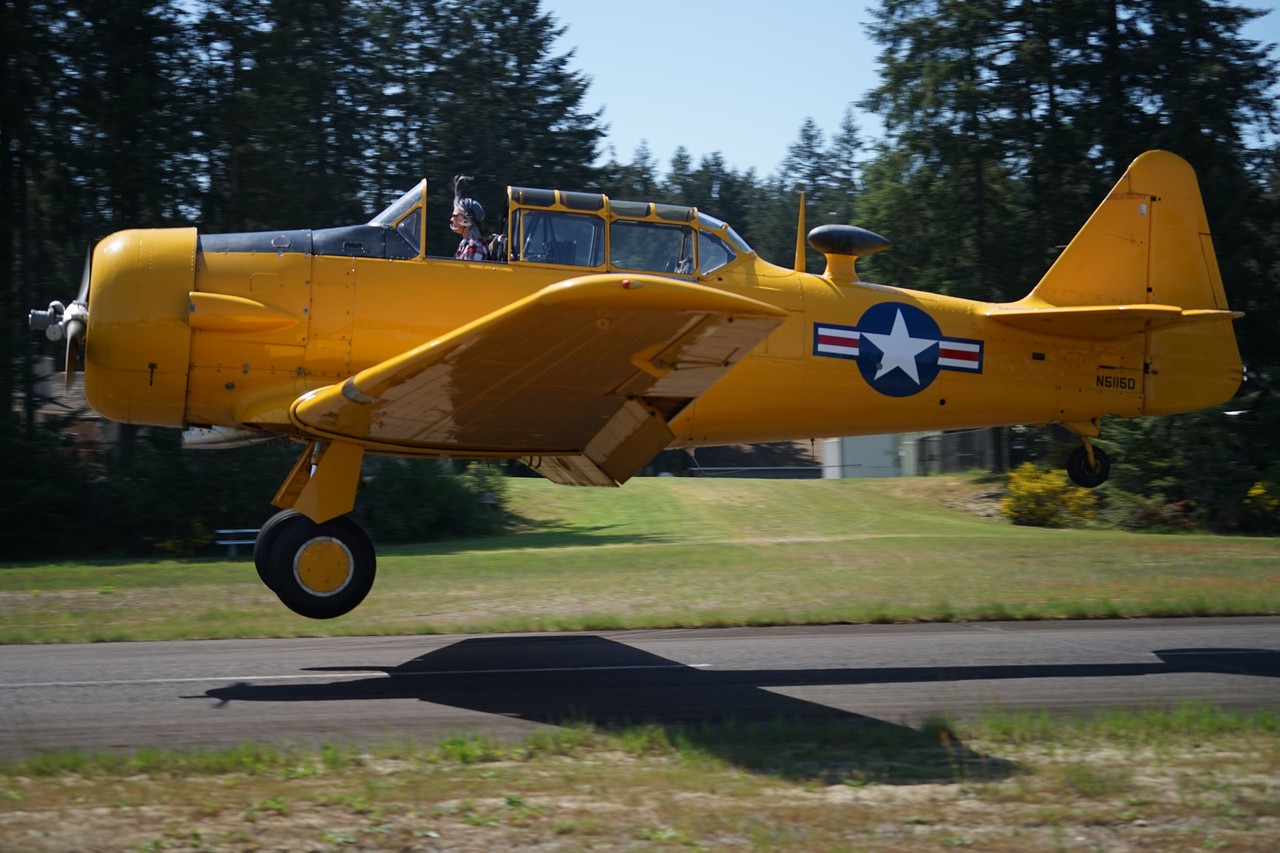
The Foundation of Allied Air Power
The AT-6 Texan earned its reputation as the aircraft that taught the world to fly during World War II. North American Aviation's factory in Dallas produced over 4,000 AT-6s by 1945, while licensed manufacturers including Canada's Noorduyn contributed an additional 2,557 Harvard IIs between 1942 and the war's end. This massive production effort created the backbone of Allied pilot training programs across the globe.
The aircraft's tandem cockpit configuration placed the student pilot in front with the instructor behind, providing optimal training conditions. Its robust main landing gear and tailwheel design could withstand the punishment of countless practice landings by novice pilots. The forgiving flight characteristics combined with enough complexity to prepare pilots for front-line fighters made the Texan an ideal advanced trainer.
Military Variants and Combat Service
Military services adopted the basic design with different designations: the Army Air Corps called it the AT-6, the Navy designated it SNJ (Scout Trainer North American), and the Royal Air Force knew it as the Harvard. In 1948, the newly formed U.S. Air Force redesignated surviving aircraft as T-6.
The AT-6B variant was specifically built for armament training, mounting .30-caliber machine guns on the right nose cowl, right wing, and rear cockpit, plus carrying light bomb racks. The AT-6D introduced a standardized 24-volt electrical system and included wing-mounted gun cameras for gunnery training. These combat-capable variants allowed students to practice aerial gunnery and light attack missions without transitioning to front-line aircraft.
Beyond training duties, some nations employed armed Texans in actual combat roles during regional conflicts. The aircraft saw action during the South African Border War, demonstrating its versatility beyond the training environment. South Africa operated T-6s until 1995, making it one of the longest-serving military aircraft in history, before replacing them with Pilatus PC-7 MkII turboprop trainers.
North American Aviation's Success
North American Aviation transformed from a holding company in 1928 into one of America's premier aircraft manufacturers. The company's Dallas facility rapidly expanded during World War II to meet urgent military trainer demand. Beyond the Texan, North American produced the P-51 Mustang fighter and later pioneered jet aircraft development, establishing itself as a cornerstone of American aviation manufacturing.
The success of the AT-6 program demonstrated North American's ability to scale production while maintaining quality. The company's engineering team refined the original NA-16 design through multiple iterations, culminating in the highly successful AT-6 configuration that satisfied diverse international requirements.
The Legendary R-1340 Engine
The Pratt & Whitney R-1340 Wasp engine powered virtually all Texan variants, producing 550 to 600 horsepower from its nine-cylinder, single-row radial configuration. This 1,344-cubic-inch powerplant displaced 22 liters and earned legendary status for reliability and longevity. Pratt & Whitney manufactured 34,966 R-1340 engines, powering not only the Texan but numerous other aircraft types and even K-class blimps.
The R-1340's significance earned recognition from the American Society of Mechanical Engineers, which designated it a Historic Engineering Landmark in 2016. The engine's air-cooled design simplified maintenance and reduced operational complexity, crucial factors for training aircraft operating from diverse airfields worldwide.
Post-War Transformation
After World War II, the U.S. Air Force undertook massive refurbishment programs to extend the Texan's service life. At Tinker Air Force Base in Oklahoma, 630 AT-6 aircraft underwent modification and overhaul between July and December 1946. A more comprehensive upgrade program in 1949 transformed 1,800 T-6s into T-6G standard, receiving new serial numbers and enhanced systems.
These post-war modifications included improved avionics, updated electrical systems, and structural reinforcements that allowed continued military service into the 1970s. The T-6G became the final major military variant, incorporating lessons learned from decades of training operations.
Flying Characteristics and Pilot Perspective
Pilots praised the AT-6's honest flying qualities and forgiving nature while providing enough challenge to develop advanced skills. The aircraft's conventional gear required proper rudder technique during ground operations, teaching essential skills for more complex military aircraft. Its 185-mile-per-hour cruising speed and 23,000-foot service ceiling provided realistic performance for advanced training scenarios.
The Texan's control response was crisp enough for aerobatic training yet stable enough for instrument instruction. This combination made it equally suitable for basic flying training and advanced combat maneuvers, explaining its widespread adoption across different air forces with varying training philosophies.
Enduring Legacy
Today, hundreds of AT-6 Texans remain airworthy in civilian hands, forming a cornerstone of the warbird community. These aircraft regularly appear at airshows and serve as camera planes for period films, often modified to represent other World War II aircraft including the Japanese Mitsubishi A6M Zero. Museums worldwide display static examples, preserving the legacy of an aircraft that trained more military pilots than any other type in aviation history.
The AT-6 Texan's 60-year service span across multiple generations of pilots stands as testament to North American Aviation's engineering excellence and the aircraft's fundamental soundness. From its 1935 origins through service in the 1990s, the Texan remained the world's premier advanced military trainer, earning its place among aviation's most significant aircraft.