
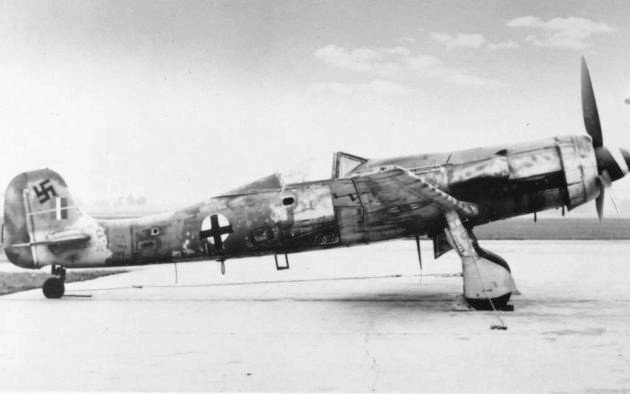
The Focke-Wulf Ta 152 was a late-war German single-seat fighter developed as a high-performance derivative of the Fw 190 series, specifically the Fw 190D-9. In 1944, the German Air Ministry (RLM) mandated that new fighter designations include the name of the chief designer; consequently, the "Ta" prefix honors Kurt Tank, Focke-Wulf's head of development. To optimize the aircraft for high-altitude operations, Tank's team implemented a lengthened fuselage and a new, larger wing to enhance stability and handling at extreme altitudes.
Production of the Ta 152 took place between October 1944 and February 1945. While wartime records are incomplete, the Smithsonian National Air and Space Museum (NASM) identifies 67 completed aircraft, including the H-0, H-1, and C-1 variants, though other estimates range from 43 to over 150 airframes. The aircraft was powered by the Junkers Jumo 213E inverted V-12 liquid-cooled piston engine, which utilized advanced boost systems including MW-50 water-methanol and GM-1 nitrous-oxide. These systems allowed the H-variant to reach a service ceiling between 48,500 and 49,500 feet and a reported top speed of approximately 472 mph.
Operationally, the Ta 152 entered limited service with the Luftwaffe in January 1945. The III./Jagdgeschwader 301 (III./JG 301) was the only Gruppe to operate the fighter in unit strength, while 20 pre-production aircraft were delivered to Erprobungskommando evaluation units in November 1944. The aircraft was heavily armed for bomber interception, typically carrying one 30 mm MK 108 motor-cannon and two 20 mm MG 151/20 cannons. Despite its technical prowess, combat success was limited; estimated victories range from 7 to 10 enemy aircraft. Notable pilots included Oberfeldwebel Willi Reschke, credited with at least three victories, and Oberleutnant Josef “Sepp” Keil, credited with between four and five kills.
By April 30, 1945, engine fires and spare part shortages had grounded most of the fleet, leaving only two Ta 152C-1s operational. Today, the only surviving example in the world is a Ta 152H-0/R11, which is held in storage at the Smithsonian National Air and Space Museum in Washington, D.C.