
Service History
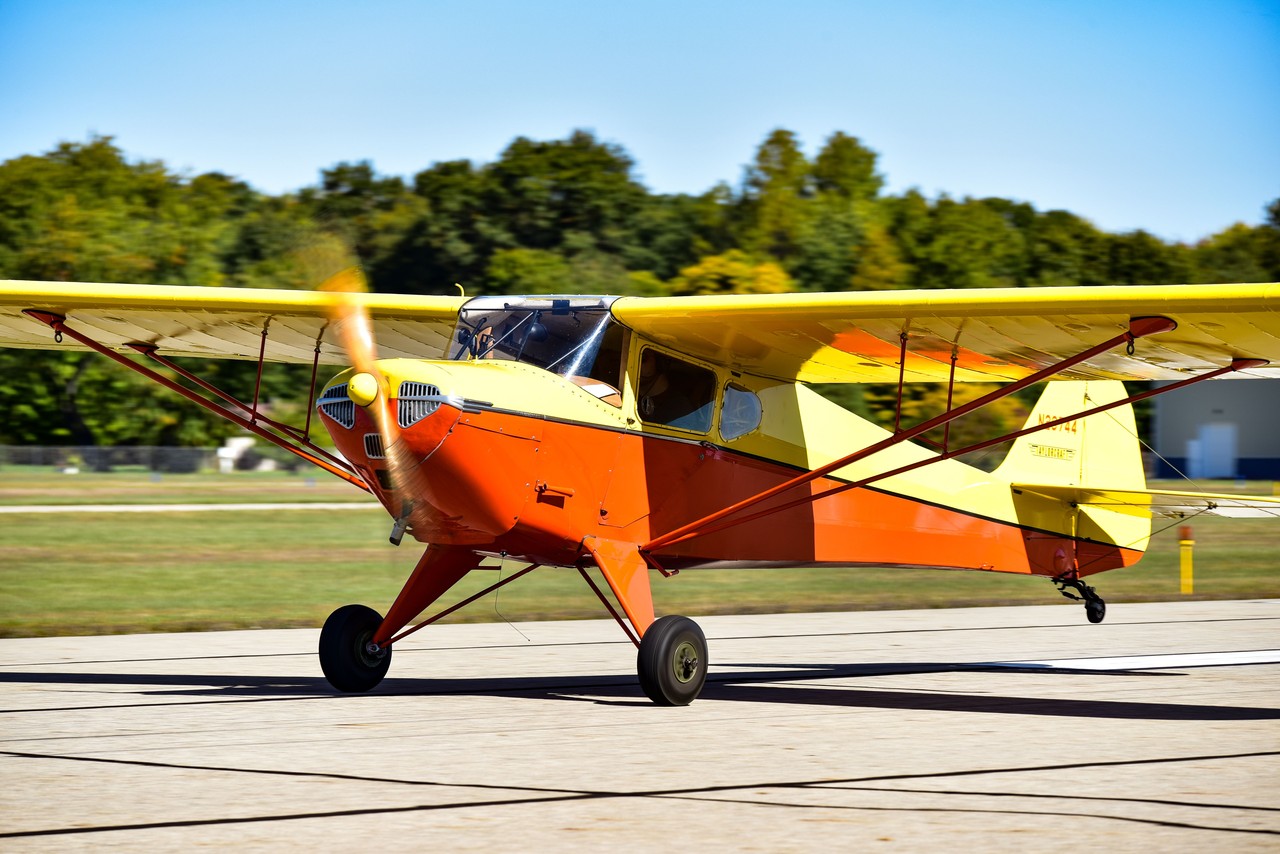
The Taylorcraft BC found immediate acceptance among flight training schools participating in the U.S. Civilian Pilot Training Program, offering an alternative to the dominant Piper Cub with its innovative side-by-side seating arrangement. At its original 1938 price of $1,495, the BC-65 provided affordable access to modern aviation for private pilots and training operations. The aircraft's configuration allowed instructors and students to sit alongside each other, facilitating better communication during flight training compared to tandem-seated competitors.
During the pre-war period from 1938 to 1941, Taylorcraft produced slightly over 2,400 B-series aircraft, including the Continental-powered BC variants alongside Franklin-powered BF and Lycoming-powered BL models. Production ceased during World War II at the American government's request, but resumed in 1946 with the improved BC-12D model, which became Taylorcraft's most successful variant with almost 4,200 aircraft built.
Wartime Service
While civilian BC production was suspended during World War II, Taylorcraft adapted the design for military service by creating a tandem-seat variant designated the L-2 liaison aircraft. The U.S. Army Air Corps accepted this military version, and approximately 2,200 L-2 variants were produced throughout the war for observation and liaison duties. This military adaptation demonstrated the basic design's versatility, though it required abandoning the signature side-by-side seating that distinguished civilian Taylorcrafts from competing designs.
The Manufacturer
Taylorcraft Aviation Company was founded in 1936 by C. Gilbert Taylor, who had previously served as President and Chief Engineer of Taylor Aircraft Company before his business relationship with William T. Piper ended. Taylor's aviation career began in 1929 when he and his brother Gordon established Taylor Brothers Aircraft Corporation. After leaving his partnership with Piper, Taylor was determined to prove that side-by-side seating could perform as well as narrow tandem configurations.
The company's Alliance, Ohio facility eventually employed 750 workers producing eight aircraft daily at peak production. However, financial difficulties led to bankruptcy in 1947, with assets auctioned on March 4 of that year. The company was subsequently reorganized under various owners, demonstrating remarkable persistence. In 2002, Texas car dealer Harry Ingram purchased the type certificates, formed a new Taylorcraft Aviation company, and reopened production at La Grange, Texas Airport, with aircraft rolling off the line by mid-2004.
Engine & Technical Details
The BC designation specifically indicated Continental engine installation, distinguishing it from the BF (Franklin) and BL (Lycoming) variants that shared identical airframes. The Continental A-65 was a 65-horsepower inline piston engine that became the standard powerplant, with the A-65-8A variant powering post-war BC-12D models. By 1940, Taylorcraft had standardized on three engine options, though many aircraft originally equipped with Lycoming or Franklin engines were later converted to Continental powerplants due to parts availability and reliability.
The aircraft featured tube-and-fabric construction typical of its era, with the high-wing configuration providing inherent stability and excellent short-field performance characteristics. Post-war BC-12D models incorporated refinements including enclosed engine cowlings that improved both performance and appearance compared to the original BC-65's simpler installation.
Design Philosophy and Competition
C. Gilbert Taylor, recognized as "the father of the light airplane industry," challenged conventional wisdom by insisting that side-by-side seating could match the performance of tandem designs. This philosophy directly competed with his former partner Bill Piper's Cub design and other contemporary aircraft from Aeronca, Luscombe, Stinson, and Cessna. The Model A introduced this concept in 1936, leading to the refined Model B series in 1939, which included the BC-65.
Taylor's innovation attracted pilots who preferred the social aspect and improved communication possible with side-by-side seating, particularly for training and recreational flying. The design proved its worth in the marketplace, with the basic configuration remaining viable for over five decades.
Production Legacy
The Taylorcraft line demonstrated extraordinary longevity, with the last version, the Taylorcraft-Ruckle F-22, completing production in 1991 at a list price of $34,110. This represented more than 50 years of continuous production through multiple ownership changes and modernization efforts. As of 2010, approximately 240 Taylorcraft aircraft of various types remained on the Canadian civil aircraft register alone, indicating substantial survival rates among vintage aircraft.
A British subsidiary, Taylorcraft Aeroplanes, was founded in 1939 and eventually evolved into Auster Aircraft, extending the design's influence internationally. The BC-12D's status as Taylorcraft's most-produced model established the aircraft as a significant milestone in affordable general aviation, proving that alternative design philosophies could successfully compete with established manufacturers in the expanding light aircraft market.