
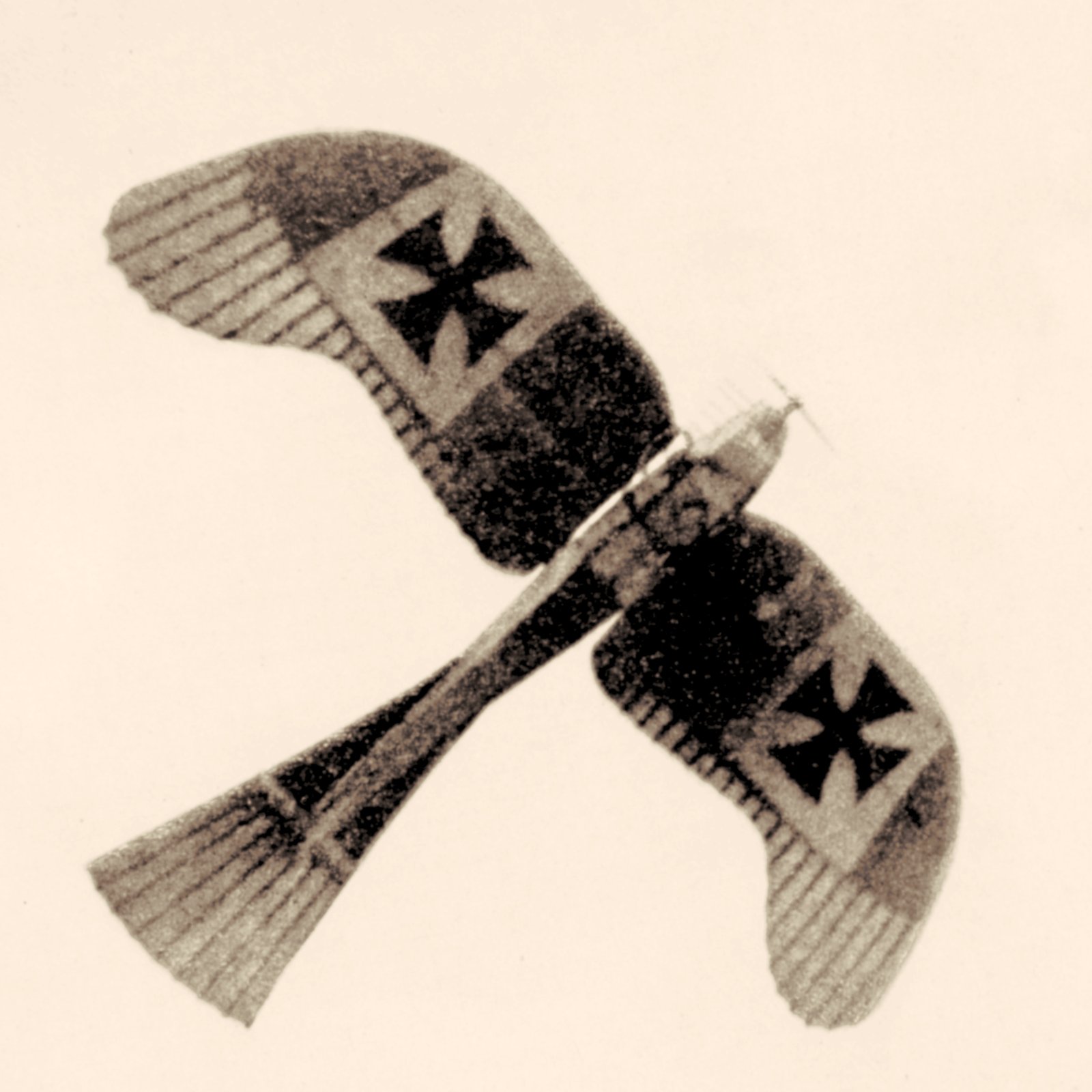
Designed by Igo Etrich in Austria-Hungary, the Taube (German for "dove") was a pioneering single-engine monoplane known for its distinctive bird-like wing planform. This design provided exceptional flight stability, making the aircraft highly controllable for its era and ideal for early reconnaissance and training. The aircraft first flew on April 6, 1910, and was subsequently licensed and copied by over 40 firms across Germany and Austria-Hungary. Notable manufacturers of Taube variants included Rumpler Luftfahrzeugbau GmbH of Berlin, Gotha, Albatros, Deutsche Flugzeug-Werke (DFW), Halberstadt, and Aviatik.
Technically, the Taube was a two-seat light monoplane. A common powerplant for the type was the Mercedes E4F, a liquid-cooled, six-cylinder inline piston engine producing 75 kW (100 hp), though some variants utilized Argus or Mercedes G4F engines. Typical specifications for the Rumpler/Etrich versions included a wingspan of 14.3 meters, a length of 9.9 meters, and a wing area of 32.5 square meters. With a loaded weight of 860 kg, the aircraft could reach a maximum speed of 100 km/h and a cruising speed of 90 km/h, with a service ceiling ranging between 2,000 and 3,000 meters and a range of 140 km.
The Taube holds a significant place in military aviation history. During the Italo-Turkish War on November 1, 1911, Giulio Gavotti used a Taube to perform the first military aerial bomb drop by releasing small bombs by hand. The type also saw action during the Balkan Wars (1912–1913). At the onset of World War I, Taubes were utilized by Germany, Italy, and Austria-Hungary. German spotter aircraft were instrumental in detecting the Imperial Russian Army during the Battle of Tannenberg, and other units dropped propaganda leaflets and bombs over Paris in 1914. In East Asia, Lieutenant Gunther Plüschow flew a Taube during the Japanese siege of Qingdao, attacking warships on October 2, 1914.
While highly stable, the Taube lacked the maneuverability required for intensifying air combat. By early 1915, it was largely replaced on the front lines by faster Allied scouts and relegated to training roles. In the civil sector, the aircraft was used for sport and endurance flights; notably, Gino Linnekogel and Suvelick Johannisthal set a two-man endurance record of 4 hours and 35 minutes on December 8, 1911.