
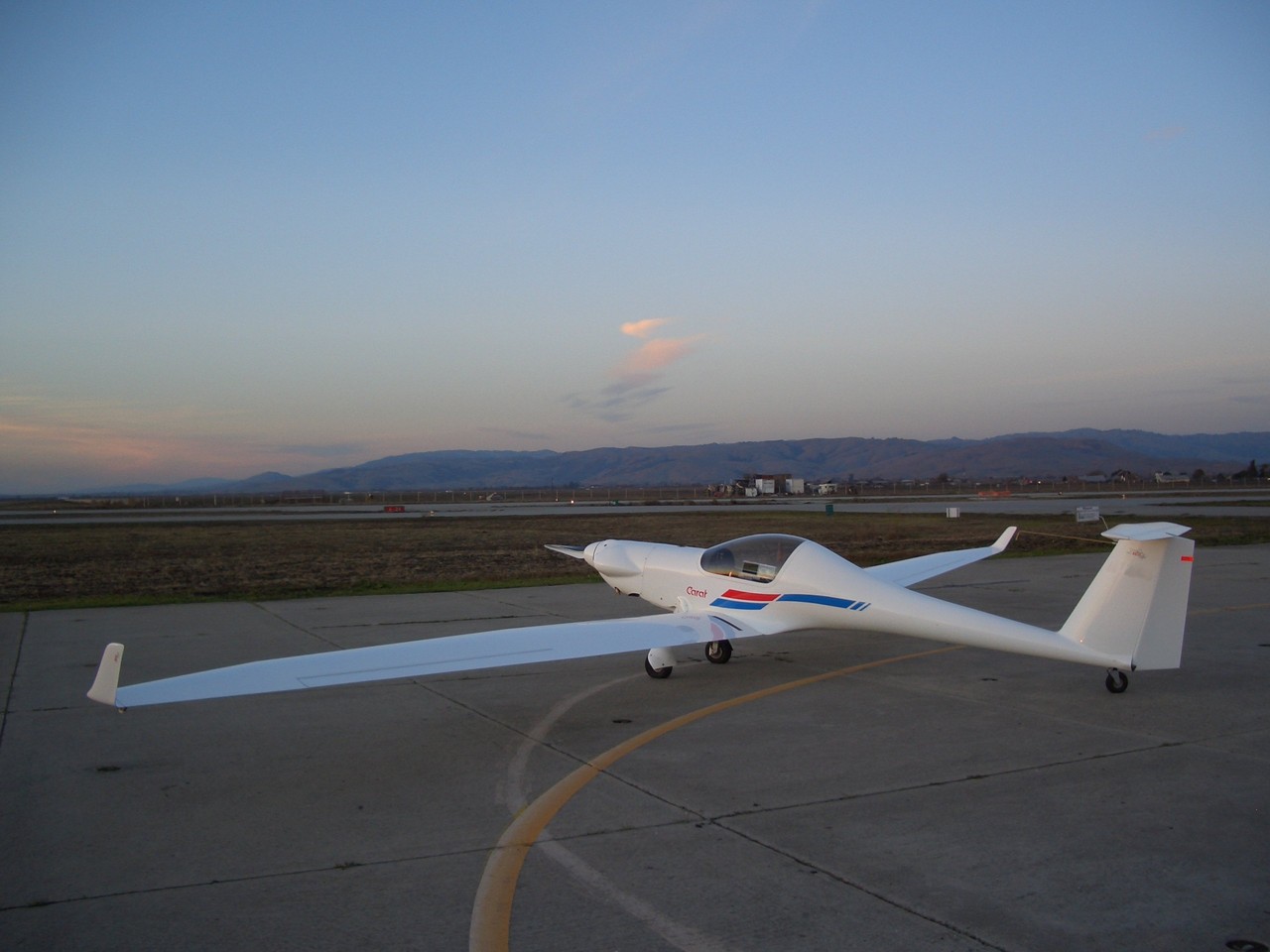
Development and Design Innovation
The TFK-2 Carat emerged from TECHNOFLUG's ambitious goal to create a motorglider that would excel in both powered flight and soaring modes. Rather than designing entirely new aerodynamic surfaces, the company made the shrewd decision to adapt the proven wings and horizontal stabilizer from the Schempp-Hirth Discus sailplane, one of the most successful competition gliders of its era. This approach allowed TECHNOFLUG to focus development resources on integrating a new fuselage, vertical stabilizer, landing gear, and powerplant with the established high-performance wing design.
The first prototype took to the air on December 16, 1997, validating the design concept that combined fibreglass and carbon fiber composite construction with PVC foam cores in the wing structure. This advanced materials approach resulted in an empty weight of just 341 kilograms (752 pounds) while maintaining structural integrity for the aircraft's maximum takeoff weight of 490 kilograms (1,080 pounds).
Propulsion and Technical Features
The Carat's most distinctive feature was its innovative propeller system designed to minimize drag during unpowered flight. The two-blade AMS AM KS-F3-1A/140-1 propeller, measuring 1.40 meters (4 feet 7 inches) in diameter, folded forward in a spear-like configuration when the engine was shut down. Gas damping springs held the blades in their streamlined position, effectively eliminating the drag penalty that conventional fixed propellers impose on gliding performance.
Power came from the Sauer S1800-1-ES1C engine, a specialized aviation powerplant derived from Volkswagen automotive components but extensively modified for aircraft use. This 1,754-cubic-centimeter, air-cooled, four-cylinder inline engine produced a maximum of 44 kilowatts (60 horsepower) at 3,000 rpm, with a continuous power rating of 40 kilowatts (54 horsepower). Heinrich Sauer founded Sauer Motorenbau in Germany in 1978, establishing the company as a specialist in Volkswagen-based aircraft engines that incorporated modern materials and design improvements over the original automotive components.
Production and Certification
TECHNOFLUG unveiled the first production TFK-2 Carat at the Aero '99 exhibition in Friedrichshafen in April 1999, marking the aircraft's commercial debut. However, the path to full certification proved lengthy, with official approval finally achieved in 2003. By this time, manufacturing responsibility had transferred from TECHNOFLUG in Germany to AMS-Flight in Ljubljana, Slovenia.
Production proceeded at a modest pace typical of specialized motorglider manufacturing. Six aircraft had been completed by the end of 2003, with the total reaching 31 units by September 2009. This limited production reflected both the specialized nature of the high-performance motorglider market and the aircraft's relatively high cost compared to simpler powered aircraft or pure sailplanes.
Performance and Dimensions
The Carat's dimensions reflected its sailplane heritage, with a wingspan of 15.00 meters (49 feet 3 inches) and an overall length of 6.21 meters (20 feet 4 inches). The wing area of 10.58 square meters (113.9 square feet) combined with the generous wingspan to produce an aspect ratio of 21.3, providing exceptional lift-to-drag characteristics essential for efficient soaring flight.
Fuel capacity of 52 liters (13.7 US gallons) gave the Carat sufficient range for cross-country flights while keeping weight to a minimum. The single-seat cockpit was optimized for the pilot's interaction with both engine controls and the instruments necessary for soaring flight, including variometers and navigation equipment.
Market Distribution and Legacy
Despite its German and Slovenian manufacturing origins, the majority of the 31 TFK-2 Carats found homes with pilots in the United States, with the remainder distributed primarily throughout Western Europe. This geographic distribution reflected the stronger market for high-performance motorgliders in these regions, where soaring conditions and regulatory environments favored such specialized aircraft.
The Carat achieved the ICAO type designation TFK2 in the light aircraft category, formally recognizing its place in aviation's regulatory framework. While production numbers remained limited, the aircraft demonstrated the viability of combining proven sailplane aerodynamics with modern composite construction and innovative drag-reduction technologies.
As of the last available records from September 2009, most of the 31 aircraft built remained in active service, testament to both the aircraft's design quality and the dedication of its owners to maintaining these specialized machines. The TFK-2 Carat represented a sophisticated engineering solution to the fundamental challenge of motorglider design: achieving excellent performance in both powered flight and soaring modes without significant compromise in either regime.