
Production and Manufacturer History
The Timm N2T Tutor was produced by the Timm Aircraft Corporation (also known as the O.W. Timm Aircraft Company) based in Los Angeles, California. The company was founded by Otto William Timm, who had been building experimental aircraft since 1911. By 1939, the corporation was developing the PT160K trainer prototype using a proprietary molded-plywood process. In 1943, the U.S. Navy ordered 262 N2T-1 aircraft, all of which were delivered within that same year. No follow-on contracts were awarded, as both the Army and Navy had over-ordered trainers by the end of 1943. Beyond the N2T, the company license-built 436 CG-4A gliders for the U.S. Army. Following the war, the company transitioned into Timm Industries, focusing on the repair of transport aircraft such as the Douglas C-47. The entity eventually merged with the International Glass Corporation in 1957, after which it ceased to exist as an independent aircraft manufacturer.
Design and Technical Specifications
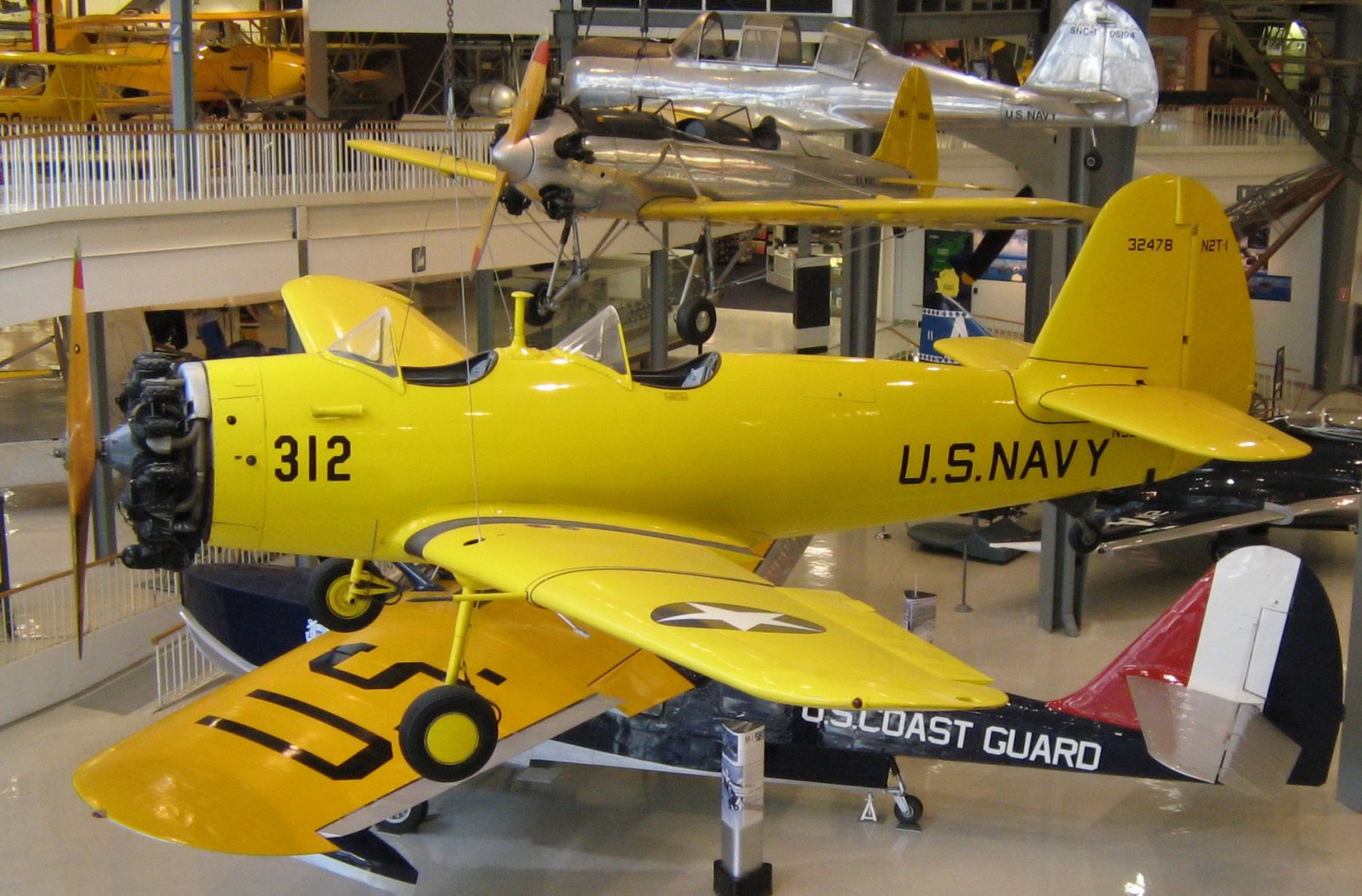
Originally developed as the Timm PT-220C, the N2T-1 incorporated slight changes from the prototype to meet Navy requirements. The aircraft is a two-seat, tandem, open-cockpit low-wing monoplane. Its most notable feature was the Aeromold process, which utilized plastic-bonded plywood to create a non-critical composite structure. This design allowed the Navy to conserve strategic metals during the wartime production surge. The N2T-1 was powered by a 220 hp Jacobs R-755-16 seven-cylinder, air-cooled radial piston engine. Technical specifications for the N2T-1 include a length of 26 ft 4 in, a wingspan of 36 ft 0 in, and a height of 8 ft 2 in. It achieved a maximum speed of 128 mph at sea level, a cruise speed of 110 mph, and a service ceiling of 15,200 ft, with a range of 400 miles.
Service History and Legacy
Operated exclusively by the United States Navy during World War II, the N2T Tutor—nicknamed "Tiny Timm"—served as a basic trainer for student pilots. While praised for its rugged construction and pursuit-type performance, the Aeromold composite structure proved susceptible to decomposition over time, which limited the aircraft's long-term durability. After military retirement, many N2Ts were sold as surplus to private owners for sport flying and airshow demonstrations. A notable tragedy occurred on September 15, 1951, when an N2T-1 (registration N56308) crashed during the Rocky Mountain Airshow in Colorado, resulting in the deaths of the pilot and 19 spectators. This accident led the Mississippi director of aviation to ban airshows within that state for the remainder of the year.
By 2001, only 10 N2T-1 aircraft remained on the U.S. civil aircraft register. Preserved examples can be found at the Air Zoo in Michigan and the National Naval Aviation Museum at Naval Air Station Pensacola, Florida.