
Design Origins and Innovation
The Twin Navion project emerged from a practical problem facing Ryan Navion operators in the early 1950s. The White brothers of White Engineering in San Antonio, Texas, recognized that the original Navion suffered from chronic power deficiency that limited its utility and performance. Their solution was revolutionary for its time: completely redesigning the aircraft's powerplant configuration rather than simply upgrading the existing engine.
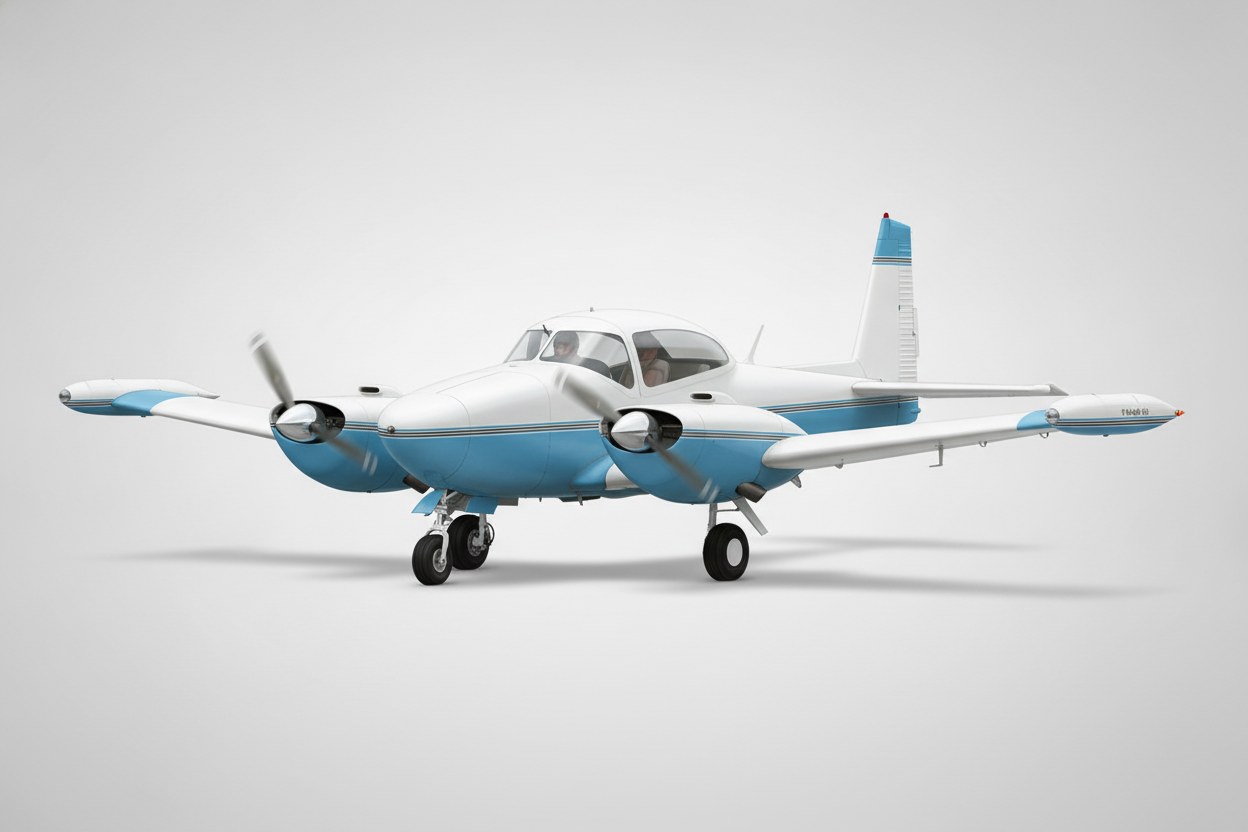
The conversion process required extensive structural modifications. The White brothers removed the original nose-mounted engine entirely, replacing it with a baggage compartment to improve the aircraft's utility. Two Continental O-470-3 engines, each producing 240 horsepower, were mounted in purpose-built nacelles attached to the wing leading edges. The engineers fitted a new fiberglass tail fin to accommodate the changed weight distribution and aerodynamics, while repurposing surplus World War II napalm canisters as wingtip fuel tanks.
Certification and Production
The prototype WE-1 completed its maiden flight in 1953, demonstrating the viability of the twin-engine concept. Civil Aviation Authority type certification followed in May 1955 under the designation Camair 480, after CAMAIR Aircraft acquired the design rights from White Engineering.
Camir's production run lasted four years, from 1955 through 1959, during which the company manufactured 25 aircraft. The Twin Navion found its primary market among corporate operators and specialized utility roles, with Cameron Iron Works serving as an early customer who reportedly expressed satisfaction with the aircraft's capabilities. After Camair ceased production in 1959, ownership of the design rights changed hands twice more over the following decade, resulting in an additional eight aircraft being constructed by subsequent manufacturers.
Performance and Capabilities
The twin-engine configuration transformed the Navion's performance envelope dramatically. At 75 percent power and 6,500 feet altitude, the Camair 480 achieved a cruise speed of 192 mph, making it the fastest variant in the Navion family. The aircraft's service ceiling reached 21,000 feet with an initial climb rate of 1,750 feet per minute, figures that far exceeded the original single-engine version.
Operational characteristics included a stall speed of 62 mph with landing gear and flaps extended, while takeoff performance required 905 feet to clear a 50-foot obstacle. The aircraft's 109-gallon fuel capacity provided a maximum range of 900 miles, suitable for medium-range corporate and utility missions. Two-blade Hartzell constant-speed propellers, each measuring 6 feet 10 inches in diameter, efficiently converted the Continental engines' power into thrust.
Design Configuration
The Camair 480's dimensions reflected its transformation from the original Navion design. At 28 feet in length with a wingspan of 34 feet 8 inches and height of 10 feet 8 inches, the aircraft maintained manageable proportions for hangar storage and ground handling. Wing area totaled 184.3 square feet, providing adequate lift generation for the aircraft's maximum gross weight of 4,323 pounds.
Empty weight reached 2,950 pounds, reflecting the structural reinforcement required for twin-engine operations and the additional systems complexity. The four-seat cabin accommodated two crew members and two passengers, though operational flexibility allowed for various cargo and passenger combinations depending on mission requirements.
Manufacturing Legacy
CAMAIR Aircraft's involvement with the Twin Navion represented a focused effort to serve a specialized market segment. The company's decision to acquire and develop the White brothers' design demonstrated recognition of the untapped potential in twin-engine conversions during an era when such modifications were relatively uncommon in general aviation.
The total production of 33 aircraft across all manufacturers established the Twin Navion as a rare but significant variant in the broader Navion family. Its distinction as the heaviest and fastest Navion variant secured its place in aviation history, while National Transportation Safety Board records documenting Twin Navion accidents from 1962 onward indicate that examples remained in active service for decades following production.
Technical Innovation
The Continental O-470-3 engines represented reliable powerplants well-suited to the Twin Navion's mission profile. These air-cooled, flat-six engines provided the necessary power-to-weight ratio while maintaining the simplicity that general aviation operators demanded. The twin-engine configuration offered improved safety margins through redundancy, addressing one of single-engine aviation's fundamental limitations.
The engineering challenges overcome in the Twin Navion conversion established precedents for future aircraft modifications and demonstrated the viability of transforming existing designs to meet evolving operational requirements. This approach would later influence numerous other conversion programs throughout general aviation history.