
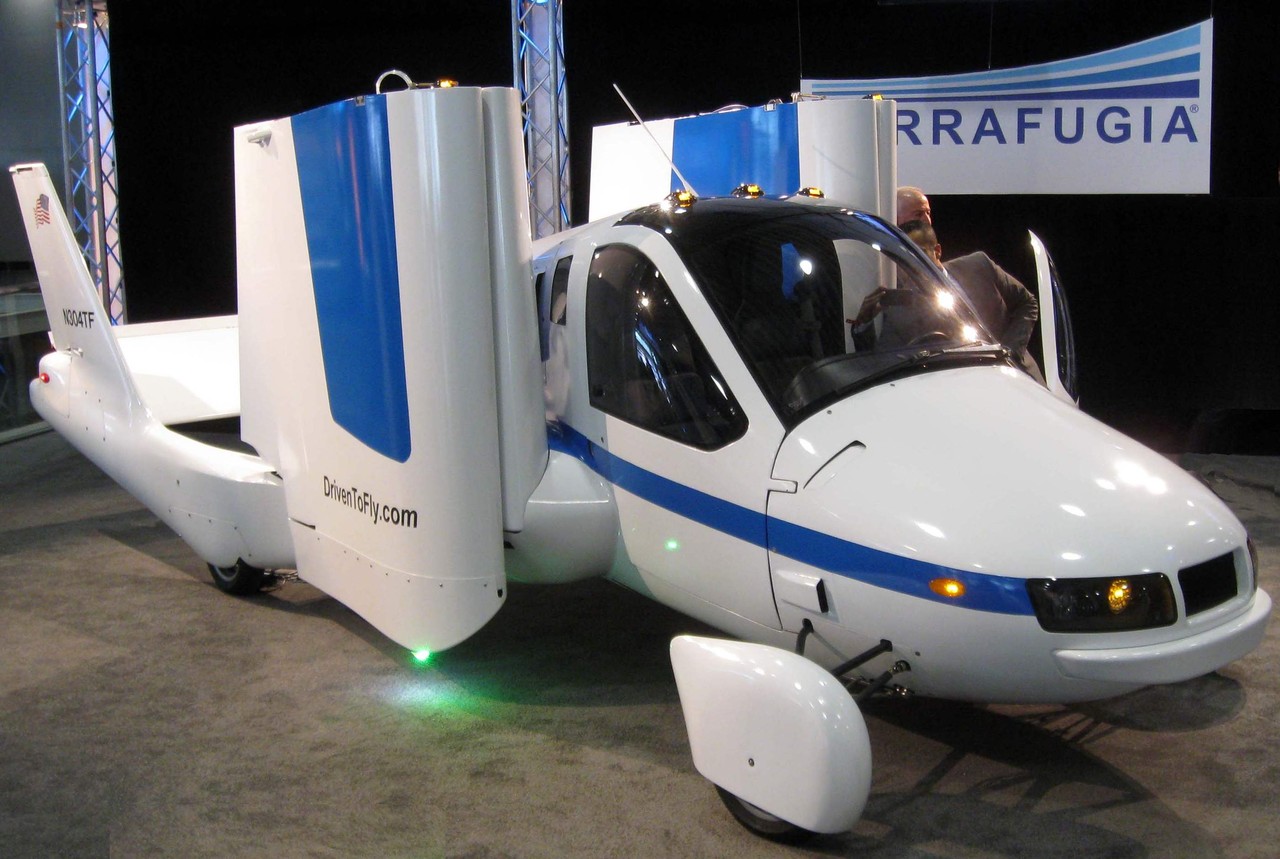
Development and Design Philosophy
The Terrafugia Transition emerged from an ambitious vision to solve the "last mile" problem of aviation—eliminating the need for separate ground transportation to and from airports. Carl Dietrich, leading a team of five MIT graduates, established Terrafugia on April 18, 2006, with the explicit goal of creating the first self-contained roadable aircraft. Unlike previous flying car concepts that required trailers for ground transport, the Transition was engineered to drive on public roads using its own power.
The design challenge was formidable: creating an aircraft light enough to qualify as a Special Light-Sport Aircraft while incorporating automotive safety features like airbags, bumpers, and crumple zones. Danish designer Jens Martin Skibsted and his partners at KiBiSi contributed to the production version's aesthetic, unveiled at EAA AirVenture Oshkosh on July 26, 2010. The Federal Aviation Administration granted a crucial exemption on July 1, 2010, allowing the Transition to exceed the standard light-sport aircraft weight limit by 110 pounds to accommodate necessary road safety equipment, bringing its maximum takeoff weight to 1,430 pounds.
Flight Testing and Technical Evolution
The proof-of-concept prototype achieved its maiden flight on March 5, 2009, at Plattsburgh International Airport in New York. The historic 37-second flight at 3,000 feet, monitored by chase pilots Giora Guth and John Telfeyan in a Cessna 172, marked the first successful flight of a practical roadable aircraft. This milestone generated significant media attention and positioned Terrafugia as "the world's first practical flying car" manufacturer.
The production prototype first flew on March 23, 2012, also at Plattsburgh, representing significant refinements over the initial design. This aircraft accumulated 212 flight hours across 317 takeoffs and landings before retirement in April 2018. A third prototype, introduced in 2015, featured the upgraded Rotax 912iS engine, offering improved fuel efficiency and electronic fuel injection compared to the earlier 912ULS powerplant.
Engineering Innovations
The Transition's most distinctive feature was its wing-folding mechanism, allowing transformation from aircraft to automobile configuration. The carbon-fiber airframe incorporated optimized airfoils and Hoerner wingtips for improved aerodynamic efficiency. Early designs included a canard configuration, but this was removed after testing revealed adverse interactions with the wing struts.
Powered by Austrian-manufactured Rotax engines producing 100 horsepower, the Transition utilized a pusher configuration with the propeller mounted between twin vertical stabilizers. This arrangement allowed the propeller to be stopped and secured during road operations. The aircraft could operate on either premium unleaded automotive gasoline or 100LL aviation fuel, enhancing operational flexibility.
In July 2018, Terrafugia announced hybrid-electric upgrades featuring lithium iron phosphate batteries and an electric motor providing additional power during flight operations while enabling silent ground operation.
Corporate Challenges and Ownership Changes
Despite technical achievements, Terrafugia struggled with production and certification challenges. The company repeatedly projected delivery dates—including 2011, 2016, and 2019—but never achieved actual customer deliveries. Financial pressures mounted as development costs escalated without revenue generation.
Chinese automotive conglomerate Zhejiang Geely Holding Group acquired Terrafugia on November 13, 2017, bringing substantial capital and manufacturing expertise. Geely, which owns Volvo and Lotus, sought to accelerate production and leverage Terrafugia's technology for broader mobility applications. However, even with Chinese backing, production challenges persisted.
Performance and Capabilities
The Transition achieved a cruise speed of 93 knots (107 mph) with a maximum range of 425 nautical miles. The Dynon SkyView glass cockpit provided modern avionics, while options included autopilot systems and a Ballistic Recovery Systems whole-aircraft parachute. The 2018 configuration added three rearview cameras and expanded cargo capacity.
As a light-sport aircraft, the Transition required only a sport pilot certificate for operation, lowering the barrier to entry compared to traditional private pilot licensing requirements.
Certification and Regulatory Milestones
The FAA granted Special Light-Sport Aircraft airworthiness certification in January 2021, though this approval covered flight operations only. Road certification remained pending as of 2022, requiring separate approval from the National Highway Traffic Safety Administration.
Legacy and Industry Impact
While the Transition never achieved commercial production, its development influenced the emerging urban air mobility sector. The project demonstrated both the technical feasibility and regulatory complexity of roadable aircraft, providing valuable lessons for subsequent eVTOL developers.
Terrafugia's U.S. operations ended in February 2021 with employee layoffs and facility closure. Operations relocated to China under Geely ownership, where development continues on advanced air mobility concepts. The Transition's pioneering flights from 2009 to 2018 established crucial precedents for the integration of aircraft and automotive technologies, influencing regulatory frameworks and design approaches that continue to shape the industry today.