
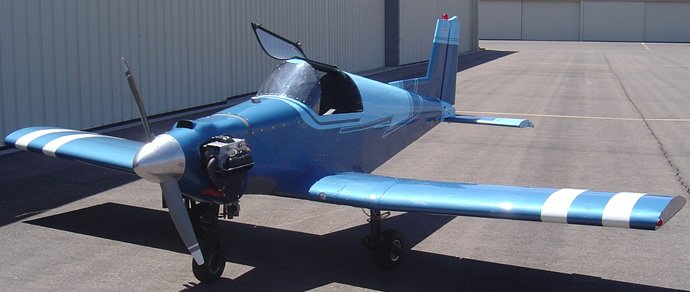
Democratizing Aviation Through Simple Design
The Teenie Two emerged during the late 1960s homebuilt aviation boom when Calvin Y. Parker recognized that most amateur builders lacked the specialized metalworking skills required for aircraft construction. Parker's revolutionary approach eliminated the need for expensive bending brakes or professional riveting experience, instead utilizing hand-formed aluminum sheet metal techniques that any dedicated builder could master in their garage.
Parker promoted his design through grassroots marketing, traveling across the country with a partially built example towed behind his automobile. This hands-on demonstration approach, operating from his mother's home in Meridian, Mississippi during the early 1960s promotional phase, embodied the Experimental Aircraft Association's philosophy of bringing aviation to everyday enthusiasts.
Production and Global Reach
Plans sales began in 1969, with Parker operating as a sole proprietor from Claremont, North Carolina. Over 100 examples were completed worldwide through the 1990s, with individual builds documented as late as 1996. The design's international appeal extended far beyond American shores, with notable examples including ZK-TTO built by D. McGill in Blenheim, New Zealand during the mid-1980s, and a modified variant designated SF-01 (registration HB-YAO) completed in Switzerland in 1974.
Parker's informal business model meant no centralized factory existed – builders worldwide ordered plans directly and sourced their own materials. This approach kept costs minimal while fostering a global community of Teenie Two enthusiasts who shared construction techniques and modifications through EAA publications and fly-ins.
Calvin Y. Parker: Pioneer Designer
Calvin Y. Parker began his homebuilt aircraft development with the JT-1, which first flew in 1968, serving as the foundation for the improved Teenie Two design. Parker's engineering philosophy centered on practicality over performance extremes, creating aircraft that prioritized buildability and affordability while maintaining respectable flying characteristics.
The designer's commitment to supporting builders extended well beyond initial plans sales. EAA publications listed Parker's contact information through 2001, indicating decades of ongoing technical support for the homebuilt community. His Claremont, North Carolina address (P.O. Box 928, Claremont NC 28610) became well-known among sport aviation enthusiasts seeking guidance on construction challenges.
Volkswagen Power: Automotive Aviation
The Teenie Two's success depended heavily on reliable, inexpensive powerplants, leading Parker to specify Volkswagen 1,600cc automotive engines producing 53 to 65 horsepower. These air-cooled, flat-four engines proved ideal for homebuilt applications, offering proven reliability at a fraction of certified aircraft engine costs.
Builders typically machined their own propeller hubs and performed the automotive-to-aircraft conversion themselves, further reducing costs while providing valuable hands-on experience. The VW conversion movement peaked during the 1960s through 1980s, with thousands of automotive engines finding new life in experimental aircraft applications.
Performance and Flying Characteristics
Despite its diminutive size, the Teenie Two delivered impressive performance for its 65-horsepower powerplant. The aircraft achieved 140 mph maximum speed and 110 mph cruise, with a 1,000 feet-per-minute climb rate that allowed brisk departures from short strips. Stall speed of 50 mph provided reasonable approach speeds for amateur pilots.
The design's 600-foot takeoff roll and 800-foot landing distance made it suitable for small airports, while its 400-mile range with 9 gallons of fuel provided meaningful cross-country capability. These specifications represented an ideal balance for weekend sport flying and local aviation events.
Enduring Legacy and Modern Status
Active Teenie Twos continue operating worldwide as of 2025, evidenced by recent accident reports indicating ongoing flight activity. The type's simple construction and reliable powerplant have contributed to remarkable longevity, with many examples remaining airworthy decades after completion.
The design's cultural significance extends beyond its technical achievements. Featured regularly in Sport Aviation magazine from 1970 through 2001, the Teenie Two inspired countless builders to attempt their first aircraft project. A 2022 YouTube documentary featuring a 1996-built example demonstrates continued enthusiasm for Parker's creation among modern aviation enthusiasts.
While exact airworthy numbers remain unknown due to the type's homebuilt nature, the Teenie Two's influence on subsequent amateur-built designs cannot be overstated. Parker's emphasis on accessible all-metal construction techniques established principles still followed by kit manufacturers today, making the tiny sport plane a true pioneer in democratizing aircraft ownership.