
Dominating American Aviation
The Travel Air 2000's commercial success was unprecedented in 1920s American aviation. Production numbers tell the story of its market dominance: 19 aircraft in 1925, 46 in 1926, and a remarkable 530 units in 1928 alone. By early 1928, Travel Air had delivered over 1,000 Type 2000s and 4000s combined, contributing to their total output of 1,696 aircraft by 1930. This production volume made Travel Air the top-selling aircraft manufacturer in the United States throughout the late 1920s.
Pacific Air Transport operated numerous Travel Air 2000s as mail carriers, while barnstormers and private operators relied on the type for cross-country travel and aerial demonstrations. The aircraft's three-seat configuration—two passengers in front cockpits and a pilot in the rear—proved ideal for commercial passenger operations and flight training. Some operators fitted floats for seaplane operations, expanding the type's versatility.
The Wichita Powerhouse
Travel Air Manufacturing Company represented a convergence of aviation talent that would reshape American aircraft manufacturing. Founded in January 1925 in Wichita, Kansas, the company brought together Walter Beech, Clyde Cessna, Lloyd Stearman, and Walter Innes Jr.—names that would become synonymous with general aviation excellence. Each founder contributed expertise that elevated the Travel Air 2000 above its competitors.
Lloyd Stearman led the design team, drawing structural inspiration from the proven Fokker D.VII fighter aircraft. The resulting biplane featured innovative balanced ailerons that earned the nickname "Old Elephant Ears" due to their distinctive appearance. The company pioneered assembly-line production techniques for aircraft manufacturing, enabling profitable mass production that competitors couldn't match.
Travel Air's success ended abruptly with the Great Depression. Curtiss-Wright absorbed the company in 1930, closing one of aviation's most successful chapters. The vacant Wichita factory briefly housed a new venture in 1932-1933 when Clyde and Eldon Cessna rented space to build custom racing aircraft, including the CR-2 and CR-3 racers.
Power and Performance
The Curtiss OX-5 engine defined the Travel Air 2000's operational characteristics. This liquid-cooled V-8 powerplant produced 90 horsepower at 1,400 rpm, with short-term capability of 105 horsepower at 1,800 rpm. Weighing 390 pounds and displacing 503 cubic inches, the OX-5 represented America's first mass-produced aircraft engine, with over 12,000 units manufactured from the 1910s through the late 1920s.
Some Travel Air 2000s received engine upgrades, including the 100-horsepower Curtiss OXX-6. Aircraft CF-AFG, the 720th example built in 1929, underwent this conversion during its operational life. The water-cooling system required additional maintenance compared to air-cooled radials, but provided reliable power throughout the engine's operational temperature range.
The most unusual powerplant conversion occurred in 1933 when brothers George and William Besler installed an experimental steam engine in a Travel Air 2000. This oil-fired reversible V-twin compounding steam powerplant achieved the first successful steam-powered flight, demonstrating the airframe's adaptability to alternative propulsion systems.
Wartime Restrictions
While never designed for military service, civilian Travel Air 2000s faced wartime restrictions during World War II. Canadian aircraft CF-AFG was withdrawn from service in July 1941 as authorities restricted civilian aviation operations. In Australia, VH-UGY received camouflage paint with Royal Australian Air Force-style markings in 1942 before final deregistration in April 1944.
The Australian example, construction number 287 built in 1928, had previously competed in the 1936 Brisbane-Adelaide Air Race under the name Wings of Song. The aircraft's racing career ended when it bogged down during the competition. Burnt remains discovered in 1966 marked the end of this particular airframe's story.
Preserved Legacy
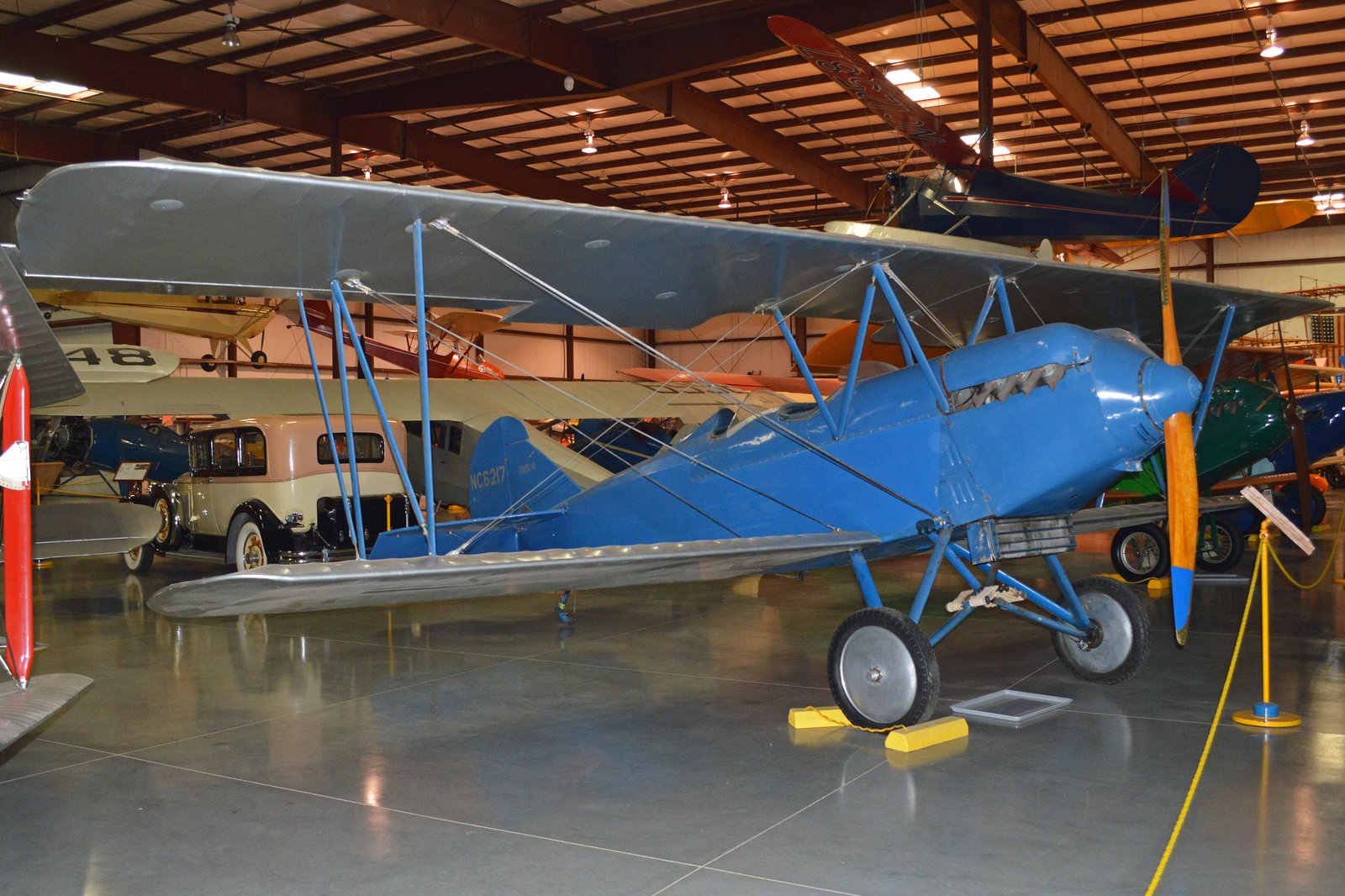
Three Travel Air 2000s survive in museum collections today. The Canada Aviation and Space Museum in Ottawa displays CF-AFG, fully restored with an OX-6 engine and freshly doped wings. The Port Townsend Aero Museum completed restoration of their 1928 example in 2017, configured as a Pacific Air Transport mail carrier. California's Yanks Air Museum maintains the third preserved airframe in their collection.
Fewer than a handful of Travel Air 2000s remain airworthy today, though Orlando Helicopter Airways in Deland, Florida, produces modern kit versions with updated engines producing up to 300 horsepower. These reproductions allow builders to experience the classic biplane configuration with contemporary powerplants and systems.
The Travel Air 2000's significance extends beyond production numbers. Its commercial success demonstrated that quality general aviation aircraft could compete in the marketplace through superior design and manufacturing efficiency. The company's founders—Beech, Cessna, and Stearman—later established separate aircraft companies bearing their names, creating legacies that continue today. Their initial collaboration on the Travel Air 2000 established Wichita as America's general aviation capital and proved that innovative design, quality construction, and efficient production could dominate the aviation market.