
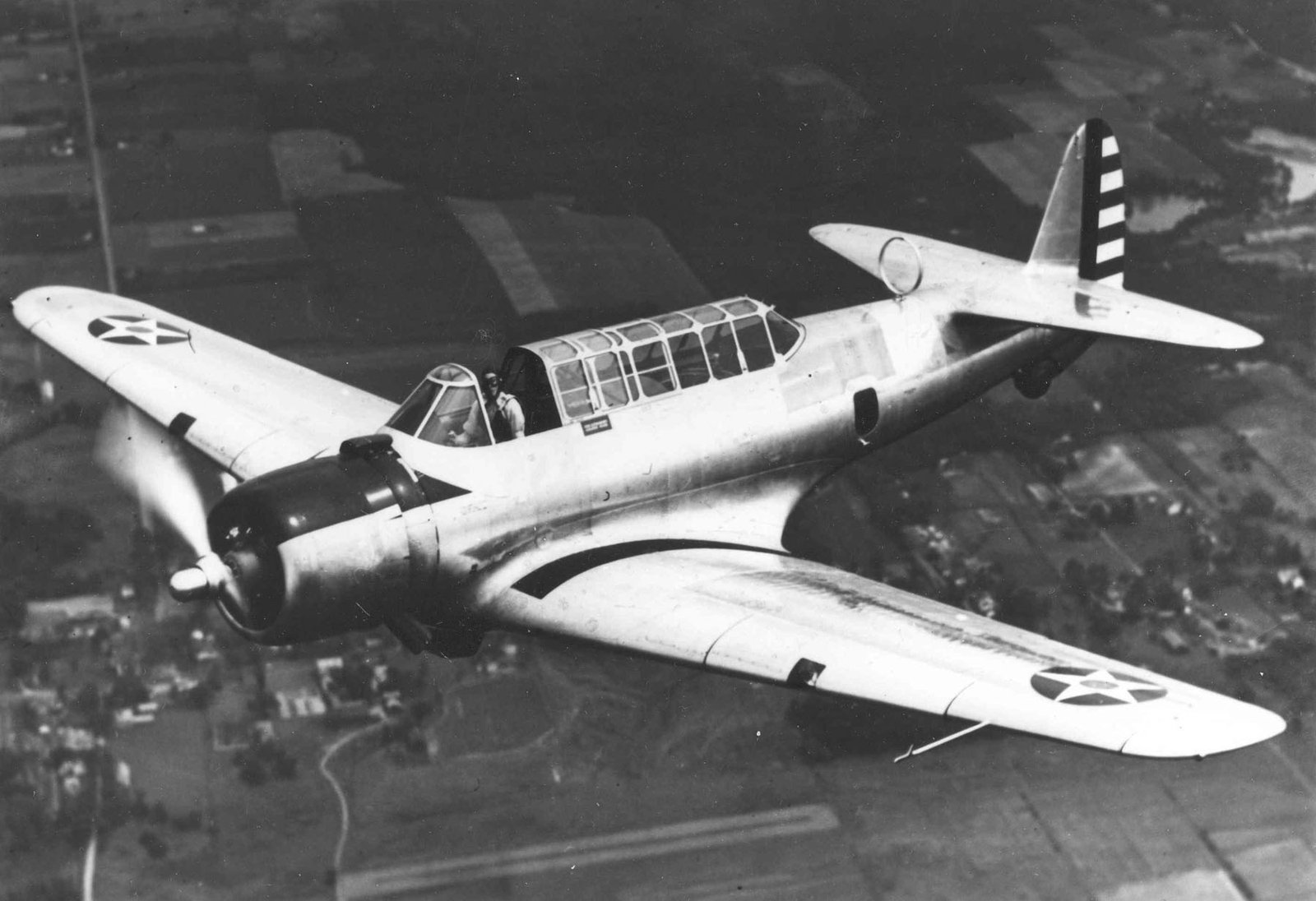
The Vultee V-11 was an American single-engine light bomber and attack aircraft developed in the 1930s. Designed by Gerard Vultee, the aircraft was a military adaptation of the V-1A, a single-engine passenger transport. This transition represented a significant design shift, resulting in a stressed-skin monocoque, all-metal, low-wing monoplane. The aircraft first flew in 1935, offering a modern structural approach compared to many of its contemporaries.
Production occurred throughout the mid-to-late 1930s at Vultee's plants in the United States. While a definitive total production number for all V-11 variants is not provided, records indicate that the underlying V-1 civil airliner production ended at 25 aircraft. Deliveries to China took place between July 1937 and April 1938, and the U.S. Army procured the YA-19 variant in 1938. The manufacturer, Vultee Aircraft, Inc., later merged into the Consolidated Vultee Aircraft Corporation during the Second World War.
Technical specifications varied by customer and variant. Most Vultee-built models utilized the 9-cylinder air-cooled Wright GR-1820-G2 radial engine, producing 850 hp. The U.S. Army's YA-19 variant was powered by a 1,200 hp Pratt & Whitney R-1830-17 Twin Wasp radial piston engine, while the XA-19A evaluation aircraft used a 1,200 hp Lycoming P-1230-1. The YA-19 configuration featured a crew of three, consisting of a pilot, a bombardier/photographer, and an observer/gunner. This variant was armed with six .30 caliber machine guns and could carry a bomb load of up to 1,080 lb (490 kg), though some V-11 sources cite a maximum load of 1,100 lb.
Operationally, the V-11 saw significant combat in the Second Sino-Japanese War. The 14th International Volunteer Squadron (also known as the 14th Volunteer Bombardment Squadron), based at Hankow, utilized the aircraft. On February 7, a mission involving American, French, and Chinese aircrew used six Vultees to attack Japanese troop concentrations north of Nanking. Brazil also operated the type, acquiring 26 V-11-GB2s. Brazilian aircraft engaged in anti-submarine warfare, attacking a surfaced German U-boat on August 26, 1942, and conducting another attack near Araranguá on February 26, 1942. Other operators included Turkey and the Soviet Union, the latter of which produced BSh-1 and PS-43 derivatives under license or from imported parts.
In the United States, seven YA-19s were ordered for comparison testing against twin-engine attack aircraft. Five were redesignated as A-19s and assigned to the 17th Attack Group at March Field, California, before being moved to the Panama Canal Zone for liaison and utility transport work; these aircraft did not see combat. While a floatplane variant, the V-11GB2F, was developed for water operations, it was deemed impractical for operational service.