
Development and Design Philosophy
The VA-10 Vantage emerged from VisionAire Corporation's revolutionary vision to democratize business jet aviation by creating an affordable single-engine alternative to expensive twin-engine aircraft. Founded in 1988 specifically to develop this concept, VisionAire collaborated with Burt Rutan's renowned Scaled Composites facility in Mojave, California, to engineer a design that would challenge conventional wisdom about business jet configuration.
The aircraft's most distinctive feature was its forward-swept wing design, a configuration chosen to solve the competing demands of high-speed cruise performance and exceptional low-speed handling characteristics. This innovative wing geometry enabled the Vantage to achieve its target cruise speed of 350 knots while maintaining a remarkably low landing speed of just 70 knots, allowing operations from 2,500-foot runways that were inaccessible to most business jets.
The Manufacturer's Journey
VisionAire Corporation established its primary operations in Ames, Iowa, where local community support helped fund the completion of a manufacturing facility in 1997. The company's ambitious timeline called for certification and production to begin shortly after the prototype's first flight, with initial aircraft pricing set at an unprecedented $1.75 million—substantially below comparable twin-engine business jets of the era.
The proof-of-concept aircraft, registered as N247VA, successfully completed its maiden flight from Mojave Air and Space Port on November 16, 1996. This milestone represented years of engineering development and marked the aviation industry's first serious attempt to create a single-engine turbine business aircraft.
Technical Specifications and Performance
Powering the Vantage was a single Pratt & Whitney JT15D-5D turbofan engine, a proven powerplant producing 1,370 kg of thrust. VisionAire deliberately selected this established engine rather than developing new propulsion technology, recognizing that reliability and maintenance support would be crucial for market acceptance. The JT15D series had already demonstrated its capabilities in twin-engine applications, making it an logical choice for this pioneering single-engine installation.
The aircraft's design specifications promised exceptional versatility: a 1,000-nautical-mile range while carrying a 1,250-pound payload, combined with the ability to access smaller airports typically beyond the reach of business jets. These performance parameters would have positioned the Vantage as an ideal aircraft for companies and individuals requiring jet performance without the operational costs associated with larger, twin-engine alternatives.
Development Challenges and Technical Setbacks
Despite the innovative design concept, the VA-10 encountered significant technical obstacles during its development phase. Engineering teams identified critical issues affecting the wing design, landing gear systems, engine inlet configuration, and interior arrangements. These problems required extensive redesign work that consumed both time and financial resources, pushing the program far beyond its original certification timeline.
The prototype was grounded in December 1998, more than two years after its first flight, to address certification requirements and resolve outstanding technical issues. This extended development period proved costly for VisionAire, as competitor aircraft like the Cessna Citation Jet gained market momentum while the Vantage remained uncertified.
Market Response and Financial Struggles
By late 1998, despite the ongoing technical challenges, VisionAire had accumulated 150 firm orders for the Vantage, with the first two production aircraft scheduled for completion in early 1999. This substantial order book demonstrated significant market interest in the single-engine business jet concept and validated VisionAire's belief that demand existed for an affordable alternative to traditional business aircraft.
However, financial pressures mounted as development costs escalated. By January 2003, VisionAire had invested $110 million in the project while accumulating $35 million in debt. The combination of technical setbacks, certification delays, and mounting financial obligations effectively halted active development, leaving the program largely dormant despite the substantial order backlog.
Attempts at Revival
VisionAire Corporation's bankruptcy led to the acquisition of its intellectual property by real-estate developer Matt Eller in October 2003 for $441,000. Eller established Eviation Jets to continue development, proposing a redesigned twin-engine variant designated EV-20 Vantage. This new configuration would have featured two Williams turbofan engines, cruise capability of 488 mph at 36,000 feet, a 1,300-nautical-mile range, and seating for 8-10 passengers, with pricing targeted between $2 million and $2.5 million.
Subsequent revival attempts included the formation of VisionAire Jets, which announced plans in early 2013 to construct the Vantage at a North Carolina facility with a prototype flight scheduled for 2014. However, by the end of 2015, no tangible progress had been achieved, and these efforts ultimately failed to resurrect the program.
Legacy and Current Status
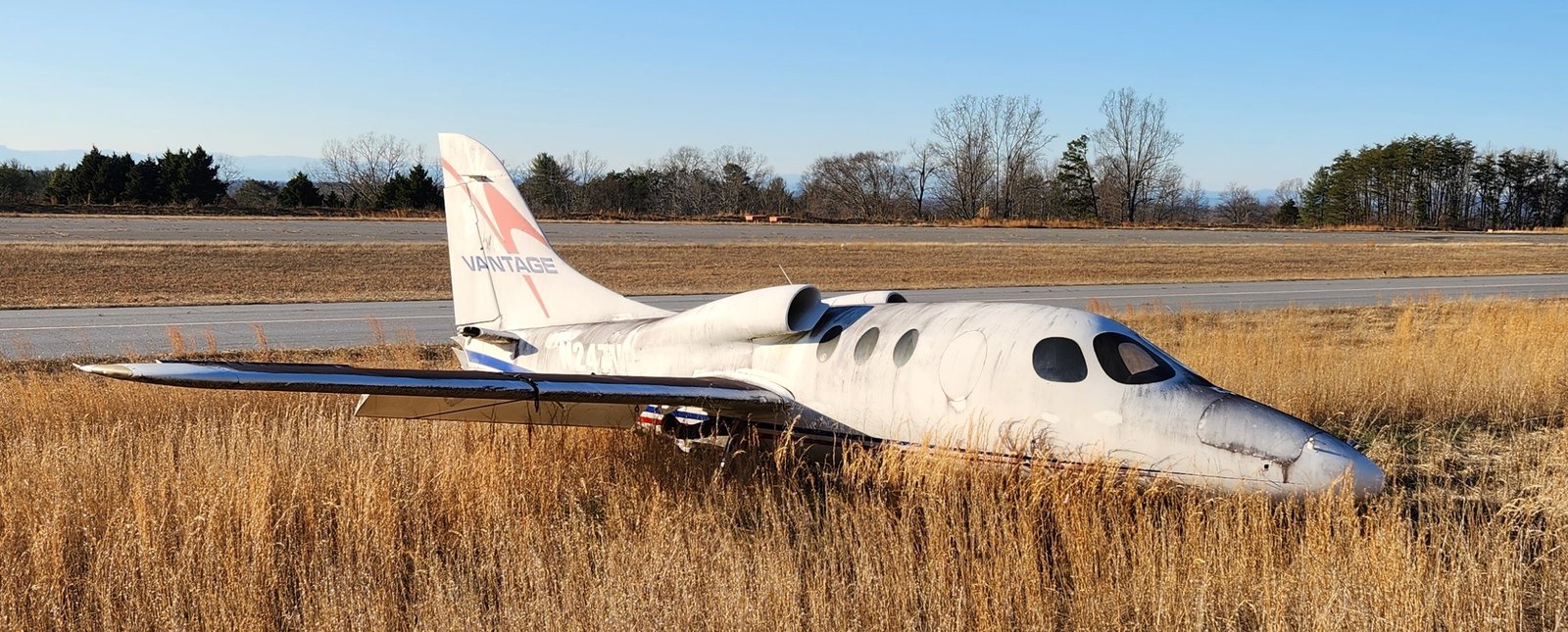
The single VA-10 Vantage prototype now sits abandoned at Hickory Regional Airport in North Carolina, a testament to both the innovation and the challenges inherent in developing revolutionary aircraft designs. While the program failed to achieve its commercial objectives, the Vantage pioneered the single-engine business jet concept that would eventually influence later developments in the light jet market.
The aircraft's forward-swept wing design and focus on operational efficiency from short runways demonstrated engineering approaches that challenged conventional business aviation thinking, even though technical and financial obstacles prevented these innovations from reaching production status.