
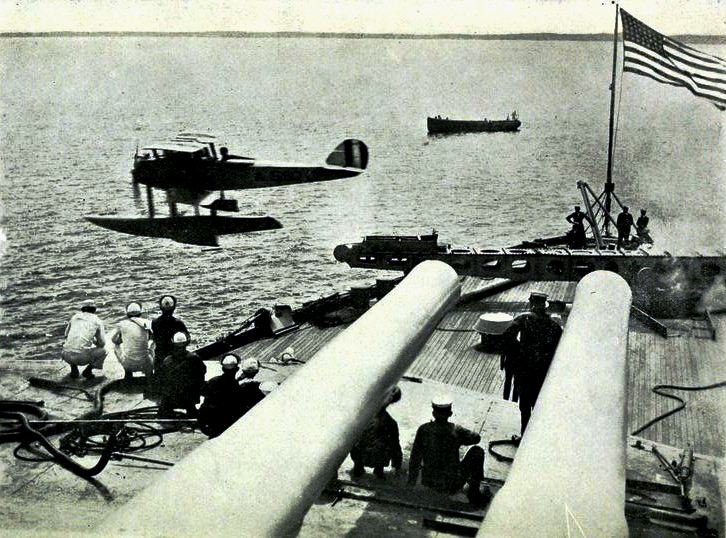
The Vought VE-7 Bluebird was the inaugural aircraft produced by the Lewis & Vought Corporation, a firm founded by Chance Milton Vought and Birdseye B. Lewis. Designed in response to a U.S. government requirement for an advanced trainer, the VE-7 was a two-place tractor biplane of fabric-covered construction. While intended as a trainer, its performance was highly regarded; Brigadier General William "Billy" Mitchell praised the aircraft as being superior to the Allied combat types then operating over the Western Front during World War I.
Production activity began in early 1918, with the first test aircraft delivered to the government on February 11, 1918. Manufacturing was shared between the Lewis & Vought Corporation and the U.S. Naval Aircraft Factory in Philadelphia, the latter of which produced approximately half of the Navy's order using Lewis & Vought plans. The U.S. Army Air Service ordered 14 units for advanced training, all built by Lewis & Vought. The U.S. Navy acquired 128 examples. Consequently, total production is documented as being at least 142 aircraft, though an authoritative total for all users is not firmly stated in the records.
Technically, the VE-7 was powered by a 180-horsepower Wright-Hispano E-3 liquid-cooled V-8 piston engine. The aircraft's versatility allowed it to be fitted with either wheels or floats, enabling operations from land, water, or carrier decks. This adaptability led to its role as the U.S. Navy's first carrier-based fighter, equipping the first two fighter squadrons, VF-1 and VF-2. On October 17, 1922, a VE-7SF from VF-2 achieved a milestone by becoming the first aircraft to take off from the USS Langley (CV-1).
Beyond carrier operations, the VE-7 was used for compressed-air catapult tests on battleships and cruisers, including the USS Maryland (BB-46). In 1925, pilots from VF-2B conducted early dive-bombing experiments at Ream Field, San Diego, by fitting bomb racks to their aircraft. While the Army used the VE-7 strictly for training, the Navy employed various versions as fighters, trainers, and observation aircraft until they were last reported in inventory in 1928.