
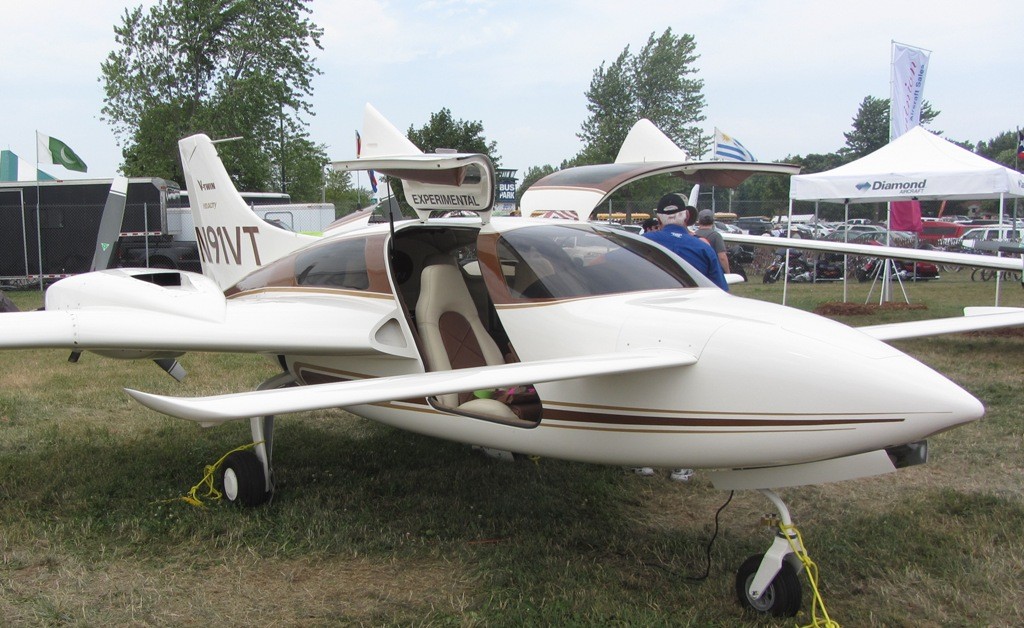
Development and Innovation
The V-Twin's origins trace back more than a decade before its maiden flight, when Duane Swing crafted a wooden scale model of his twin-engine vision and displayed it at the Sun 'n Fun Fly-In in 2002. The concept generated immediate interest from over 100 aviation enthusiasts, yet actual development remained dormant until late 2011 when Velocity Aircraft committed to bringing the design to reality.
Swing's revolutionary approach addressed a fundamental safety problem that had plagued twin-engine general aviation for decades. Traditional twin-engine aircraft, with their engines mounted far apart on the wings, created dangerous asymmetrical thrust conditions when one engine failed. This asymmetry often resulted in uncontrollable yaw moments that could lead to deadly spins, particularly during critical phases of flight like takeoff and landing. The V-Twin's centerline-mounted pusher engines virtually eliminated this hazard by reducing asymmetrical thrust to negligible levels.
Test pilot Abraham lifted the prototype into Florida skies on March 13, 2012, marking the culmination of Swing's decade-long vision. The aircraft demonstrated remarkable single-engine handling characteristics, with minimum controllable airspeed falling well below the airplane's stall speed—a critical safety margin impossible to achieve in conventional twins.
The Manufacturer's Evolution
Velocity Aircraft emerged from humble beginnings when Danny Maher founded the company in 1984, designing and constructing the original Velocity prototype that achieved first flight in October 1985. The Sebastian, Florida-based operation changed hands in 1992 when brothers Scott and Duane Swing acquired the company, bringing fresh engineering perspectives to the canard aircraft market.
The Swing brothers implemented significant design improvements throughout the 1990s, most notably introducing distinctive gull-wing doors in 1995 that became a trademark feature across the Velocity line. Under their stewardship, the company evolved from a small startup into an established player in the experimental aircraft kit market, with the V-Twin representing their most ambitious engineering achievement.
Engine and Performance Specifications
Powering the V-Twin are two Lycoming IO-320 engines, each delivering 160 horsepower through three-bladed MT propellers. These naturally aspirated, air-cooled, four-cylinder powerplants have served the general aviation industry reliably for decades, offering proven durability and widespread maintenance support. The engines' close-coupled mounting arrangement not only enhances safety but also improves aerodynamic efficiency by minimizing drag-inducing nacelles.
At typical cruise altitude of 10,000 feet, the V-Twin achieves 170 knots true airspeed while consuming just 12 gallons per hour total—remarkable fuel efficiency for a twin-engine aircraft. The airplane's 100-gallon fuel system, distributed between two 48-gallon wingtip tanks and a five-gallon header tank, provides more than 1,100 nautical miles range with substantial reserves.
Single-engine performance capabilities distinguish the V-Twin from its conventional counterparts. At maximum gross weight and 12,000 feet altitude, the aircraft maintains level flight on one engine. At 7,500 feet with 9,500-foot density altitude conditions, it climbs at 100 feet per minute on single-engine power, with maximum single-engine climb capability extending to 8,000 feet.
Design Philosophy and Construction
The V-Twin employs composite construction throughout, utilizing advanced materials and techniques that Velocity Aircraft refined across three decades of canard aircraft development. The configuration features the company's signature canard layout with a single vertical stabilizer—a departure from the twin end-plate fins used on single-engine Velocity models. This central fin arrangement optimizes directional stability while complementing the pusher propeller installation.
Dual sidestick controllers provide redundant flight control capability, while the spacious cabin accommodates four passengers as standard with an optional fifth seat. The retractable tricycle landing gear retracts cleanly into the composite structure, contributing to the aircraft's impressive cruise efficiency.
Production and Market Impact
Velocity Aircraft launched V-Twin production in early 2013 following extensive flight testing and certification activities. As of current records, 27 aircraft have been completed, representing steady but selective adoption among experimental aircraft builders willing to tackle the complexity of a twin-engine homebuilt project.
The V-Twin's market significance extends beyond mere production numbers. Test pilots and aviation safety experts recognized the design as addressing fundamental twin-engine safety concerns that conventional manufacturers had never successfully resolved. As the prototype's test pilot noted, "No one has ever brought an economical twin to market that's incapable of spinning," highlighting the V-Twin's breakthrough achievement in twin-engine safety.
Legacy and Continuing Development
The V-Twin established new benchmarks for twin-engine general aviation safety while delivering impressive performance capabilities typically associated with much larger and more expensive aircraft. Its resemblance to the Beechcraft Starship, though superficial, reflects similar advanced thinking about pusher configurations and canard layouts in pursuit of optimal aerodynamic efficiency.
Velocity Aircraft continues offering V-Twin kits to qualified builders, maintaining its position as the only manufacturer providing an economical twin-engine homebuilt design with inherently safe single-engine handling characteristics. The aircraft represents the successful culmination of Duane Swing's vision to democratize twin-engine flying by eliminating the asymmetrical thrust dangers that had claimed countless lives in conventional twin-engine aircraft.