
Record-Breaking Dominance
The Vega Gull achieved its greatest fame in the 1936 Schlesinger Race from England to Johannesburg, where C.W.A. Scott and Giles Guthrie in aircraft G-AEKE became the only finishers after 52 hours 56 minutes 48 seconds of flight time. This spectacular victory generated enormous publicity for Percival Aircraft and directly led to the company establishing expanded production facilities in Luton. The aircraft's success in long-distance flying attracted aviators worldwide, with notable pilot Beryl Markham attempting the first solo transatlantic flight in a Vega Gull, though her aircraft ended in an American bog.
The Designer and His Vision
Captain E.W. Percival designed the Vega Gull as an evolution of his earlier D-Series Gull, with specific objectives to accommodate four occupants, incorporate dual controls, and dramatically improve utility without sacrificing speed. Working with draughtsman Arthur Bage, Percival implemented sophisticated aerodynamic refinements including a widened fuselage, increased wingspan, and reduced parasitic drag from external fittings. The result was an aircraft that matched the performance of the sleeker Gull Six while offering significantly enhanced practicality for touring and record attempts.
Manufacturing and Production
Percival Aircraft Limited began Vega Gull production at their Gravesend facility in 1935, becoming a limited company in 1936 following their racing success. The company relocated to larger premises in Luton, where they completed all 90 production aircraft by July 27, 1939, when the final example made its maiden flight. The aircraft featured an innovative wing-folding mechanism to conserve hangar space, with later examples incorporating an improved system using a tommy bar that retracted inside the wing structure.
Technical Excellence
Powered by the de Havilland Gipsy Six air-cooled inline engine, most Vega Gulls received the optional Series II variant of this six-cylinder, 200-horsepower powerplant. First developed by de Havilland in 1934, the Gipsy Six became the engine of choice for racing and record-breaking aircraft throughout the decade. The Vega Gull's wooden frame construction, covered in doped fabric, incorporated flaps of greater area than earlier Gull variants, contributing to its superior handling characteristics and operational flexibility.
Global Operations
Vega Gulls found buyers across the British Empire and beyond, with aircraft delivered to Australia, Canada, India, Iraq, Japan, and Kenya. Multiple examples were christened for specific record attempts, including one named "County of Monmouth" by the Mayor of Newport for a Cape record flight, and another flown by H.F. Broadbent on an outward record attempt to Flores. The aircraft's combination of speed, range, and reliability made it the preferred choice for ambitious long-distance flights during the late 1930s.
Wartime Service
World War II brought military service for many Vega Gulls through government impressment. Aircraft G-AFIE served as a wartime communications aircraft with Smith's Aircraft Instruments Ltd at Hatfield until its destruction during a German air raid on Hendon aerodrome on October 10, 1940. In Australia, Vega Gull VH-UVG was impressed into Royal Australian Air Force service as A32-1 in 1940, retaining its civil paintwork including the distinctive Gull motif under the windscreen before returning to civilian use in 1946.
Evolution and Legacy
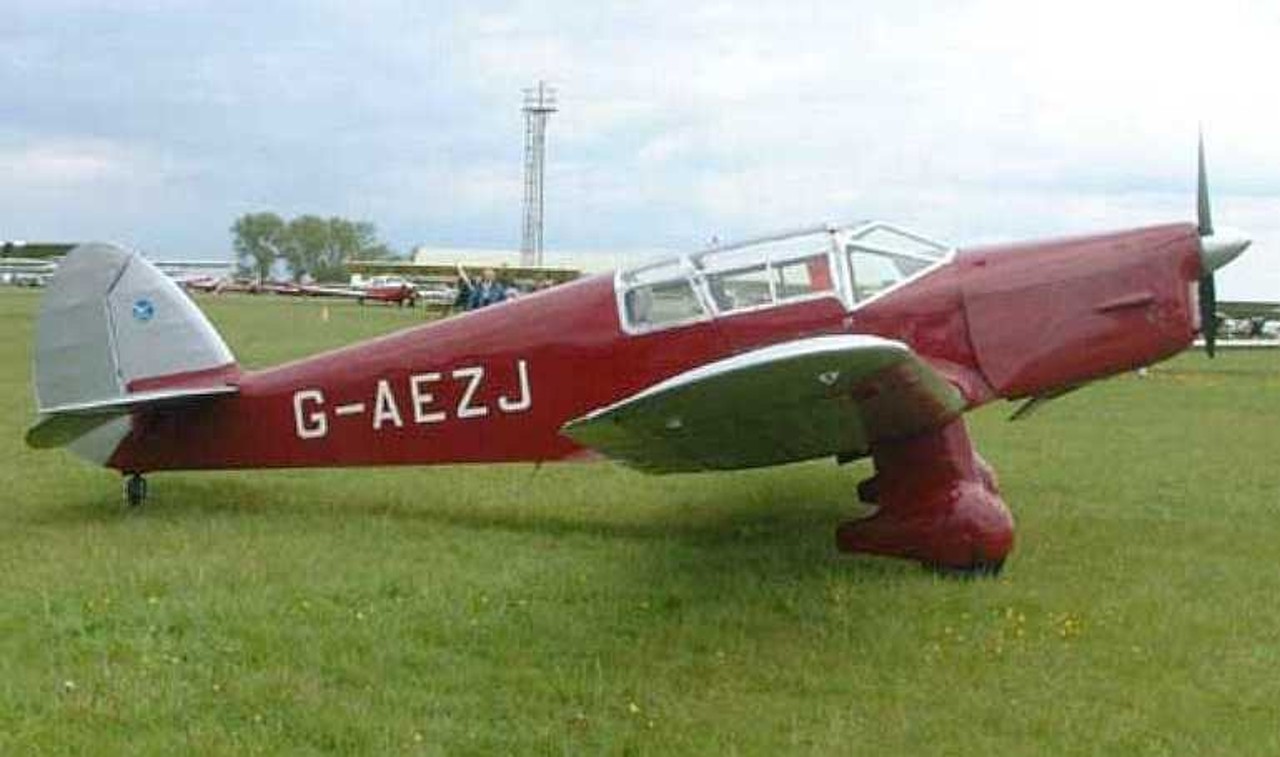
By war's end, the Vega Gull had been largely superseded by Percival's military Proctor trainer, of which more than 1,100 examples were manufactured for the Royal Air Force. However, the Vega Gull's influence on aircraft design continued, representing a crucial bridge between the pure racing machines of the early 1930s and the practical touring aircraft that followed. Several examples survive today, including G-AEZJ, which was restored to flying condition near Salisbury, Wiltshire after arriving from Sweden in 1987.
The National Museum of Australia maintains a three-seat Percival Gull predecessor in pristine condition, preserving the original de Havilland Gipsy Six Series 1 engine as a testament to 1930s engineering excellence. The Vega Gull's design philosophy of combining speed with utility established principles that influenced general aviation aircraft development for decades, making it one of the most significant touring aircraft of aviation's golden age.