
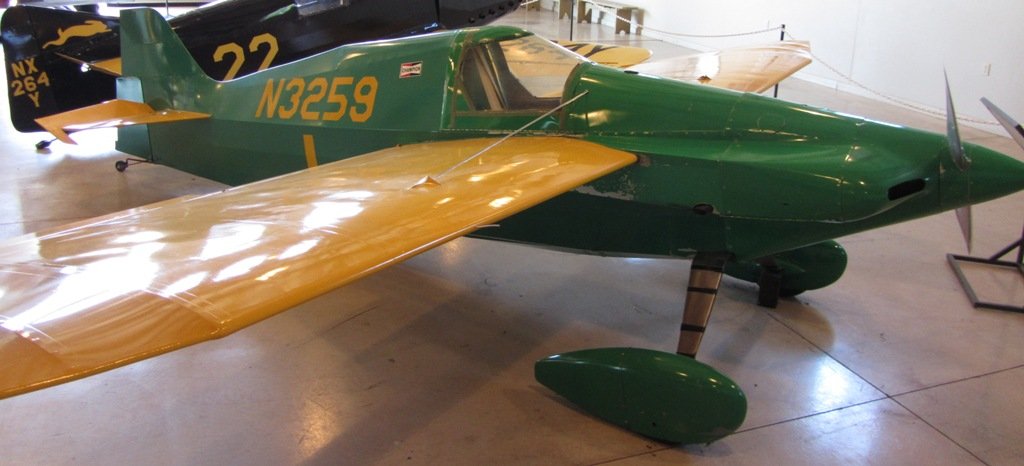
Racing Heritage and Formula V Innovation
The V-Witt emerged from Steve Wittman's vision to democratize air racing through affordable aircraft design. Wittman, already famous for setting a world speed record of 238.22 mph in his Chief Oshkosh racer in 1937, recognized that traditional racing aircraft were becoming prohibitively expensive for amateur pilots. His solution was Formula V racing, a class built around modified Volkswagen engines that could deliver competitive performance at a fraction of traditional racing costs.
Wittman's prototype made its racing debut in 1972 and competed successfully through 1981, proving that the concept of economical racing aircraft was viable. The design achieved its 165 mph maximum speed while maintaining an empty weight of just 430 pounds, demonstrating exceptional power-to-weight efficiency.
Design Philosophy and Engineering
The V-Witt embodied Wittman's minimalist approach to aircraft design. Its welded steel tube fuselage provided structural integrity while keeping weight low, and the fabric covering reduced both cost and maintenance complexity. The wire-braced wing configuration, spanning 20 feet with 75 square feet of area, allowed for a lightweight structure that could handle racing loads.
Wittman incorporated a 12-inch propeller extension to achieve optimal cowling streamlining around the converted Volkswagen engine. This attention to aerodynamic detail, combined with the aircraft's clean lines and minimal frontal area, enabled the V-Witt to extract maximum performance from its modest 60-70 horsepower powerplant.
The original design featured square wingtips, later modified with triangular extensions to improve the wing's aspect ratio and enhance overall aerodynamic efficiency. These refinements demonstrated Wittman's continuous development philosophy, where racing experience directly informed design improvements.
The Volkswagen Powerplant Revolution
The choice of Volkswagen's air-cooled flat-four engine represented a revolutionary approach to aircraft power. While aviation engines typically cost thousands of dollars, used VW engines could be acquired for hundreds and modified using Wittman's detailed conversion plans. The 1600cc engine, originally designed for automotive use, proved remarkably adaptable to aviation applications when properly converted.
This powerplant selection made Formula V racing accessible to builders who could not afford traditional aircraft engines. The VW conversion retained the automotive engine's reputation for reliability while providing sufficient power for competitive racing performance.
Steve Wittman's Legacy
Steve Wittman's career spanned aviation's golden age of racing and homebuilding. Beyond the V-Witt, he designed the famous Tailwind, which became the first amateur-built aircraft certified under CAR 174-3 regulations in 1953. His racing achievements included numerous speed records and innovations that influenced generations of aircraft designers.
Wittman's death in 1995 marked the end of an era, but his designs continued to inspire builders worldwide. His philosophy of practical, affordable aircraft construction resonated with the homebuilt community's core values of innovation and self-reliance.
Aircraft Spruce's Role
Aircraft Spruce & Specialty Company, founded in 1965 by Bob and Flo Irwin, began as a supplier of aircraft-grade spruce lumber before expanding into comprehensive homebuilt support. The company acquired rights to Wittman designs through his estate in January 1996, ensuring continued availability of both Tailwind and V-Witt plans.
The 1999 redrawing of the original circa-1970 plans brought updated drafting standards while preserving Wittman's design intent. Aircraft Spruce's distribution network, operating from facilities including their Corona, California location, has kept these classic designs available to new generations of builders.
Current Status and Museum Preservation
Wittman's original V-Witt prototype now resides at the EAA AirVenture Museum in Oshkosh, Wisconsin, where it serves as a testament to innovative racing design. The aircraft's preservation ensures that future generations can study Wittman's engineering approaches and understand the evolution of homebuilt racing aircraft.
While exact numbers of completed V-Witts remain unknown due to the amateur-built nature of the design, plans continue to sell through Aircraft Spruce, indicating ongoing interest in the type. The design's 350-mile range and 15,000-foot service ceiling provide practical cross-country capability beyond pure racing applications.
The V-Witt's legacy extends beyond its competitive achievements to its role in establishing affordable racing as a viable pathway into aviation. By proving that innovative design could overcome budget limitations, the V-Witt inspired countless builders to pursue their own aviation dreams through homebuilt construction.