
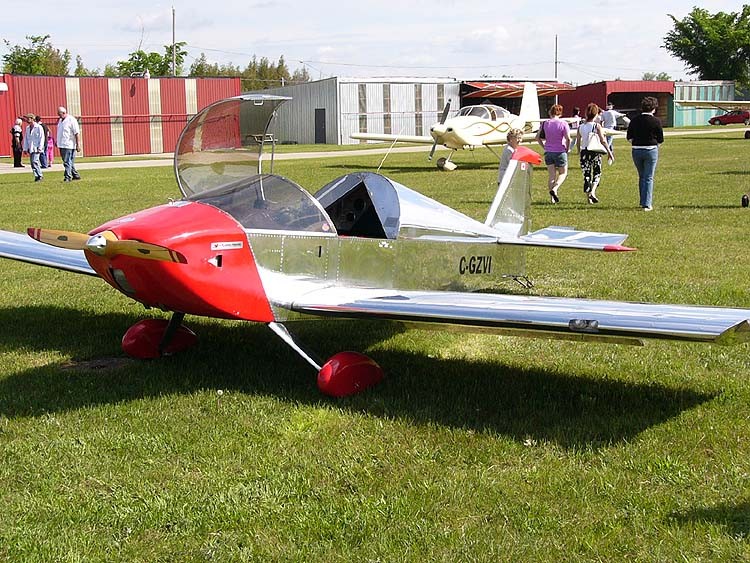
Design Genesis and Development
The Waiex emerged from an intriguing design reversal in aviation history. Aircraft designer John Monnett, working alongside mechanical engineer and A&P Pete Buck, originally conceived the Y-tail configuration for what would become the Sonex aircraft family. However, concerns about market acceptance led the team to pursue a conventional tail design for the initial Sonex model. The Y-tail concept, shelved but not forgotten, eventually found its expression in the Waiex variant.
Monnett's vision centered on creating lightweight, affordable aircraft that would democratize aviation access for homebuilders. His approach emphasized simplicity without sacrificing performance, a philosophy that would prove prescient in the growing experimental aircraft market of the early 2000s.
Manufacturing and Production Philosophy
Sonex Aircraft, LLC, established in 1998 by John Monnett in Oshkosh, Wisconsin, adopted a kit-only approach for the Waiex from its inception. Unlike the original Sonex, which offered plans-built options, the first Waiex kit shipped in 2004 exclusively as a complete kit package. This decision reflected lessons learned about builder success rates and the complexity of the Y-tail configuration, which benefited from factory-precision components.
By 2014, the entire Sonex family—including the Onex, Sonex, Waiex, and Xenos variants—had achieved 500 completed customer-built aircraft. This milestone demonstrated the viability of Monnett's design philosophy and Sonex Aircraft's manufacturing approach.
Technical Innovation and Engine Flexibility
The Waiex accommodates a remarkable range of powerplants, accepting engines from 80 to 130 horsepower while maintaining a weight restriction of less than 200 pounds. Initial engine options included the company's own AeroVee and AeroVee Turbo units, based on Volkswagen automotive engines, alongside the Jabiru/CAMit 3300. This flexibility allowed builders to balance performance desires with budget constraints.
The aircraft's all-aluminum construction provides durability while maintaining the low weight essential for sport flying performance. The distinctive Y-tail configuration, while visually striking, delivers flight characteristics virtually identical to the conventional-tail Sonex, dispelling concerns about handling complexity that might deter potential builders.
Performance Characteristics
Operational testing revealed cruise speeds between 130 and 170 mph, with the variation primarily dependent on engine selection and installation. The aircraft achieves a remarkably low stall speed of approximately 40 mph with full flaps deployed, providing comfortable approach speeds for pilots transitioning from training aircraft. This performance envelope, combined with a useful load typically ranging from 480 to 530 pounds, creates practical two-seat capability for cross-country flying.
Fuel capacity in the original configuration totaled 16 gallons, though this would later expand with the B-Model variant. Range capability extends up to 687 miles in optimal conditions, making the Waiex suitable for genuine cross-country touring despite its sport aircraft classification.
Evolution and Modernization
Recognizing opportunities for improvement, Sonex introduced the Waiex-B model in 2016, incorporating lessons learned from over a decade of customer feedback. The B-Model featured an enlarged cockpit addressing ergonomic concerns, expanded panel space for modern avionics, and increased fuel capacity to 20 gallons. Additional engine options included the UL Power 350i and 350is, plus Rotax 912-series engines, broadening builder choices significantly.
The B-Model kits also incorporated manufacturing improvements, including factory-assembled wing spars, precision-machined angle components, and laser-cut parts. These enhancements reduced build time while maintaining the educational value that attracts many homebuilders to experimental aircraft projects.
Electric Aviation Pioneer
Sonex demonstrated forward-thinking innovation with the E-Flight Electric Waiex, achieving first flight on December 3, 2010, at Wittman Regional Airport in Oshkosh. The electric motor generated 3,040 rpm and 54 kW power output, positioning Sonex as an early explorer of electric propulsion in general aviation. While remaining a proof-of-concept, this project showcased the Waiex airframe's adaptability to emerging technologies.
Operational Longevity
Real-world operation has validated the Waiex design's durability and practicality. One documented example, aircraft W0082, accumulated over 1,000 flight hours by 2022 through consistent recreational flying. This milestone demonstrates the aircraft's capability to serve as more than a weekend toy, functioning as a legitimate cross-country touring machine for dedicated owners.
The sustained production of the Waiex-B model, nearly two decades after the original concept's first flight, reflects continued market demand and validates Monnett's original vision of accessible high-performance aviation.