
Revolutionary Design Impact
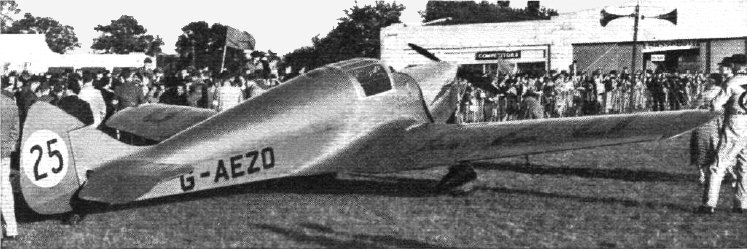
The Whitney Straight transformed light aviation by demonstrating that modern enclosed cabin aircraft could successfully compete with traditional open-cockpit biplanes. Frederick George Miles, the aircraft's designer, achieved his objective of creating an economical yet comfortable touring aircraft that would appeal to flying clubs and private owners. The prototype's maiden flight on May 14, 1936, piloted by F.G. Miles himself, marked the beginning of a brief but significant production run that would see exactly 50 aircraft built by April 1938.
Service History and Performance
The aircraft quickly proved its capabilities in competitive flying, achieving notable success in the 1937 King's Cup Air Race where General Lewin, aged 63, secured second place while another Whitney Straight finished fourth. F.G. Miles personally demonstrated the aircraft's capabilities through an extensive European tour in 1936, including a remarkable flight over the Alps at 17,000 feet without supercharging. The aircraft's performance specifications included a maximum speed of 145 mph and exceptional fuel economy of more than 20 miles per gallon, making it highly attractive to cost-conscious operators.
Wartime Service
Following Britain's entry into World War II on September 3, 1939, the Royal Air Force requisitioned 23 Whitney Straights for communications duties. Twenty-one aircraft served within the United Kingdom, while one each was stationed in India and Egypt. The Fleet Air Arm operated at least one M.11A from 1940 to 1943, and the Royal New Zealand Air Force utilized three aircraft. Despite five years of military service, the aircraft proved remarkably durable, with many remaining operational throughout the conflict. The aircraft served exclusively in non-combat roles, handling communications and transport duties rather than engaging in fighter, bomber, or reconnaissance missions.
Manufacturing Excellence
Miles Aircraft, initially known as Philips and Powis Aircraft Ltd. until its 1938 renaming, operated from Woodley Aerodrome near Reading from 1929 until financial difficulties forced liquidation in 1947. The company earned a reputation for innovative light aircraft design and rapid prototyping capabilities that enabled quick market entry. Miles aircraft frequently achieved high placements in the King's Cup Race, establishing the manufacturer's credibility in competitive aviation circles. The Whitney Straight's construction featured a spruce frame covered with three-ply birch and plywood, creating a lightweight yet robust structure.
Technical Innovation and Variants
The standard M.11A utilized the proven de Havilland Gipsy Major I, a 130-horsepower four-cylinder air-cooled inverted inline engine known for exceptional reliability and smooth operation. Two experimental variants explored enhanced performance capabilities: the sole M.11B featured a 135-horsepower Amherst Villiers Maya I supercharged engine, while the unique M.11C incorporated a 145-horsepower de Havilland Gipsy Major II with variable-pitch propeller. These variants demonstrated improved performance, with the M.11B achieving an additional 10 mph speed increase and 200 feet per minute climb improvement, while the M.11C excelled in takeoff and climb performance.
Pilot Experience
The Whitney Straight's enclosed cockpit with molded Perspex canopy provided unprecedented comfort for light aircraft pilots accustomed to open-cockpit designs. The side-by-side seating arrangement with standard dual controls made the aircraft ideal for instruction and touring applications. Pilots appreciated the aircraft's docile handling characteristics and the protection offered by the enclosed cabin during adverse weather conditions. The fixed tailwheel undercarriage with fairings provided stable ground handling while maintaining the simplicity preferred by private operators.
Legacy and Historical Significance
The Whitney Straight's influence extended beyond its modest production run of 50 aircraft, establishing design principles that would influence post-war light aircraft development. The aircraft served as a developmental stepping stone to Miles' later M.17 Monarch, which first flew on February 21, 1938. The type's prominence at the June 28, 1936 SBAC Show at Hatfield demonstrated British light aircraft manufacturing capabilities to international audiences.
Tragically, the program suffered a significant setback when the sole M.11C variant, registration G-AEYI, crashed on June 28, 1938, at Harefield, Berkshire, killing test pilot Wing Commander F.W. Stent. Despite this loss, the Whitney Straight's contribution to aviation development remained significant, bridging the gap between 1920s biplane designs and modern club aircraft that would dominate post-war general aviation.
The aircraft's cultural impact included establishing Miles Aircraft's reputation for innovation and demonstrating that British manufacturers could produce competitive light aircraft for the growing civilian market. While no examples are known to remain airworthy today, the Whitney Straight's pioneering enclosed cockpit design became standard practice for subsequent general aviation aircraft, representing a crucial evolutionary step in light aircraft development.