
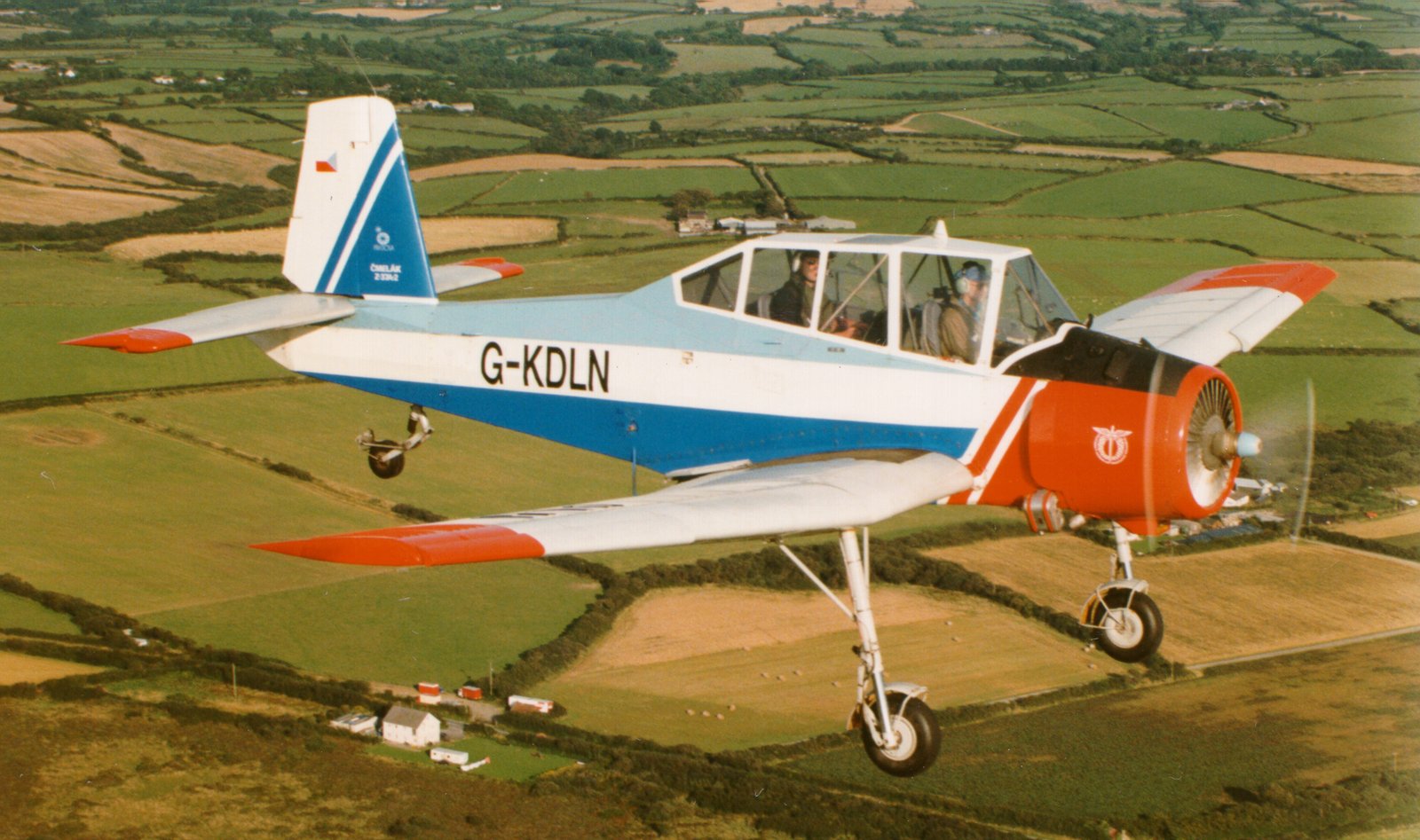
Development and Design
The Z-37T emerged from Moravan's ambitious plan to modernize agricultural aviation in the early 1980s. Following the success of over 700 piston-powered Z-37A Cmelak aircraft, company engineers initiated design work in 1982 to create a turboprop successor that would address the limitations of radial engines in demanding agricultural operations. The XZ-37T prototype took its maiden flight on September 6, 1981, powered by a more powerful Walter M-601B engine producing 691 shaft horsepower.
Two production prototypes followed on July 12 and December 29, 1983, incorporating refinements that would define the production aircraft. The design team extended the wingspan to 44 feet 9 inches—longer than the original Z-37—and added distinctive winglets to improve fuel efficiency during low-level operations. Most significantly, they selected the Walter M-601Z turboprop, specifically configured for the harsh operating environment of agricultural spraying where engines face constant exposure to chemicals and dust.
The Manufacturer's Legacy
Moravan's roots traced back to the 1930s through the Masarykova Letecká Liga (Masaryk Aviation League), which began aircraft construction in Zlín by 1933. The company evolved into a key producer of trainers and agricultural aircraft, collaborating with Let Kunovice on the original piston-powered Z-37 development starting in 1961. Based in Otrokovice, Czechoslovakia, Moravan had established itself as a specialist in utility aircraft before undertaking the turboprop conversion project.
The company continues operations today as ZLIN Aircraft Otrokovice a.s., focusing on aerobatic and trainer aircraft including the Z-242L and Z-143L models, maintaining the engineering expertise developed through decades of specialized aircraft production.
Engine and Technical Innovation
The heart of the Z-37T was its Walter M-601Z turboprop, manufactured by Walter Avia (now PBS Velká Bíteš) in the Czech Republic. Producing 490 shaft horsepower, this engine offered significant advantages over radial powerplants in agricultural service, including improved reliability when operating at low altitudes in dusty, chemical-laden environments. The later Z-137T variant featured an uprated version delivering 520 shaft horsepower for enhanced performance.
The aircraft's single-seat configuration maximized payload capacity, with the pilot positioned ahead of a chemical hopper designed for pesticides and granular materials. At 34 feet 4 inches long and 11 feet 6 inches high, the Z-37T maintained manageable ground handling characteristics while providing the wing area necessary for low-speed maneuvering over crop fields. The design achieved certification under British Civil Aviation Requirements in 1984, followed by EASA Type Certificate Data Sheet A.443.
Production and Service Record
Moravan produced approximately 56 Z-37T aircraft between 1985 and 1994, including about 51 single-seat agricultural variants and 2 two-seat Z-37T-2 trainers. This limited production reflected the specialized nature of the agricultural aviation market and competition from established manufacturers in the United States and other countries.
The aircraft found service with operators across multiple continents, including Bolivia, Czech Republic, France, Hungary, Slovakia, South Africa, Sudan, and Turkey. Slovak firm Slov Air became the largest operator, receiving at least 24 aircraft for agricultural spraying operations. The Z-37T's maximum takeoff weight of 5,567 pounds and empty weight of 2,756 pounds provided substantial payload capacity for chemical application missions.
Operational Characteristics
Pilots appreciated the Z-37T's turboprop reliability compared to radial engines, though the aircraft demanded respect during low-level agricultural work. The Walter M-601Z delivered consistent power output across varying atmospheric conditions, with a takeoff power setting of up to 1,800 rpm. Range varied from 188 nautical miles with maximum payload to 346 nautical miles with reduced chemical loads, providing flexibility for different mission profiles.
Takeoff performance required 1,905 feet to clear a 50-foot obstacle, while landing distance from 50 feet measured 2,365 feet—figures that accommodated most agricultural airstrips. The wing area of 256 square feet supported the low-speed handling characteristics essential for precise chemical application.
Limited Military Evaluation
A single Z-37TM conversion underwent military evaluation in the mid-1980s for potential close air support duties, reflecting Cold War interest in utility aircraft adaptations. However, testing determined the aircraft unsuitable for combat roles, and it returned to agricultural service. This brief military assessment represented the only deviation from the Z-37T's civilian agricultural mission.
Legacy and Current Status
Production ceased in 1994 with no significant number of aircraft remaining in active service today. One documented example, Z-37T-2 trainer with construction number 02-58 and registration OM-PEL, was photographed at Hosín Airport in the Czech Republic, representing the few survivors of this specialized agricultural aircraft.
While the Z-37T achieved its design objectives of providing turboprop efficiency for crop dusting operations, limited production numbers and the specialized nature of agricultural aviation prevented widespread adoption. The aircraft stands as an example of Eastern European innovation in utility aircraft design during the final decade of Communist rule, demonstrating technical capability in a highly specialized aviation sector.