
Combat Dominance
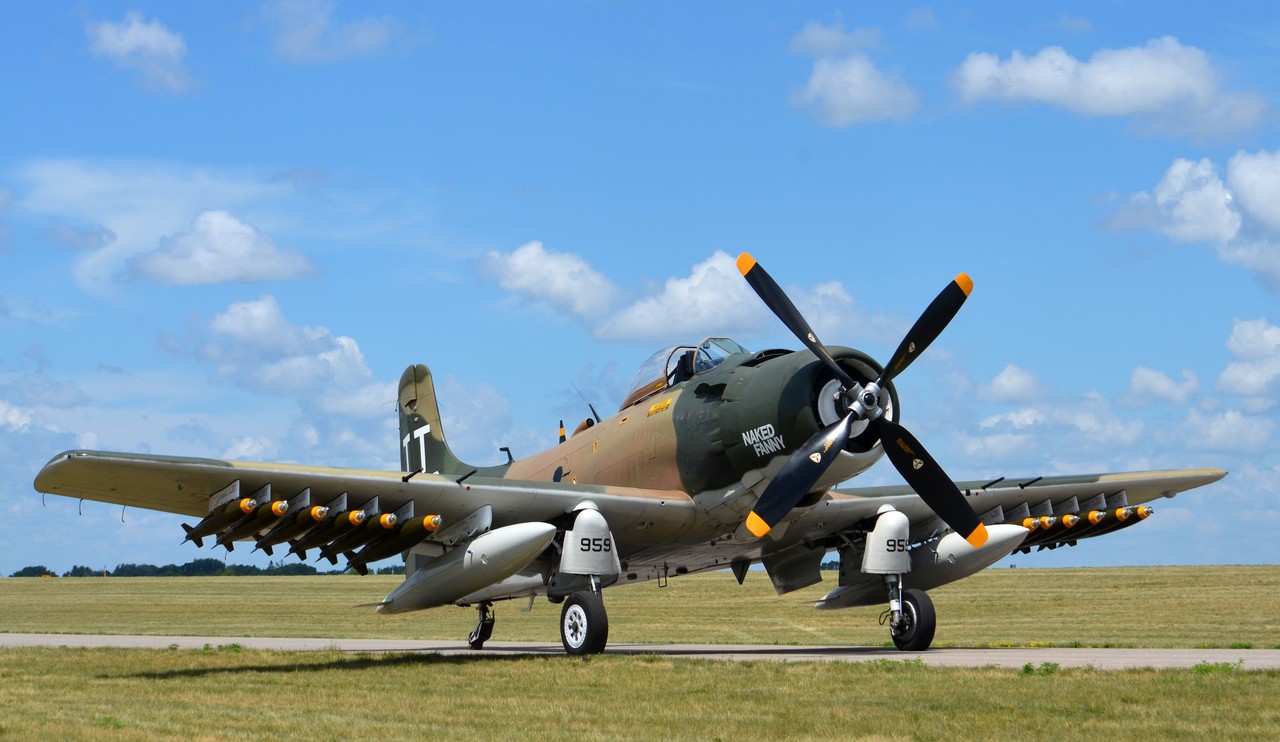
The Skyraider earned its reputation as one of the most effective close air support aircraft ever built through extensive combat service in both the Korean War and Vietnam War. Despite being a piston-engine aircraft in an era increasingly dominated by jets, the A-1 proved superior for many missions due to its exceptional loiter time, massive ordnance capacity, and ability to operate from short, unprepared airstrips. On May 21, 1953, an AD-4B operating from Naval Air Station Dallas demonstrated the aircraft's remarkable capability by lifting 14,941 pounds of payload—exceeding the aircraft's own empty weight of 11,798 pounds.
The aircraft served with distinction in Vietnam, where both Navy and Air Force variants flew diverse missions ranging from close air support to search and rescue operations. The museum's A-1H Skyraider, Bureau Number 135300, flew the final Navy Skyraider attack mission in Vietnam on February 20, 1968, marking the end of an era. For Air Force operations in Southeast Asia, Skyraiders were equipped with the Stanley Yankee extraction system, a rocket-powered pilot escape mechanism that functioned similarly to an ejection seat.
Evolution Through Variants
The Skyraider underwent continuous development throughout its 12-year production run, resulting in eight major models and 37 different versions. The initial AD-1 variant, with 242 aircraft built, established the basic configuration, while subsequent models incorporated progressive improvements. The AD-4 became the most numerous single variant with 372 aircraft, featuring strengthened landing gear, improved radar systems, and four 20mm cannons mounted in 14 Aero rocket launchers.
Specialized variants expanded the aircraft's mission envelope significantly. The AD-4B carried nuclear weapons, with 165 purpose-built aircraft plus 28 conversions. Night attack capabilities came with the three-seat AD-4N, later redesignated A-1D, with 307 built. Electronic warfare variants included the AD-1Q, AD-4Q, AD-3W, and AD-4W, the latter being particularly significant with 168 built, including 50 transferred to the Royal Navy as Skyraider AEW Mk 1s for airborne early warning duties.
Douglas Aircraft Legacy
Douglas Aircraft Company, founded by Donald Douglas in 1921, established itself as a premier manufacturer of both military and civilian aircraft. The company's El Segundo plant in Southern California served as the primary production facility for the Skyraider throughout its manufacturing run. Ed Heinemann, the brilliant Douglas engineer who designed the Skyraider, created an aircraft that perfectly balanced ruggedness, versatility, and payload capacity. Douglas Aircraft merged with McDonnell Aircraft in 1967 to form McDonnell Douglas, which Boeing acquired in 1997, making Boeing the current inheritor of the Skyraider's legacy.
Powerplant Excellence
The Wright R-3350 Duplex-Cyclone engine proved to be the perfect powerplant for the Skyraider's demanding mission requirements. This 18-cylinder radial engine, manufactured by Wright Aeronautical Corporation, evolved throughout the aircraft's service life. Early models produced well over 2,000 horsepower, while the final AD-7 variant's R-3350-26WB engine delivered 2,800 horsepower. The engine's reliability and power enabled the Skyraider to haul enormous loads while maintaining the endurance necessary for extended combat air patrol missions that jet aircraft of the era could not match.
Pilot's Aircraft
Pilots praised the Skyraider for its honest handling characteristics and exceptional stability as a weapons platform. With a maximum cruise speed of 280 knots and an approach speed of just 76 knots, the aircraft provided pilots with a wide speed envelope for various tactical situations. The three dive brakes on later models like the AD-6 (A-1H) allowed precise dive bombing attacks, while the centerline hardpoint could accommodate ordnance loads up to 3,500 pounds. Single-seat operation was standard, though specialized variants accommodated multiple crew members for night attack and electronic warfare missions.
Remarkable Longevity
The Skyraider's extraordinary service life extended far beyond its contemporaries, with the type remaining in combat use until 1972 with U.S. forces and continuing with allied air forces into the 1980s. The Gabonese Air Force operated Skyraiders until 1985, nearly 40 years after the first flight. This longevity earned the aircraft its nickname "Spad" after the French World War I fighter and its reputation as an "anachronism" that proved older technology sometimes remained superior for specific missions.
Today, approximately 19 Skyraiders remain airworthy, treasured by warbird enthusiasts and air show audiences who appreciate witnessing this legendary aircraft that bridged the gap between World War II-era piston fighters and modern jet attack aircraft. The Skyraider's combination of devastating firepower, exceptional payload capacity, and remarkable durability established it as one of the most successful attack aircraft designs in aviation history.