
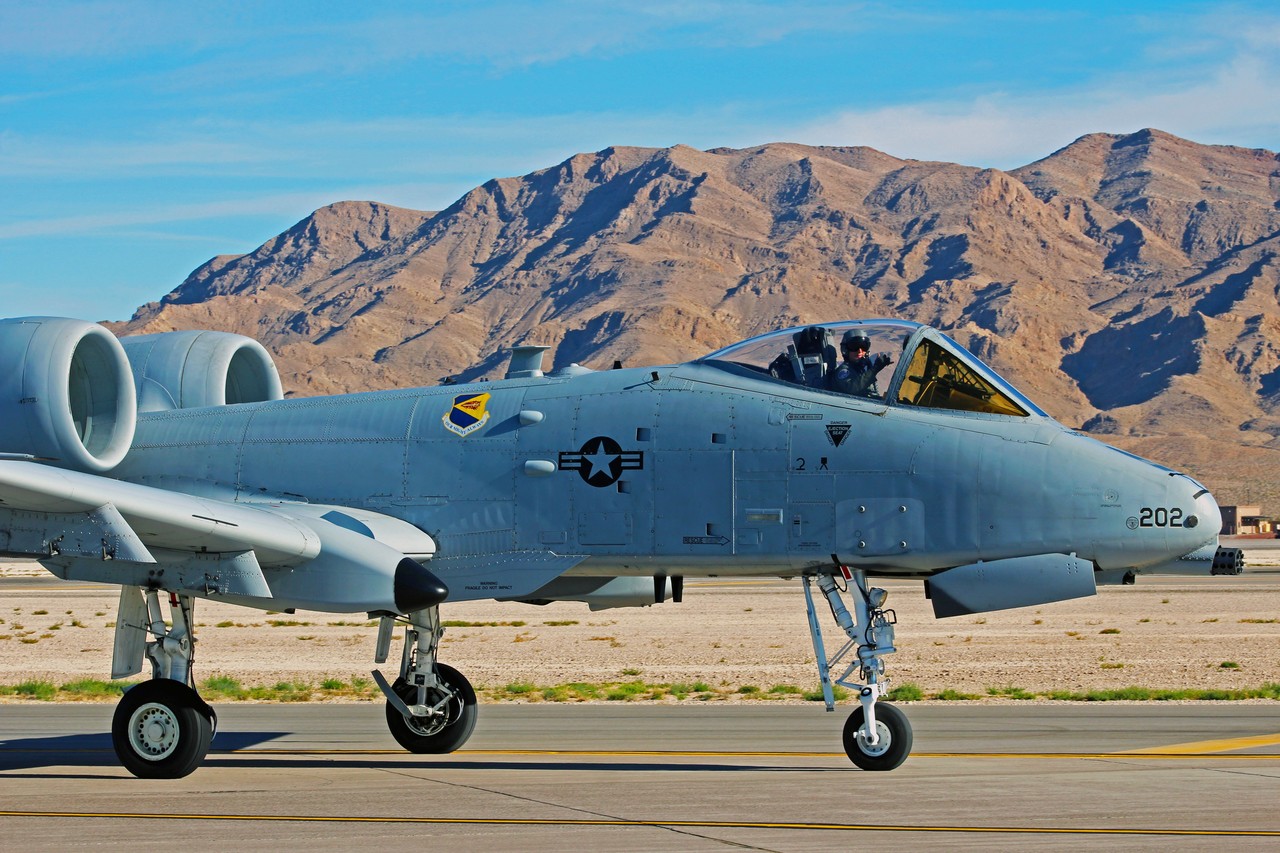
Combat Dominance and Service History
The A-10 established itself as the premier close air support platform through devastating effectiveness in multiple conflicts. During Operation Desert Storm, A-10s flew 8,100 sorties and destroyed more than 900 tanks, 2,000 other military vehicles, and 1,200 artillery pieces while maintaining exceptional survivability rates. The aircraft's combination of heavy firepower, extended loiter capability, and remarkable damage tolerance made it indispensable for protecting ground forces.
The United States Air Force began operating A-10s in March 1976 when the 355th Tactical Training Wing at Davis-Monthan Air Force Base received the first aircraft. Initial operating capability was achieved in October 1977 with the 354th Tactical Fighter Wing at Myrtle Beach Air Force Base. From these beginnings, the A-10 proved its worth in conflicts spanning four decades, from the Gulf War through operations in Iraq and Afghanistan.
Development and Design Innovation
Fairchild Republic's design emerged victorious from an intense competition that began with the A-X close air support program. On May 10, 1972, test pilot Howard "Sam" Nelson lifted the first YA-10 prototype into the air from Republic's Farmingdale, New York facility. The Air Force announced the YA-10's selection over the competing Northrop YA-9 on January 18, 1973, followed by a 1974 fly-off against the proven A-7D Corsair II that further validated the need for a dedicated attack aircraft.
The revolutionary design centered around the massive GAU-8/A Avenger cannon, a seven-barrel rotary weapon capable of firing 30mm depleted uranium rounds at 3,900 rounds per minute. This gun, weighing 4,029 pounds when loaded, essentially dictated the aircraft's entire configuration. The straight wing design optimized low-altitude maneuverability while twin General Electric TF34-GE-100A turbofans, each producing 9,065 pounds of thrust, provided redundancy and survivability.
Manufacturing Legacy
Fairchild Republic Aviation, successor to the legendary Republic Aviation Corporation, built all 715 A-10s between 1972 and 1984 at their Hagerstown, Maryland facility. Production reached peak efficiency at 13 aircraft per month during the program's height. The first production A-10 flew in October 1975, with deliveries commencing in March 1976 following full-rate production authorization on February 10.
Republic Aviation had earned fame with the P-47 Thunderbolt, the World War II fighter-bomber renowned for its ability to absorb battle damage and deliver devastating ground attack capabilities. The A-10's naming honored this heritage, carrying forward the Thunderbolt legacy into the jet age with similar survivability characteristics and ground attack mission focus.
Pilot Operations and Performance
A-10 pilots operate from a titanium "bathtub" cockpit that can withstand direct hits from 23mm cannon shells. The aircraft's design prioritizes pilot survivability and mission completion over speed, with redundant flight control systems and the ability to fly with one engine, half a tail, or significant wing damage. Maximum speed reaches 420 miles per hour, though typical combat operations occur at much lower speeds that allow precise weapons delivery.
The straight wing configuration and powerful control surfaces enable tight turning radius and excellent low-speed handling characteristics essential for close air support missions. Service ceiling reaches 45,000 feet, though most combat operations occur below 10,000 feet where pilots can visually identify targets and coordinate with ground forces. Combat radius extends 288 miles with maximum ordnance load, while ferry range reaches 2,240 miles.
Modernization and Extended Service
Recognizing the A-10's irreplaceable capabilities, the Air Force launched extensive modernization programs to extend service life. The A-10C upgrade program, initiated in 2005, installed modern digital avionics, precision engagement capabilities, and improved situational awareness systems. This variant achieved initial operational capability in September 2007, transforming the analog-era attack aircraft into a precision weapons platform.
Wing replacement programs addressed structural fatigue, with new wings designed to extend service life to 16,000 flight hours. The Thick-skin Urgent Spares Kitting (TUSK) Program demonstrated successful wing replacement in November 2011, enabling operations potentially through 2035. In June 2017, the Air Force announced indefinite retention of the A-10 fleet, with current projections indicating service through 2040.
Museum Preservation and Legacy
Significant A-10 examples reside in major aviation museums, preserving the type's remarkable history. Hill Aerospace Museum in Utah displays serial number 73-1666, one of the first six A-10As built for Development Test and Evaluation. The Cradle of Aviation Museum houses an early production aircraft that served with the 354th Tactical Fighter Wing before transferring to the 45th Tactical Fighter Squadron. Edwards Air Force Base's Flight Test Center Museum preserves the unique YA-10B Night/Adverse Weather prototype, the only two-seat A-10 variant ever constructed.
The A-10's nickname "Warthog" reflects both its ungainly appearance and fierce combat effectiveness. This aircraft demonstrated that specialized design focused on a single mission could achieve legendary status, proving that sometimes the most effective military aircraft prioritize capability over aesthetics. With over four decades of service and multiple combat deployments, the A-10 Thunderbolt II stands as one of the most successful ground attack aircraft ever created.